
Doctors have praised a Tunisian-designed artificial intelligence app that can spot early Covid-19 signs in patients’ lungs in seconds, saying it could prove useful in regions without specialists and complex equipment.
The application–which is as yet unnamed and casually referred to as ‘the app’–was developed through German development organization GIZ’s partnership with INSAT, the National Institute of Applied Science and Technology, along with international tech companies like IBM.
It uses chest X-rays and CT scans to search for Covid-19 infections and when fully tested and rolled out across the country could serve as a tool for early infection detection.
The INSAT team was led by Mustapha Hamdi, a professor at INSAT and co-ordinator of the Innov'Challenge, an initiative which invites companies annually to pitch projects and problems for which Mr Hamdi's team find technology solutions.
He said he’s training hospital workers at a handful of hospitals, and the app could potentially be in use there in a few weeks. As for nationwide use, that remains unknown.
"Artificial intelligence has been used to detect pneumonia, and has been used for Covid-19 in China," he told The National. "But what we've done is the first public access Covid-19 platform. And it's the first such technology in the region."
-
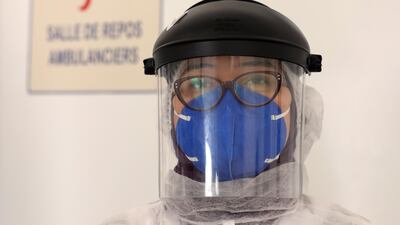
Abir Mdini, a physician of SAMU Tunisia, wears protective equipment before visiting the coronavirus patients in Tunis, Tunisia. EPA -
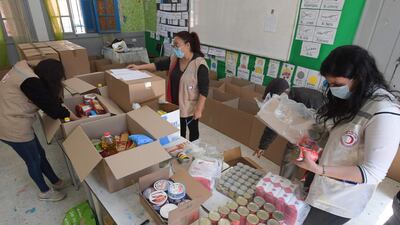
Members of Tunisian Red Crescent prepare food packages for the elderly and low-income families in the coastal town of Ezzahra near Tunis during the coronavirus pandemic. AFP -
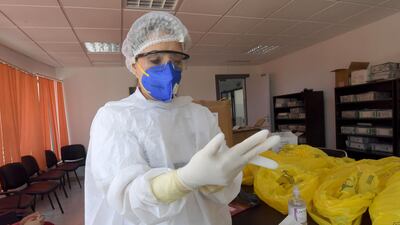
Saida Zelfani, a physician of SAMU Tunisia, dressed in personal protective equipment (PPE) puts on latex glove before attempting to get a swab sample of suspected Covid-19 patients in the capital Tunis. AFP -
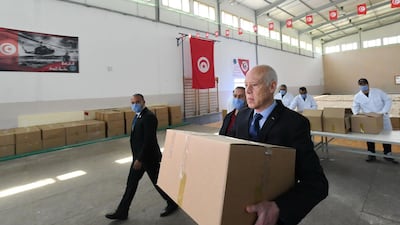
President Kais Saied taking part in the distribution of aid packages amid the coronavirus pandemic, in Gammarth town on the outskirts of Tunis. AFP -
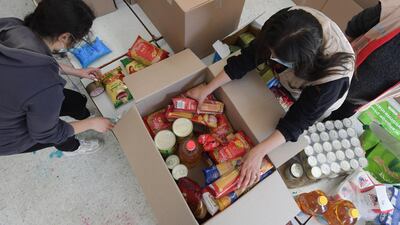
Members of Tunisian Red Crescent prepare food packages for the elderly and low-income families in the coastal town of Ezzahra near Tunis. AFP -
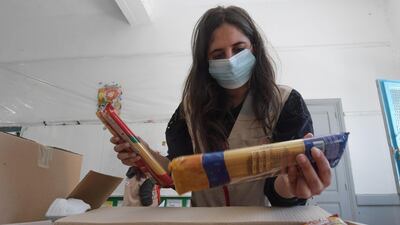
A member of Tunisian Red Crescent prepares food packages for the elderly and low-income families in the coastal town of Ezzahra near Tunis. AFP -
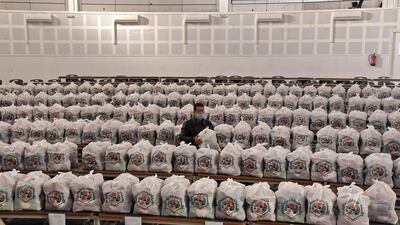
An employee of the Tunisian Social Solidarity Union prepares food packages for the elderly and low-income families in Tunis. AFP -
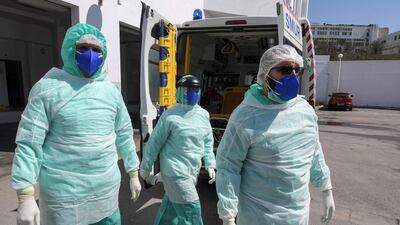
Medical and paramedical staff of SAMU Tunisia dressed in personal protective equipment (PPE) head out to visit a coronavirus patient in the capital Tunis. AFP -
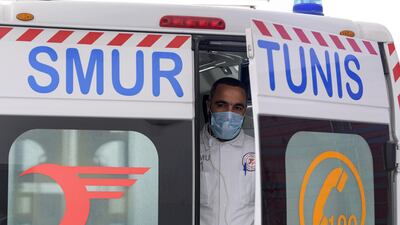
A paramedic rescuer of SAMU Tunisia looks out from the back of an ambulance in the capital Tunis. AFP


Mr Hamdi said that his responsibility as project leader has been to collect X-ray chest scans and CT scans from around the world, which he feeds into the app. Mr Hamdi says he has so far received five thousand images from around the world and entered one thousand into the app for processing. Of these, four hundred and fifty are Covid-19 positive, and another two hundred are other pneumonia cases.
The app's artificial intelligence then learns from the X-rays, creating more and more accurate analyses as it searches for signs of Covid-19 infection in the images.
Those involved in the project believe it could be especially useful in Tunisia's marginalised south and interior.
Since Tunisia's independence and before, Tunisian leaders favoured economic development in their home areas of the fertile northern coast, centreing infrastructure, administration and employment opportunities there. Meanwhile, the interior and south were used as areas for resource and labour exploitation.
Noomane Elkadri, from Tunisia's Ministry of Health, is a member of a commission bringing together different ministries, multinational NGOs, and local groups like Innov'Challenge.
He said the coronavirus app is just one of many tech ideas that have come over the commission's desk.
“In the Ministry of Health we are open to any tech that helps. We encourage all our youth in creating technology solutions. But they must understand that their app won’t save everything. The coronavirus crisis is just so complex.”

He said he believes the coronavirus app will be most useful should the number of cases in Tunisia spike.
“If the number of patients was higher, without enough radiologists, the app would be critical. Indeed artificial intelligence is sometimes better than doctors because it can analyse a higher number of scans more quickly. But so far the number of patients is low enough.”
Samira Marai, a former Minister of Health who is now the director of the pulmonary unit at Al Rabta Hospital in Tunis, is hopeful for the app’s future use. She says it heralds a more immediately practicable use of medical knowledge in the country.
"[In Tunisia] we were always stuck in clinical studies but there were few contacts between tech developers and industry. This and other projects are where the two come together."
The need for technological solutions to Tunisia's resource shortfalls is badly needed, said Ms Marai, especially in the country's marginalised south and interior. It could potentially help in getting reliable diagnoses where specialists and equipment are in short supply.
"Regional hospitals in the interior are lacking doctors specialised in lung diseases. Doctors from Sfax are being sent to the south. Doctors from Sousse sent to the centre. Doctors from Tunis to the northwest. Regions are missing radiologists.
“So the doctors who were sent out take pictures of scans and send them to us by WhatsApp for our opinion.”
The designers of the app say doctors will be crucial to its further development in fine-tuning its analyses even further through interaction with patients.
“A doctor can look at the app’s analyses of X-ray chest images. Then he can ask the patient about the symptoms they feel, then add that information into the app for a sharper analysis,” Mr Hamdi said.
Locals in the long-marginalised interior regions concur, saying the medical system is in disarray.
"We don't have enough tests to tell whether people are Covid-19 positive or negative in regions like ours, like [other interior cities of] Kasserine and Kebilli," said Ghazala Mhemdi, a municipal worker and activist in the southwestern city of Gafsa.
She said that another trouble with the Covid-19 tests, even when they are available in Gafsa, is that they must be sent to Tunis for analysis, which takes 3 to 4 days for results.
"Meanwhile, patients are sitting around with the potential to infect others," she added.
As for the coronavirus app, she said, "If the app is faster, we want it. We in Gafsa welcome anything that can help us test cases, and improve safety for the many vulnerable among us."
However, there are potential stumbling blocks, given that many rural Tunisians lack access to the internet and, like many around the world, are afraid to visit hospitals due to the risk of infection.
Najeh Amroussia, a nurse at Gafsa's Houcine Bouzaine hospital, says the coronavirus response is so poorly managed in hospitals like his that he's been working for a month and a half without going home.
"There's no strategy for containing the virus. In some cases the first or second [Covid-19] test say negative, but the third says positive."
"So the app could help us. The X-ray scanners only give us seventy per cent accuracy in determining infection. But this technology is more accurate, so we can diagnose better and avoid overlooking some cases."
Whatever the case, Norman Schräpel, the responsible officer at the head of GIZ's Tunisia's Centre for Digital Transformations, which supported the app's development said that pioneering technology projects like the coronavirus app are encouraging a sense among Tunisians that solutions can be made at home.
"The app gives Tunisians a sense that there is an alternative to something that is scarce or even absent sometimes–the testing," he said,
“And it produces a narrative that ‘We have the competencies ourselves.’ And this is a big point.”
The lung scanning app is not the only technological invention helping in the battle against coronavirus.
Mr Schräpel said other Tunisian tech companies like Proxym have created coronavirus apps, like STOP Corona app, and a web platform for applying for movement authorizations while Tunisia is on lockdown and travel is limited.

