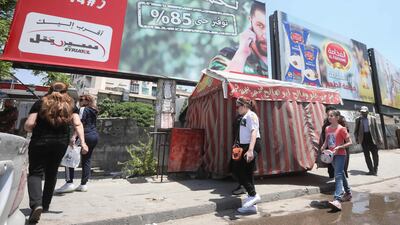
Syrian tycoon Rami Makhlouf has accused the regime in Damascus of impeding what he described as his charitable work, pulling out a new card in the most public internecine war since the Assad family took power five decades ago.
The 50-year old billionaire published overnight a letter he sent nine days ago to the authorities, saying the government is preventing charities he runs from accessing their cash to give to people in need.
These charities sit among complex corporate structures headed by Mr Makhlouf that combine business and non-profit organisations.
“The government should be in the service of the people and not the people in the service of the government,” Mr Makhlouf said.
The rift between Mr Makhlouf and the Assads, his maternal cousins, is unmasking his money man role in an inner circle controlling vast resources in Syria and its war economy, as well as crucial societal-financial ties that bound the Assads and their Alawite constituency.
Mr Makhlouf became a pivotal go-between in this relationship since the March 2011 revolt against the Assad family’s rule. In June of the same year, Mr Makhlouf said he was leaving the business to devote himself to charitable work.
But Mr Makhlouf became a major player in the war economy and expanded his business-charity structure to cover activities ranging from the financing of militias to UN aid contracts, as well as the creation of more front companies to position himself for any reconstruction flows, diplomats and regional businessmen said.
The letter is the latest salvo in Mr Makhlouf’s defence strategy, which has been to appeal through Facebook to the Alawite community to shield him from what described as repression by the security apparatus and others in power he did not name.
Mr Makhlouf said that the Central Bank had prevented an increase in the capital of Noor Microfinance, which he described as part of Ramak Humanitarian, an entity at the top of one of his business-charity structures.
He said the restrictions forced Noor Microfinance to stop giving loans three months ago, although it aspired to grow and serve almost 10,000 families badly in need of these types of loans”.
A confidential business database presented to regional and Western governments last year and seen by The National showed Noor Microfinance as a subsidiary of the Al Bustan Association, which falls under Ramak Humanitarian.
The Guardian reported in 2015 that the United Nations International Children's Emergency Fund (UNICEF) gave a $268,000 contact to Al Bustan Association for education and other services in areas controlled by the Syrian regime.
Ramak Humanitarian is also the father company of Rawafed Damascus, a partner in a multi-billion dollar construction project in Damascus called Marota City.
The project is planned in the Basateen Al Razi area of the capital, a hub of the peaceful protest movement against Assad that the regime emptied of its mostly Sunni population.
The European Union put Rawafed Damascus on sanctions in January 2019, along most of the partners in the Marota City project.
EU sources said then that the move was designed to signal to the regime and to Russia that the organisation is against any reconstruction in Syria that is not preceded with a political solution or makes permanent ethnic cleansing and forced population transfers.
The study said that multiple shell companies in the “crony business outfits” of Mr Makhlouf “indicates the ease by which the regime’s business structure is used to avoid sanctions or bid for UN contracts without an obvious link to the system’s patrons”.
“While the Bustan Association’s regime connections are fairly well-known in Syria, 14 shell companies...lurk within the Ramak structure,” the study said.
“The commercial-charity structure serves another use in that it is a vehicle for war economy players who were co-opted by the regime to get a cut of the aid or reconstruction funds,” it added.
Over the last two weeks, Mr Makhlouf has been decrying what he described as repression against him as an established businessman helping the downtrodden, as opposed to what he called war profiteers.
Regional financiers say until he started to fall out with the Assads sometime last year he remained behind the scenes at the top of his business game, as well as the money keeper of the inner circle, managing tens of billions of dollars for the Assads.
The money was amassed after Hafez Al Assad took power in a 1970 coup, which consolidated the Alawite ascendency in the mostly Sunni country.
In 2008, Washington placed sanctions on Mr Makhlouf under a category called public corruption. The EU put him under EU sanctions in 2011 for his support to the crackdown on the peaceful protest movement.
When Bashar Al Assad inherited power, Mr Makhlouf became one of the three most powerful men in Syria, along with Assad and his brother Maher Al Assad, who commands the elite Fourth Mechanised Division, the successor of the Defence Brigades, a praetorian guard unit headed by Hafez Al Assad’s brother Rifaat.
A failed attempt by Rifaat Al Assad in the 1980s to take power from his brother was the last major public rift within the inner circle. In the 1990s, Maher Al Assad shot in the stomach his late brother-in-law Assed Shawkat, another army commander, who survived the shooting. The dispute was kept under wraps.
In a series of videos this month, Mr Makhlouf hinted that families of Alawites who were killed defending the regime would be cut off financially without him.
He signalled that by targeting him, it undermines the cohesion of the Alawite sect, as well as the outlook for its survival.
The regime moved against Mr Makhlouf in recent weeks to strip him of telecom company Syriatel, the crown jewel in his business empire.
Mr Makhlouf confirmed on Wednesday that the authorities froze his assets in the last few days over disputed levies on Syriatel.
But executives who had worked with Mr Makhlouf said Syriatel was the most high profile asset among billions of dollars in assets Mr Makhlouf and his father had managed on behalf of the inner circle for decades.

TOP%2010%20MOST%20POLLUTED%20CITIES
%3Cp%3E1.%20Bhiwadi%2C%20India%0D%3Cbr%3E2.%20Ghaziabad%2C%20India%0D%3Cbr%3E3.%20Hotan%2C%20China%0D%3Cbr%3E4.%20Delhi%2C%20India%0D%3Cbr%3E5.%20Jaunpur%2C%20India%0D%3Cbr%3E6.%20Faisalabad%2C%20Pakistan%0D%3Cbr%3E7.%20Noida%2C%20India%0D%3Cbr%3E8.%20Bahawalpur%2C%20Pakistan%0D%3Cbr%3E9.%20Peshawar%2C%20Pakistan%0D%3Cbr%3E10.%20Bagpat%2C%20India%3C%2Fp%3E%0A%3Cp%3E%3Cem%3ESource%3A%20IQAir%3C%2Fem%3E%3C%2Fp%3E%0A
How to apply for a drone permit
- Individuals must register on UAE Drone app or website using their UAE Pass
- Add all their personal details, including name, nationality, passport number, Emiratis ID, email and phone number
- Upload the training certificate from a centre accredited by the GCAA
- Submit their request
What are the regulations?
- Fly it within visual line of sight
- Never over populated areas
- Ensure maximum flying height of 400 feet (122 metres) above ground level is not crossed
- Users must avoid flying over restricted areas listed on the UAE Drone app
- Only fly the drone during the day, and never at night
- Should have a live feed of the drone flight
- Drones must weigh 5 kg or less
Mica
Director: Ismael Ferroukhi
Stars: Zakaria Inan, Sabrina Ouazani
3 stars
FFP EXPLAINED
What is Financial Fair Play?
Introduced in 2011 by Uefa, European football’s governing body, it demands that clubs live within their means. Chiefly, spend within their income and not make substantial losses.
What the rules dictate?
The second phase of its implementation limits losses to €30 million (Dh136m) over three seasons. Extra expenditure is permitted for investment in sustainable areas (youth academies, stadium development, etc). Money provided by owners is not viewed as income. Revenue from “related parties” to those owners is assessed by Uefa's “financial control body” to be sure it is a fair value, or in line with market prices.
What are the penalties?
There are a number of punishments, including fines, a loss of prize money or having to reduce squad size for European competition – as happened to PSG in 2014. There is even the threat of a competition ban, which could in theory lead to PSG’s suspension from the Uefa Champions League.
Learn more about Qasr Al Hosn
In 2013, The National's History Project went beyond the walls to see what life was like living in Abu Dhabi's fabled fort:
Results
Stage three:
1. Stefan Bissegger (SUI) EF Education-EasyPost, in 9-43
2. Filippo Ganna (ITA) Ineos Grenadiers, at 7s
3. Tom Dumoulin (NED) Jumbo-Visma, at 14s
4. Tadej Pogacar (SLO) UAE-Team Emirates, at 18s
5. Joao Almeida (POR) UAE-Team Emirates, at 22s
6. Mikkel Bjerg (DEN) UAE-Team Emirates, at 24s
General Classification:
1. Stefan Bissegger (SUI) EF Education-EasyPost, in 9-13-02
2. Filippo Ganna (ITA) Ineos Grenadiers, at 7s
3. Jasper Philipsen (BEL) Alpecin Fenix, at 12s
4. Tom Dumoulin (NED) Jumbo-Visma, at 14s
5. Tadej Pogacar (SLO) UAE-Team Emirates, at 18s
6. Joao Almeida (POR) UAE-Team Emirates, at 22s
How to donate
Send “thenational” to the following numbers or call the hotline on: 0502955999
2289 – Dh10
2252 – Dh 50
6025 – Dh20
6027 – Dh 100
6026 – Dh 200
Sholto Byrnes on Myanmar politics
if you go
The flights
Etihad, Emirates and Singapore Airlines fly direct from the UAE to Singapore from Dh2,265 return including taxes. The flight takes about 7 hours.
The hotel
Rooms at the M Social Singapore cost from SG $179 (Dh488) per night including taxes.
The tour
Makan Makan Walking group tours costs from SG $90 (Dh245) per person for about three hours. Tailor-made tours can be arranged. For details go to www.woknstroll.com.sg
Muslim Council of Elders condemns terrorism on religious sites
The Muslim Council of Elders has strongly condemned the criminal attacks on religious sites in Britain.
It firmly rejected “acts of terrorism, which constitute a flagrant violation of the sanctity of houses of worship”.
“Attacking places of worship is a form of terrorism and extremism that threatens peace and stability within societies,” it said.
The council also warned against the rise of hate speech, racism, extremism and Islamophobia. It urged the international community to join efforts to promote tolerance and peaceful coexistence.
Company%C2%A0profile
%3Cp%3E%3Cstrong%3ECompany%20name%3A%20%3C%2Fstrong%3EOutsized%0D%3Cbr%3E%3Cstrong%3EStarted%3A%20%3C%2Fstrong%3E2016%0D%3Cbr%3E%3Cstrong%3EFounders%3A%20%3C%2Fstrong%3EAzeem%20Zainulbhai%2C%20Niclas%20Thelander%2C%20Anurag%20Bhalla%20and%20Johann%20van%20Niekerk%20%0D%3Cbr%3E%3Cstrong%3EBased%3A%20%3C%2Fstrong%3EIndia%2C%20South%20Africa%2C%20South-East%20Asia%2C%20Mena%0D%3Cbr%3E%3Cstrong%3ESector%3A%3C%2Fstrong%3E%20Recruitment%0D%3Cbr%3E%3Cstrong%3EInvestment%20raised%3A%3C%2Fstrong%3E%20%241%20million%0D%3Cbr%3E%3Cstrong%3ECurrent%20staff%20count%3A%3C%2Fstrong%3E%2040%0D%3Cbr%3E%3Cstrong%3EInvestors%3A%20%3C%2Fstrong%3ESeed%20and%20angel%20investors%0D%3Cbr%3E%3C%2Fp%3E%0A
Ten tax points to be aware of in 2026
1. Domestic VAT refund amendments: request your refund within five years
If a business does not apply for the refund on time, they lose their credit.
2. E-invoicing in the UAE
Businesses should continue preparing for the implementation of e-invoicing in the UAE, with 2026 a preparation and transition period ahead of phased mandatory adoption.
3. More tax audits
Tax authorities are increasingly using data already available across multiple filings to identify audit risks.
4. More beneficial VAT and excise tax penalty regime
Tax disputes are expected to become more frequent and more structured, with clearer administrative objection and appeal processes. The UAE has adopted a new penalty regime for VAT and excise disputes, which now mirrors the penalty regime for corporate tax.
5. Greater emphasis on statutory audit
There is a greater need for the accuracy of financial statements. The International Financial Reporting Standards standards need to be strictly adhered to and, as a result, the quality of the audits will need to increase.
6. Further transfer pricing enforcement
Transfer pricing enforcement, which refers to the practice of establishing prices for internal transactions between related entities, is expected to broaden in scope. The UAE will shortly open the possibility to negotiate advance pricing agreements, or essentially rulings for transfer pricing purposes.
7. Limited time periods for audits
Recent amendments also introduce a default five-year limitation period for tax audits and assessments, subject to specific statutory exceptions. While the standard audit and assessment period is five years, this may be extended to up to 15 years in cases involving fraud or tax evasion.
8. Pillar 2 implementation
Many multinational groups will begin to feel the practical effect of the Domestic Minimum Top-Up Tax (DMTT), the UAE's implementation of the OECD’s global minimum tax under Pillar 2. While the rules apply for financial years starting on or after January 1, 2025, it is 2026 that marks the transition to an operational phase.
9. Reduced compliance obligations for imported goods and services
Businesses that apply the reverse-charge mechanism for VAT purposes in the UAE may benefit from reduced compliance obligations.
10. Substance and CbC reporting focus
Tax authorities are expected to continue strengthening the enforcement of economic substance and Country-by-Country (CbC) reporting frameworks. In the UAE, these regimes are increasingly being used as risk-assessment tools, providing tax authorities with a comprehensive view of multinational groups’ global footprints and enabling them to assess whether profits are aligned with real economic activity.
Contributed by Thomas Vanhee and Hend Rashwan, Aurifer
The%20specs
%3Cp%3E%3Cstrong%3EPowertrain%3A%20%3C%2Fstrong%3ESingle%20electric%20motor%0D%3Cbr%3E%3Cstrong%3EPower%3A%20%3C%2Fstrong%3E201hp%0D%3Cbr%3E%3Cstrong%3ETorque%3A%20%3C%2Fstrong%3E310Nm%0D%3Cbr%3E%3Cstrong%3ETransmission%3A%20%3C%2Fstrong%3ESingle-speed%20auto%0D%3Cbr%3E%3Cstrong%3EBattery%3A%20%3C%2Fstrong%3E53kWh%20lithium-ion%20battery%20pack%20(GS%20base%20model)%3B%2070kWh%20battery%20pack%20(GF)%0D%3Cbr%3E%3Cstrong%3ETouring%20range%3A%20%3C%2Fstrong%3E350km%20(GS)%3B%20480km%20(GF)%0D%3Cbr%3E%3Cstrong%3EPrice%3A%20%3C%2Fstrong%3EFrom%20Dh129%2C900%20(GS)%3B%20Dh149%2C000%20(GF)%0D%3Cbr%3E%3Cstrong%3EOn%20sale%3A%3C%2Fstrong%3E%20Now%3C%2Fp%3E%0A
The specs
Engine: 5.0-litre supercharged V8
Transmission: Eight-speed auto
Power: 575bhp
Torque: 700Nm
Price: Dh554,000
On sale: now
The National Archives, Abu Dhabi
Founded over 50 years ago, the National Archives collects valuable historical material relating to the UAE, and is the oldest and richest archive relating to the Arabian Gulf.
Much of the material can be viewed on line at the Arabian Gulf Digital Archive - https://www.agda.ae/en
How Tesla’s price correction has hit fund managers
Investing in disruptive technology can be a bumpy ride, as investors in Tesla were reminded on Friday, when its stock dropped 7.5 per cent in early trading to $575.
It recovered slightly but still ended the week 15 per cent lower and is down a third from its all-time high of $883 on January 26. The electric car maker’s market cap fell from $834 billion to about $567bn in that time, a drop of an astonishing $267bn, and a blow for those who bought Tesla stock late.
The collapse also hit fund managers that have gone big on Tesla, notably the UK-based Scottish Mortgage Investment Trust and Cathie Wood’s ARK Innovation ETF.
Tesla is the top holding in both funds, making up a hefty 10 per cent of total assets under management. Both funds have fallen by a quarter in the past month.
Matt Weller, global head of market research at GAIN Capital, recently warned that Tesla founder Elon Musk had “flown a bit too close to the sun”, after getting carried away by investing $1.5bn of the company’s money in Bitcoin.
He also predicted Tesla’s sales could struggle as traditional auto manufacturers ramp up electric car production, destroying its first mover advantage.
AJ Bell’s Russ Mould warns that many investors buy tech stocks when earnings forecasts are rising, almost regardless of valuation. “When it works, it really works. But when it goes wrong, elevated valuations leave little or no downside protection.”
A Tesla correction was probably baked in after last year’s astonishing share price surge, and many investors will see this as an opportunity to load up at a reduced price.
Dramatic swings are to be expected when investing in disruptive technology, as Ms Wood at ARK makes clear.
Every week, she sends subscribers a commentary listing “stocks in our strategies that have appreciated or dropped more than 15 per cent in a day” during the week.
Her latest commentary, issued on Friday, showed seven stocks displaying extreme volatility, led by ExOne, a leader in binder jetting 3D printing technology. It jumped 24 per cent, boosted by news that fellow 3D printing specialist Stratasys had beaten fourth-quarter revenues and earnings expectations, seen as good news for the sector.
By contrast, computational drug and material discovery company Schrödinger fell 27 per cent after quarterly and full-year results showed its core software sales and drug development pipeline slowing.
Despite that setback, Ms Wood remains positive, arguing that its “medicinal chemistry platform offers a powerful and unique view into chemical space”.
In her weekly video view, she remains bullish, stating that: “We are on the right side of change, and disruptive innovation is going to deliver exponential growth trajectories for many of our companies, in fact, most of them.”
Ms Wood remains committed to Tesla as she expects global electric car sales to compound at an average annual rate of 82 per cent for the next five years.
She said these are so “enormous that some people find them unbelievable”, and argues that this scepticism, especially among institutional investors, “festers” and creates a great opportunity for ARK.
Only you can decide whether you are a believer or a festering sceptic. If it’s the former, then buckle up.
Company%C2%A0profile
%3Cp%3E%3Cstrong%3ECompany%20name%3A%20%3C%2Fstrong%3ELeap%0D%3Cbr%3E%3Cstrong%3EStarted%3A%20%3C%2Fstrong%3EMarch%202021%0D%3Cbr%3E%3Cstrong%3EFounders%3A%3C%2Fstrong%3E%20Ziad%20Toqan%20and%20Jamil%20Khammu%0D%3Cbr%3E%3Cstrong%3EBased%3A%3C%2Fstrong%3E%20Dubai%0D%3Cbr%3E%3Cstrong%3ESector%3A%20%3C%2Fstrong%3EFinTech%0D%3Cbr%3E%3Cstrong%3EInvestment%20stage%3A%20%3C%2Fstrong%3EPre-seed%0D%3Cbr%3E%3Cstrong%3EFunds%20raised%3A%3C%2Fstrong%3E%20Undisclosed%0D%3Cbr%3E%3Cstrong%3ECurrent%20number%20of%20staff%3A%20%3C%2Fstrong%3ESeven%3C%2Fp%3E%0A
