Elyes Fakhfakh resigned as prime minister on Wednesday, leaving President Kais Saied to fill the position as the country braces for an economic downturn sparked by Covid-19. EPA

Race to stabilise Tunisian government as Covid-19 second wave looms


  • English
  • Arabic

Tunisia took a further lurch into the unknown last night with the resignation of prime minister Elyes Fakhfakh narrowly before the passage of a vote of no-confidence in his leadership.

Mr Fakhfakh will now head a caretaker government until the president, Kais Saied names his successor within one month. The prime minister-designate will then have until August 26 to form a new government that can command a majority within a fractious parliament or risk tipping the country into new legislative elections.

The death knell for Mr Fakhfakh’s career was sounded on Wednesday with the decision by self-styled ‘Muslim democrats’, Ennahda to withdraw their confidence in his government.

The party claimed Mr Fakhfakh had retained his interests in companies that had profited from government contracts, an accusation he denies.

Seeking to pre-empt the result of that vote, Mr Fakhfakh resigned before it could be passed, subsequently dismissing all of Ennahda’s ministers within government, the legality of which has been questioned.

Within Tunis, many see Mr Fakhfakh’s resignation as the latest example of a parliament that continues to place its own interests above those of the country.

“I think it is a matter of settling scores between Fakhfakh and the other parties, especially Ennahda," 26-year-old Manel Azouz, a professional from Ben Arous, near Tunis, said. “It is evident to all Tunisian people and the world that the parliament is a joke and most of its members are only power hungry with no intentions to lead the country forward economically and socially.”

The challenge now facing Tunisia's president is not to be underestimated. Last year’s legislative elections produced no clear winner, with only Ennahda gaining a plurality of the votes cast.

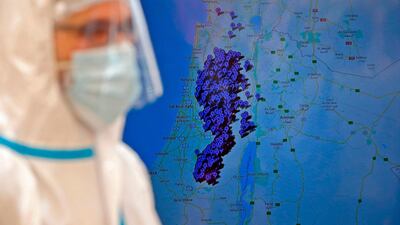
  • A doctor from the Palestinian ministry of health stands next to a map tracking the location of people infected with the coronavirus, in Hebron in the occupied West Bank. AFP
    A doctor from the Palestinian ministry of health stands next to a map tracking the location of people infected with the coronavirus, in Hebron in the occupied West Bank. AFP
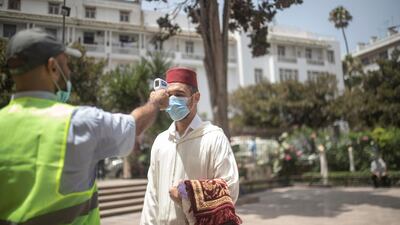
  • A worker checks the temperature of people who are going to pray at a mosque in Rabat, Morocco. With the exception of Friday prayer, mosques reopened for the first time since their closure in March following the coronavirus outbreak. AP Photo
    A worker checks the temperature of people who are going to pray at a mosque in Rabat, Morocco. With the exception of Friday prayer, mosques reopened for the first time since their closure in March following the coronavirus outbreak. AP Photo
  • A Palestinian youth sells sweets by the beach in Gaza City as coronavirus restriction eases. AFP
    A Palestinian youth sells sweets by the beach in Gaza City as coronavirus restriction eases. AFP
  • A health worker conducts a coronavirus test at a drive-through testing centre in the central Iraqi city of Najaf. AFP
    A health worker conducts a coronavirus test at a drive-through testing centre in the central Iraqi city of Najaf. AFP
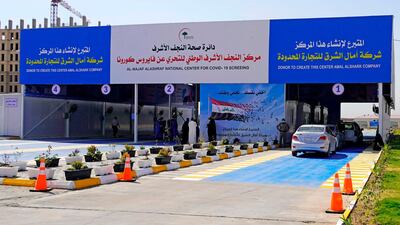
  • A drive-through testing facility for coronavirus in the central Iraqi city of Najaf. AFP
    A drive-through testing facility for coronavirus in the central Iraqi city of Najaf. AFP
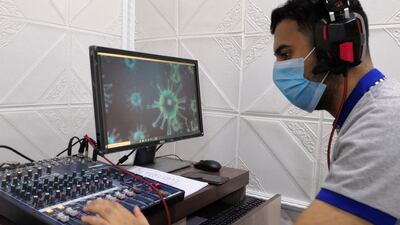
  • An employee from the ministry of health during a radio broadcast that offers advice about the coronavirus precautionary measures at a radio station in Basra, Iraq. Reuters
    An employee from the ministry of health during a radio broadcast that offers advice about the coronavirus precautionary measures at a radio station in Basra, Iraq. Reuters
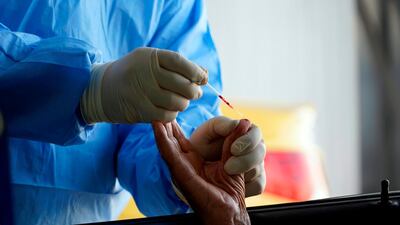
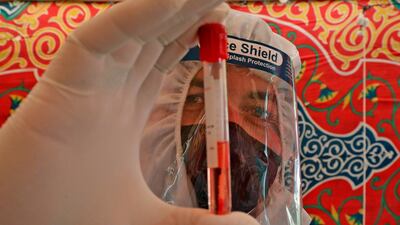
  • A doctor displays a blood sample taken from a person suspected of being infected with the coronavirus in Hebron in the occupied West Bank. AFP
    A doctor displays a blood sample taken from a person suspected of being infected with the coronavirus in Hebron in the occupied West Bank. AFP
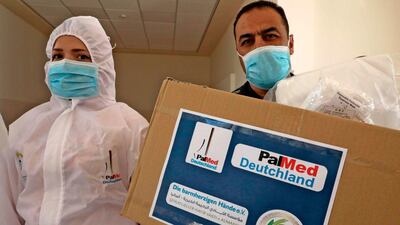
  • Dr Issam Mujahed, right, a member of the Pal-Med Europe, presents medical donations to doctors battling the coronavirus in Hebron in the occupied West Bank. AFP
    Dr Issam Mujahed, right, a member of the Pal-Med Europe, presents medical donations to doctors battling the coronavirus in Hebron in the occupied West Bank. AFP
  • A Palestinian man rides a bicycle with his child in Gaza City as coronavirus lockdown eases. AFP
    A Palestinian man rides a bicycle with his child in Gaza City as coronavirus lockdown eases. AFP
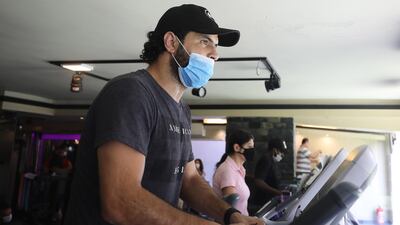
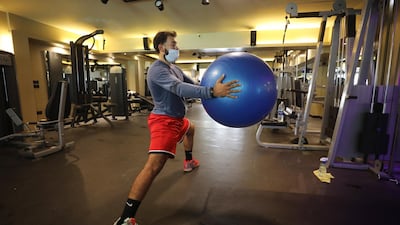
  • People training at a gym after its reopening in Cairo, Egypt. EPA
    People training at a gym after its reopening in Cairo, Egypt. EPA
  • People train at a gym after its reopening in Cairo, Egypt. EPA
    People train at a gym after its reopening in Cairo, Egypt. EPA
  • A policeman wears a face mask as he reviews the passport of a traveller at Mohammed V International Airport in Casablanca, Morocco. AP Photo
    A policeman wears a face mask as he reviews the passport of a traveller at Mohammed V International Airport in Casablanca, Morocco. AP Photo

With the remaining votes split across a diverse range of politicians and parties, Mr Saied must select a candidate not only able to command a majority, but one who can steer the country through a potential second wave of Covid-19 and negotiate with international donors, such as the International Monetary Fund, upon which Tunisia depends.

"The timing is very bad," Youssef Cherif, the head of the Columbia Centre in Tunis told The National. "Tunisia has just come out of the first wave of Covid-19, so they have a bit of time to play this game.

However, they have a potential second wave on the horizon, plus the ongoing economic crisis to deal with.”

While Tunisia has won plaudits for its handling of the Covid-19 pandemic, it remains fated to experience the brunt of the global economic downturn. Joblessness, long a cause of social unrest in Tunisia, is slated to rise from 15 per cent to 21.6 per cent by the year’s end.

Poverty, likewise, is forecast to increase to 19.2 per cent, according to a joint survey by the United Nations Development Programme and the Tunisian government. Neither stand to be helped by further political deadlock.

Nevertheless, observers are hopeful that a second election could still be avoided. With the exception of the Free Destourian Party, which hearkens back to the pre-revolutionary regime of Zine El Abidine Ben Ali, the majority of Tunisia’s politicians are aware of their waning popularity within the country and are unlikely to be willing to subject themselves to a further vote.

Adding to the parliament’s woes is the proposed vote of censure for "exceeding his prerogatives" against the speaker of the house and Ennahda co-founder, Rashid Ghannouchi, which stands to undermine his leadership both within the parliament and potentially his own party.

“While it looks like we might be heading towards another election, I’m hopeful that an agreement will be reached before that," Mr Cherif said. "Obviously, the politicians have concerns of their own, but there’s also the potential for a second wave of Covid-19, which might fall in the middle of any new election."


The specs: 2018 Volkswagen Teramont

Price, base / as tested Dh137,000 / Dh189,950

Engine 3.6-litre V6

Gearbox Eight-speed automatic

Power 280hp @ 6,200rpm

Torque 360Nm @ 2,750rpm

Fuel economy, combined 11.7L / 100km

Who has lived at The Bishops Avenue?
  • George Sainsbury of the supermarket dynasty, sugar magnate William Park Lyle and actress Dame Gracie Fields were residents in the 1930s when the street was only known as ‘Millionaires’ Row’.
  • Then came the international super rich, including the last king of Greece, Constantine II, the Sultan of Brunei and Indian steel magnate Lakshmi Mittal who was at one point ranked the third richest person in the world.
  • Turkish tycoon Halis Torprak sold his mansion for £50m in 2008 after spending just two days there. The House of Saud sold 10 properties on the road in 2013 for almost £80m.
  • Other residents have included Iraqi businessman Nemir Kirdar, singer Ariana Grande, holiday camp impresario Sir Billy Butlin, businessman Asil Nadir, Paul McCartney’s former wife Heather Mills. 
Hunting park to luxury living
  • Land was originally the Bishop of London's hunting park, hence the name
  • The road was laid out in the mid 19th Century, meandering through woodland and farmland
  • Its earliest houses at the turn of the 20th Century were substantial detached properties with extensive grounds


The more serious side of specialty coffee

While the taste of beans and freshness of roast is paramount to the specialty coffee scene, so is sustainability and workers’ rights.

The bulk of genuine specialty coffee companies aim to improve on these elements in every stage of production via direct relationships with farmers. For instance, Mokha 1450 on Al Wasl Road strives to work predominantly with women-owned and -operated coffee organisations, including female farmers in the Sabree mountains of Yemen.

Because, as the boutique’s owner, Garfield Kerr, points out: “women represent over 90 per cent of the coffee value chain, but are woefully underrepresented in less than 10 per cent of ownership and management throughout the global coffee industry.”

One of the UAE’s largest suppliers of green (meaning not-yet-roasted) beans, Raw Coffee, is a founding member of the Partnership of Gender Equity, which aims to empower female coffee farmers and harvesters.

Also, globally, many companies have found the perfect way to recycle old coffee grounds: they create the perfect fertile soil in which to grow mushrooms. 

Poland Statement
All people fleeing from Ukraine before the armed conflict are allowed to enter Poland. Our country shelters every person whose life is in danger - regardless of their nationality.

The dominant group of refugees in Poland are citizens of Ukraine, but among the people checked by the Border Guard are also citizens of the USA, Nigeria, India, Georgia and other countries.

All persons admitted to Poland are verified by the Border Guard. In relation to those who are in doubt, e.g. do not have documents, Border Guard officers apply appropriate checking procedures.

No person who has received refuge in Poland will be sent back to a country torn by war.

World Cricket League Division 2

In Windhoek, Namibia - Top two teams qualify for the World Cup Qualifier in Zimbabwe, which starts on March 4.

UAE fixtures

Thursday February 8, v Kenya; Friday February 9, v Canada; Sunday February 11, v Nepal; Monday February 12, v Oman; Wednesday February 14, v Namibia; Thursday February 15, final