

“Have you seen this?” asked Walid, a generator owner in Beirut, as he held up a plastic bottle in disbelief.
It was filled with two different liquids: yellow at the top, and transparent at the bottom.
“This is diesel mixed with water that I bought on the black market last week," Walid said. "It broke four of my filters."
Compounding Lebanon’s electricity problems, its local “mafia” of private generators owners went on strike for an hour on Tuesday.
They threatened to turn off all of the country’s generators next week for an entire day.
They are unhappy because the country’s economic crisis forces them to buy diesel, which is sometimes tainted, at inflated prices.
“I have spent as much money last month as I usually do in six months," Walid said. "I don’t know if I’ll be able to continue to operate."
He stood in the dark in his small basement office, regularly wiping his brow with a handkerchief because of the heat.
Walid said he had spent 2.4 million Lebanese pounds, or $315 at the black market rate, to repair the filters that were damaged by tainted diesel.
Lebanon’s state utility Electricite du Liban’s (EDL) output provides two hours of electricity a day on average in Beirut.
It has been unable to produce enough electricity to satisfy demand since the end of Lebanon’s 1975-1990 civil war.
EDL scheduled power cuts averaging three hours a day that became the norm in the capital before the financial crisis. They were as long as 12 hours in the countryside.
As the crisis worsened and in recent weeks as EDL cuts increased, private generator owners have stepped in to close the gap. They are technically illegal but operate freely.
“They are called a mafia because they divide neighbourhoods up like drug dealers,” said Nizar Hassan, a Lebanese political analyst.
"People don’t have the option to choose who they will subscribe with.
“Generator owners also impose much higher fees on people than they should and do not respect prices imposed by the energy ministry."
-
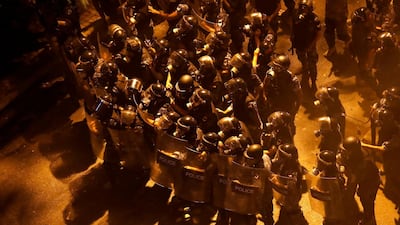
Riot police advance to push back demonstrators from a square near the government house in downtown Beirut, Lebanon. AP Photo -
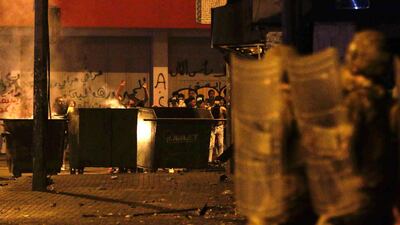
Lebanese security forces advance as anti-government protesters gather behind rubbish containers during a demonstration against dire economic conditions in the northern city of Tripoli. AFP -
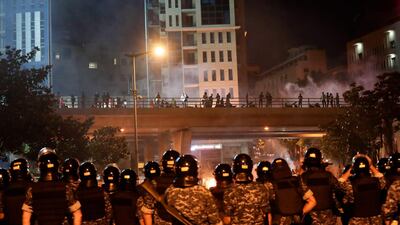
Anti-government protesters gather on the Fuad Shehab bridge, known as the Ring, as Lebanese security forces stand guard below, during a demonstration against dire economic conditions in the capital Beirut. AFP -
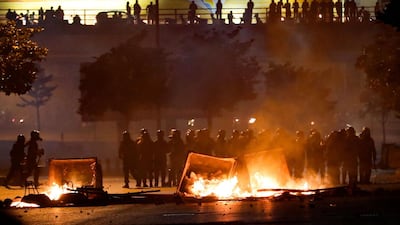
People watch from a bridge as Lebanese security forces gather behind rubbish containers set ablaze by anti-government protesters, during a demonstration against dire economic conditions in the downtown district of the capital Beirut. AFP -
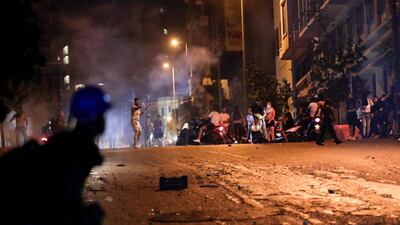
Lebanese anti-government protesters clash with security forces during a demonstration against dire economic conditions in the capital Beirut. AFP -
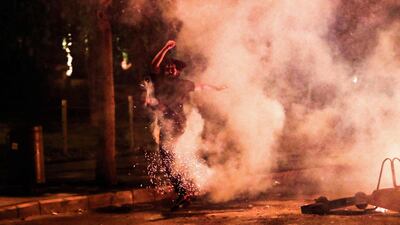
A Lebanese anti-government protester reacts as he runs in a cloud of smoke and sparks, during a demonstration against dire economic conditions in the downtown districtof the capital Beirut. AFP -
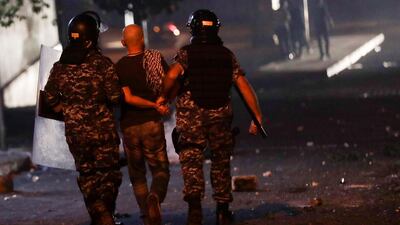
Lebanese security forces arrest a man during an anti-government demonstration against dire economic conditions in the downtown district of the capital Beirut. AFP -
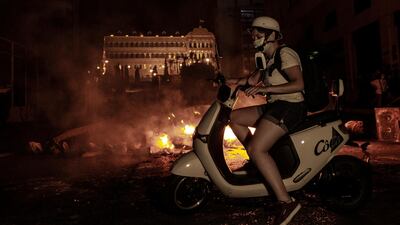
An Anti-government protester on her motorcycle returns where burn tires block the road near the government palace, during a protest against the economic condition, the collapsing Lebanese pound currency and and increasing prices in Beirut. EPA -
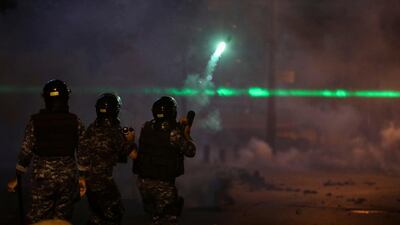
A member of the Lebanese riot police fires tear gas towards demonstrators during a protest against the fall in pound currency and mounting economic hardship, in Beirut. Reuters -

A man sells Lebanese flags, cold water and shisha, as anti-government protesters wait to reach the Rang area to start demonstrations in Beirut. EPA -
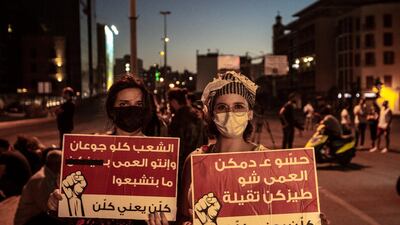
Anti-government protesters gather as they try to block tabarize highway during a protest against the economic condition, the collapsing Lebanese pound currency and increasing prices in Beirut. EPA -
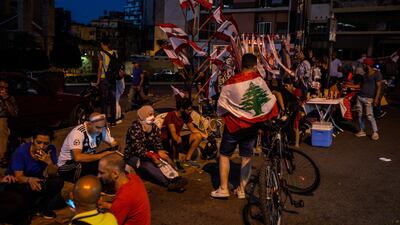
Anti-government protesters gather as they try to block tabarize highway during a protest against the economic condition, the collapsing Lebanese pound currency and increasing prices in Beirut. EPA -
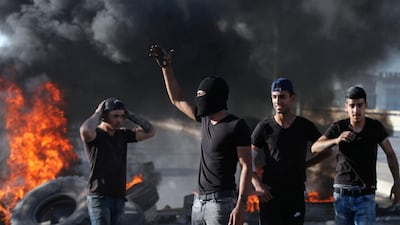
Lebanese protesters block a bridge with flaming tyres on the Sidon-Ghazieh highway amid demonstrations which erupted after the sharp drop of the Lebanese pound on the black market, in the southern coastal town of Ghazieh. AFP -
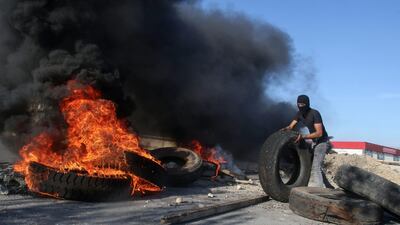
A Lebanese protester takes part in blocking a bridge with flaming tyres on the Sidon-Ghazieh highway amid demonstrations which erupted after the sharp drop of the Lebanese pound on the black market, in Ghazieh. AFP -
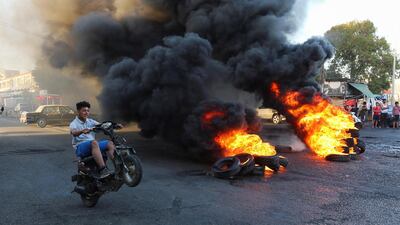
A young man boy rides his motorbike near burning tires during a sit-in protest against the fall in pound currency and mounting economic hardship, in Ghazieh. Reuters


A campaign led by former Energy Minister Raed Khoury in 2018 forced a significant number of generator owners to stop imposing flat fees and to install meters, bringing prices down.
But in these past weeks, Lebanon has struggled to import enough fuel for EDL’s power plants to function or to satisfy private generators’ demand.
As the small country is suffering a severe economic crisis, all imports are delayed and a corruption scandal in the fuel sector temporarily halted imports from Algeria last March.
As a result, electricity cuts have increased across Lebanon to more than 20 hours a day, and generator owners are running out of diesel.
In some neighbourhoods of Beirut, they turn generators off for several hours a day, most often at night.
Electricity output has become so unsteady that it is reportedly damaging electrical appliances, from fridges to laptops.
Fuel and diesel imports are partly subsidised by the central bank, which guarantees importers 85 per cent of their needs in US dollars at the official exchange rate of 1507.5 Lebanese pounds.
They buy the rest on the black market, where the local currency has lost 80 per cent of its value since banks restricted access to dollars in November.
On Monday, generator owners protested outside the energy ministry in Beirut with two demands: fair pricing and access to diesel imported by Lebanon’s official importers.
Generator owners accuse them of selling to third parties who raise the prices.
“We came here to ask for mazout [fuel] to be able to provide light to you, to citizens” a generator owner told local television network MTV.
“Tomorrow, there might be no more light in Lebanon,” another said.
Generator owners said they would continue to strike and warned that they would turn all generators off on August 5 if their demands were not met.
On Tuesday afternoon, local media reported that they dropped the threat after the intervention of Abbas Ibrahim, the head of one of Lebanon’s most powerful security services, General Security.
Walid said that General Security fined one of his colleagues five million Lebanese pounds last year for joining a strike at the time.
"They want to make us afraid to strike," he said.
Neither Energy Minister Raymond Ghajar nor the head of the union of generator owners were available for comment.
One fuel importer said most generator owners used to work with oil installations and some importing companies, or through middle men.
Oil installations and most importing companies have reduced their imports because of the economic crisis, and middlemen are raising their prices.
"They sell 20 litres of diesel for up to 34,000 Lebanese pounds instead of the usual 16,000," he told The National. "They are profiting from the situation."
The only way importers could sell diesel directly to private generator owners would be to cut down on their sales to other customers.
These include malls, hospitals, supermarkets, restaurants, factories and banks that run their own generators separately, the source said.
“We must increase the imports to satisfy the high demand,” he said.
But there is little chance that this will happen soon.
On Tuesday, Prime Minister Hassan Diab criticised French Foreign Minister Jean-Yves Le Drian, who last week repeated that the international community would not help financially unless the country introduced reforms to fight corruption and increase transparency.
Mr Le Drian, who visited Lebanon for two days last week, did not know enough about “the government’s reform journey", Mr Diab said.
He also claimed that Lebanon had enough fuel for six months.

