• Lebanese riot policemen run from firecrackers fired by the supporters of the Shiite Hezbollah and Amal Movement groups. AP
    Lebanese riot policemen run from firecrackers fired by the supporters of the Shiite Hezbollah and Amal Movement groups. AP
  • A member of the Lebanese riot police looks on after clashes with supporters of Lebanon's Shiite Hezbollah and Amal groups on December 14, 2019, in central Beirut. AFP
    A member of the Lebanese riot police looks on after clashes with supporters of Lebanon's Shiite Hezbollah and Amal groups on December 14, 2019, in central Beirut. AFP
  • Lebanese riot police react to fireworks thrown by supporters of Lebanon's Shiite Hezbollah and Amal groups during clashes on December 14, 2019 in central Beirut. AFP
    Lebanese riot police react to fireworks thrown by supporters of Lebanon's Shiite Hezbollah and Amal groups during clashes on December 14, 2019 in central Beirut. AFP
  • Supporters of the Shiite Hezbollah and Amal Movement groups, background, launch firecrackers at riot policemen as they try to attack anti-government protesters. AP
    Supporters of the Shiite Hezbollah and Amal Movement groups, background, launch firecrackers at riot policemen as they try to attack anti-government protesters. AP
  • Lebanon has been facing its worst economic crisis in decades, amid nationwide protests that began on October 17 against the ruling political class that demonstrators accuse of mismanagement and corruption. AP
    Lebanon has been facing its worst economic crisis in decades, amid nationwide protests that began on October 17 against the ruling political class that demonstrators accuse of mismanagement and corruption. AP
  • A supporter of Lebanon's Shiite Hezbollah and Amal groups gestures towards riot police. AFP
    A supporter of Lebanon's Shiite Hezbollah and Amal groups gestures towards riot police. AFP
  • Supporters of Lebanon's Shiite Hezbollah and Amal groups (background) throw fireworks towards Lebanese riot police during clashes on December 14, 2019, in central Beirut. AFP
    Supporters of Lebanon's Shiite Hezbollah and Amal groups (background) throw fireworks towards Lebanese riot police during clashes on December 14, 2019, in central Beirut. AFP
  • A supporter of the Shiite Hezbollah and Amal Movement groups holds firecrackers to fire it at the riot police. AP
    A supporter of the Shiite Hezbollah and Amal Movement groups holds firecrackers to fire it at the riot police. AP
  • A supporter of the Shiite Hezbollah and Amal Movement groups stands in the smoke of tear gas and reacts to the riot police in downtown Beirut. AP
    A supporter of the Shiite Hezbollah and Amal Movement groups stands in the smoke of tear gas and reacts to the riot police in downtown Beirut. AP
  • Lebanese riot police react to fireworks thrown by supporters of Lebanon's Shiite Hezbollah and Amal groups. AFP
    Lebanese riot police react to fireworks thrown by supporters of Lebanon's Shiite Hezbollah and Amal groups. AFP
  • Lebanese riot policemen react to firecrackers that were fired by the supporters of the Shiite Hezbollah and Amal Movement groups. AP
    Lebanese riot policemen react to firecrackers that were fired by the supporters of the Shiite Hezbollah and Amal Movement groups. AP
  • Lebanese riot policemen react to firecrackers that fired by the supporters of the Shiite Hezbollah and Amal Movement groups. AP
    Lebanese riot policemen react to firecrackers that fired by the supporters of the Shiite Hezbollah and Amal Movement groups. AP
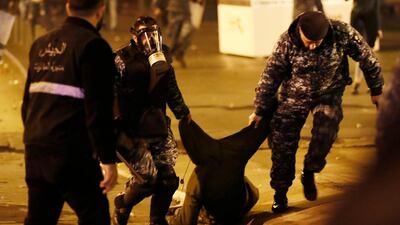
  • Riot police officers arrest an anti-government protesters trying to enter parliament square in downtown Beirut. AP
    Riot police officers arrest an anti-government protesters trying to enter parliament square in downtown Beirut. AP
  • Lebanon has been facing its worst economic crisis in decades, amid nationwide protests that began on October 17 against the ruling political class which demonstrators accuse of mismanagement and corruption. AP
    Lebanon has been facing its worst economic crisis in decades, amid nationwide protests that began on October 17 against the ruling political class which demonstrators accuse of mismanagement and corruption. AP
  • A riot police officer fires tear gas from a launcher against anti-government protesters trying to enter parliament square in downtown Beirut. AP
    A riot police officer fires tear gas from a launcher against anti-government protesters trying to enter parliament square in downtown Beirut. AP
  • Protesters wave the Lebanese flag in front of riot police during clashes in central Beirut. EPA
    Protesters wave the Lebanese flag in front of riot police during clashes in central Beirut. EPA
  • Protesters flee tear gas after they threw stones at riot police during clashes in central Beirut. EPA
    Protesters flee tear gas after they threw stones at riot police during clashes in central Beirut. EPA
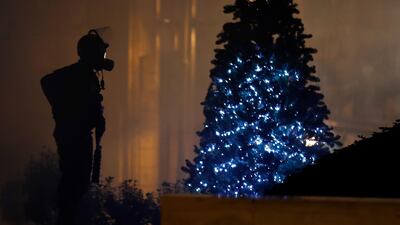
  • A riot police officer stands next of a Christmas tree during a protest. AP
    A riot police officer stands next of a Christmas tree during a protest. AP
  • A riot police officer fires rubber bullets towards anti-government protesters. AP
    A riot police officer fires rubber bullets towards anti-government protesters. AP
  • Civil defence workers treat injured protesters who were beaten by riot police. AP
    Civil defence workers treat injured protesters who were beaten by riot police. AP
  • Riot policemen run after anti-government protesters trying to enter the parliament square. AP
    Riot policemen run after anti-government protesters trying to enter the parliament square. AP
  • An anti-government protester holds stones, as he flashes victory signs during a protest near the parliament square. AP
    An anti-government protester holds stones, as he flashes victory signs during a protest near the parliament square. AP
  • Lebanese demonstrators hurl rocks at riot police during clashes in the capital Beirut on December 14, 2019. AFP
    Lebanese demonstrators hurl rocks at riot police during clashes in the capital Beirut on December 14, 2019. AFP
  • Lebanese riot police prepare to fire teargas canisters during clashes with anti-government demonstrators in the capital Beirut on December 14, 2019. AFP
    Lebanese riot police prepare to fire teargas canisters during clashes with anti-government demonstrators in the capital Beirut on December 14, 2019. AFP
  • Riot police detain an anti-government demonstrator during clashes in the capital Beirut on December 14, 2019. AFP
    Riot police detain an anti-government demonstrator during clashes in the capital Beirut on December 14, 2019. AFP
  • Lebanese demonstrators hurl tear-gas canisters back at riot police during clashes in the capital Beirut on December 14, 2019. AFP
    Lebanese demonstrators hurl tear-gas canisters back at riot police during clashes in the capital Beirut on December 14, 2019. AFP
  • Lebanese demonstrators hurl tear-gas canisters back at riot police during clashes in the capital Beirut on December 14, 2019. AFP
    Lebanese demonstrators hurl tear-gas canisters back at riot police during clashes in the capital Beirut on December 14, 2019. AFP
  • Lebanese demonstrators hurl tear-gas canisters back at riot police during clashes in the capital Beirut on December 14, 2019. AFP
    Lebanese demonstrators hurl tear-gas canisters back at riot police during clashes in the capital Beirut on December 14, 2019. AFP

Lebanon protesters angry at selective police violence after Beirut clashes


Sunniva Rose
  • English
  • Arabic

Lebanese protesters are accusing riot police of trying to crack down on peaceful demonstrators with excessive force on Saturday evening in Beirut after authorities used rubber bullets, tear gas and water cannon.

They said that hours earlier, police took a softer approach to attacks by supporters from a stronghold of the Amal Movement, who threw rocks and fireworks at police, wounding officers.

“Security forces show a lot more restraint with the groups of men who come from the neighbourhood of Khandaq Al Ghamiq and elsewhere to attack protesters and their encampment in downtown Beirut," said independent Lebanese journalist Lara Bitar, who saw the clashes on Saturday evening.

"And that's, of course, a political decision."

Khandaq Al Ghamiq, a stronghold of Hezbollah’s ally Amal, has made headlines since protests began.

Expressing their loyalty to party leader and Parliamentary Speaker Nabih Berri, groups of men from the area have attacked protesters downtown several times and burnt their tents.

They started the attacks on the day Prime Minister Saad Hariri resigned, on October 29.

Local media reported that the men were angry because they thought protesters had insulted Mr Berri.

On Saturday afternoon, clashes erupted again in central Beirut between riot police and young men from Khandaq Al Ghamiq, some of them wearing masks, as they tried to enter the city centre.

The Internal Security Forces tweeted a video showing groups of men throwing stones and fireworks at riot police and warned that these attacks “must be stopped", or the troops would “take additional and stronger measures".

They were eventually dispersed with tear gas by the riot police, two of whom were taken to hospital after being hit by stones.

Amal representatives have said they had nothing to do with these men.

None has been arrested as yet, despite the hundreds of arrests of peaceful demonstrators in the nearly two months of protests. Those detained are usually released after a few hours.

One woman who lives in an Amal-dominated neighbourhood of Beirut said she believed the men from Khandaq Al Ghamiq were being protected.

“There is no other explanation,” she said. “There are orders from Berri to not touch them.”

Amal did not respond to a request for comment on Sunday.

  • Riot police officers arrest an anti-government protester trying to enter a central square in downtown Beirut. AP Photo
    Riot police officers arrest an anti-government protester trying to enter a central square in downtown Beirut. AP Photo
  • Anti-government protesters run away as the riot police fire tear gas at them during a protest in central Beirut. AP Photo
    Anti-government protesters run away as the riot police fire tear gas at them during a protest in central Beirut. AP Photo
  • A riot police officer stands next to a Christmas tree during a protest where some anti-government protesters tried to enter a central square in downtown Beirut. AP Photo
    A riot police officer stands next to a Christmas tree during a protest where some anti-government protesters tried to enter a central square in downtown Beirut. AP Photo
  • Protesters flee gas grenades after they threw stones at riot police during clashes in central Beirut. EPA
    Protesters flee gas grenades after they threw stones at riot police during clashes in central Beirut. EPA
  • Protesters wave the Lebanese flag in front of riot police during clashes in Beirut. EPA
    Protesters wave the Lebanese flag in front of riot police during clashes in Beirut. EPA
  • People help a wounded protester during clashes in central Beirut. EPA
    People help a wounded protester during clashes in central Beirut. EPA
  • Protesters gather behind Lebanese soldiers as they flee gas grenades following stone throwing at riot police during clashes in central Beirut. EPA
    Protesters gather behind Lebanese soldiers as they flee gas grenades following stone throwing at riot police during clashes in central Beirut. EPA
  • Protesters flee gas grenades after they threw stones at riot police during clashes in Beirut. EPA
    Protesters flee gas grenades after they threw stones at riot police during clashes in Beirut. EPA
  • Protesters flee gas grenades after they threw stones at riot police during clashes in central Beirut, Lebanon. EPA
    Protesters flee gas grenades after they threw stones at riot police during clashes in central Beirut, Lebanon. EPA
  • Anti-government protesters burn a rubbish container and throw bottles at riot police during a protest in central Beirut. AP Photo
    Anti-government protesters burn a rubbish container and throw bottles at riot police during a protest in central Beirut. AP Photo

A few hours after the clashes, hundreds of protesters, including many women, gathered peacefully in the city centre, chanting slogans hostile to politicians and repeating oft-heard demands of better government services.

They were joined by groups of people from the northern city of Tripoli and the eastern region of the Bekaa, reports said.

“We were there to reclaim public space,” the woman said.

The crackdown that followed was "the most violent" since protests began on October 17, she told The National.

Bitar and other witnesses said riot police started firing tear gas and beating protesters about 7pm because some people tried to enter Nejmeh Square, an area of the city centre that includes Parliament.

Videos show protesters chanting “shabiha, shabiha” at police, using the Arabic term for partisan thugs.

But the witness said the backlash came “out of nowhere”.

She said men from Khandaq Al Ghamiq who threatened to “break Parliament” had infiltrated the protests.

“We asked the police to remove them and they refused,” the woman said.

The fighting reached a building belonging to the Christian Kataeb party, which was reportedly open to protesters who wanted to find shelter.

The party is not represented in government, positioning itself as opposition, but has been accused of trying to ride the wave of protests.

Street fights dragged on until the early hours of the morning, when the last few protesters were dispersed with water cannon.

“We lasted so long because we got smarter," the woman said. "We had gas masks, steel-toed shoes, goggles, hard hats, fireproof gloves and thick jackets."

Bitar said the Parliamentary Police were probably involved because of the proximity to the Parliament building.

“Security forces were hitting people indiscriminately, targeting sensitive parts of the body and hitting people on the head,” she said.

“They fired an excessive amount of tear gas for hours on end. There was also the presence of parliamentary guards in civilian clothes last night, who were brutally going after demonstrators with batons and stun guns."

Be aware of those trying to exploit the protests with the aim of creating clashes with security forces

Riot police fired rubber bullets at protesters, aiming below the waist, one witness said.

Human Rights Watch has documented the use of rubber bullets in Lebanon several times since the start of protests, including at least one case in which troops aimed at a protester’s face.

Videos on social media showed people sarcastically clapping their hands at deadpan riot police walking past them, saying: “If only we had seen you being such heroes with the men from Khandaq.”

"There is no excuse for the amount of violence used by security forces against protesters last night,” said Aya Majzoub, Lebanon and Bahrain researcher at Human Rights Watch.

“The Lebanese authorities should immediately initiate an independent and impartial investigation into yesterday’s attacks and ensure those responsible are held to account.

"The authorities cannot think that they can beat away people’s grievances.”

Caretaker Interior Minister Raya El Hassan said on Sunday that she had ordered an investigation into Saturday night’s violence and called on demonstrators to “be aware of those trying to exploit the protests with the aim of creating clashes with security forces".

The number of those arrested and wounded remains unclear.

Ayman Raad, a lawyer who works closely with protesters, said about 55 people were taken to hospital, although many more were treated on the ground.

Ten people were detained and released on Sunday, Mr Raad said.

The civil defence said on Saturday evening that 25 were hurt, while the Red Cross reported 14. Riot police said 23 officers were injured.

The woman witness said the violence had only hardened her resolve, just one day ahead of Parliamentary consultations that were widely expected to result in the nomination of Saad Hariri as Lebanon’s new prime minister.

The move is rejected by protesters.

“We are done being peaceful," she said. "We are humans, at the end of the day. How many times can we take a beating without responding?"