A woman wearing a protective mask walks past Central Bank building in Beirut. Lebanon has eased banking secrecy laws for a one-year period to facilitate a forensic audit of the Central Bank and other state institutions. Reuters
A woman wearing a protective mask walks past Central Bank building in Beirut. Lebanon has eased banking secrecy laws for a one-year period to facilitate a forensic audit of the Central Bank and other

Lebanon eases banking secrecy laws to allow forensic audit


Elias Sakr
  • English
  • Arabic

Lebanon eased banking secrecy laws for a year to allow a forensic audit of the Central Bank and various state institutions.

Legal experts, however, fear the process could still be derailed.

Legislators on Monday passed a bill waiving banking secrecy with regards to the accounts of the Central Bank, ministries and government agencies weeks after Parliament recommended an audit of all state accounts in response to a letter by President Michel Aoun.

The non-binding recommendation followed the withdrawal of auditor Alvarez & Marsal, given the task by government to conduct a forensic audit of Banque du Liban (BDL), a prerequisite for much-needed international financial aid for Lebanon.

But legal experts say the ratification of the recommendation into law is unlikely to pave the way for an audit any time soon owing to political paralysis.

The appointment of a new auditor necessitates a fully functioning government, said Nizar Saghieh, a lawyer who heads The Legal Agenda, a Beirut-based research and advocacy organisation.

Lebanon has been without a fully functioning Cabinet since the deadly explosion that ripped through Beirut port in August, killing more than 200 people and forcing the government’s resignation.

The caretaker Cabinet has been paralysed with little progress made in terms of enacting reforms that the international community is demanding in exchange for financial support.

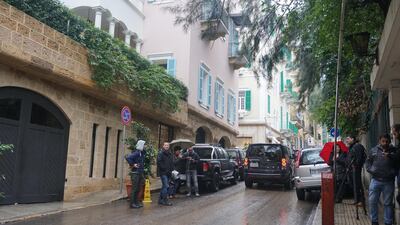
  • Carlos Ghosn's home at Ashrafieh St., in Beirut, Lebanon. Sunniva Rose for The National
    Carlos Ghosn's home at Ashrafieh St., in Beirut, Lebanon. Sunniva Rose for The National
  • Japanese journalists that were waiting outside, including when they were filming a car leaving Ghosn's house (unfortunately the driver did not look like him). Sunniva Rose for The National
    Japanese journalists that were waiting outside, including when they were filming a car leaving Ghosn's house (unfortunately the driver did not look like him). Sunniva Rose for The National
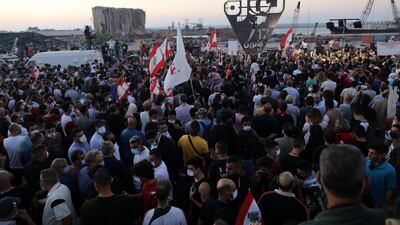
  • BEIRUT, LEBANON - OCTOBER 17: People wave Lebanese flags and chant to mark the one-year anniversary of anti-government protests with a background of the destroyed silos on the seaport on October 17, 2020 in Beirut, Lebanon. On the one year anniversary since the unprecedented mass protests of Lebanese demanding political change as the country buckled under social and economic devastation, Beirut remains in rubble after the August 4 port blast. (Photo by Marwan Tahtah/Getty Images)
    BEIRUT, LEBANON - OCTOBER 17: People wave Lebanese flags and chant to mark the one-year anniversary of anti-government protests with a background of the destroyed silos on the seaport on October 17, 2020 in Beirut, Lebanon. On the one year anniversary since the unprecedented mass protests of Lebanese demanding political change as the country buckled under social and economic devastation, Beirut remains in rubble after the August 4 port blast. (Photo by Marwan Tahtah/Getty Images)
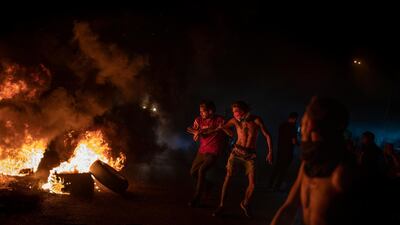
  • BEIRUT, LEBANON - JUNE 11: Protesters burn tires as large-scale protests resume on June 11, 2020 in Beirut, Lebanon. The Lebanese pound has lost 70% of its value since October when protests began. Although they abated during the coronavirus lockdown, the country's economic condition steadily worsened. (Photo by Diego Ibarra Sanchez/Getty Images)
    BEIRUT, LEBANON - JUNE 11: Protesters burn tires as large-scale protests resume on June 11, 2020 in Beirut, Lebanon. The Lebanese pound has lost 70% of its value since October when protests began. Although they abated during the coronavirus lockdown, the country's economic condition steadily worsened. (Photo by Diego Ibarra Sanchez/Getty Images)
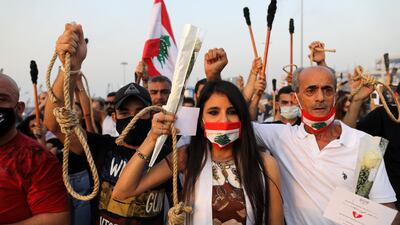
  • BEIRUT, LEBANON - SEPTEMBER 04: Protesters hold torches and nooses, which have become symbols of public anger against the Lebanese government, as they commemorate a month since the city's deadly explosion on September 4, 2020 in Beirut, Lebanon. On August 4th, a fire at Beirut's port ignited a stockpile of ammonium nitrate causing a massive explosion that killed more than 200 people, destroyed surrounding neighborhoods and upended countless lives. (Photo by Marwan Tahtah/Getty Images)
    BEIRUT, LEBANON - SEPTEMBER 04: Protesters hold torches and nooses, which have become symbols of public anger against the Lebanese government, as they commemorate a month since the city's deadly explosion on September 4, 2020 in Beirut, Lebanon. On August 4th, a fire at Beirut's port ignited a stockpile of ammonium nitrate causing a massive explosion that killed more than 200 people, destroyed surrounding neighborhoods and upended countless lives. (Photo by Marwan Tahtah/Getty Images)
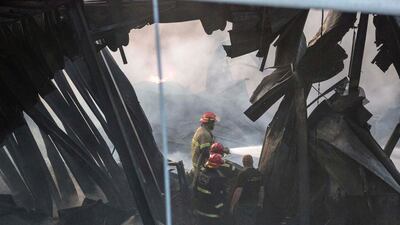
  • BEIRUT, LEBANON - SEPTEMBER 10: Firefighters walk through a burned out warehouse as they respond to a huge blaze at Beirut port on September 10, 2020 in Beirut, Lebanon. The fire broke out in a structure in the city's heavily damaged port facility, the site of last month's explosion that killed more than 190 people. (Photo by Sam Tarling/Getty Images)
    BEIRUT, LEBANON - SEPTEMBER 10: Firefighters walk through a burned out warehouse as they respond to a huge blaze at Beirut port on September 10, 2020 in Beirut, Lebanon. The fire broke out in a structure in the city's heavily damaged port facility, the site of last month's explosion that killed more than 190 people. (Photo by Sam Tarling/Getty Images)
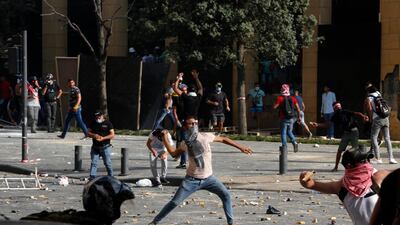
  • BEIRUT, LEBANON - AUGUST 08: Protesters throw stones during an anti-government demonstrations on August 8, 2020 in Beirut, Lebanon. The Lebanese capital is reeling from this week's massive explosion that killed at least 150 people, wounded thousands, and destroyed wide swaths of the city. Residents are demanding accountability for the blast, whose suspected cause was 2,700 tons of ammonium nitrate stored for years at the city's port. (Photo by Marwan Tahtah/Getty Images)
    BEIRUT, LEBANON - AUGUST 08: Protesters throw stones during an anti-government demonstrations on August 8, 2020 in Beirut, Lebanon. The Lebanese capital is reeling from this week's massive explosion that killed at least 150 people, wounded thousands, and destroyed wide swaths of the city. Residents are demanding accountability for the blast, whose suspected cause was 2,700 tons of ammonium nitrate stored for years at the city's port. (Photo by Marwan Tahtah/Getty Images)
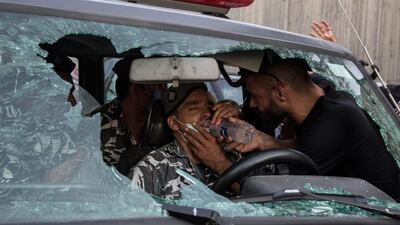
  • BEIRUT, LEBANON - SEPTEMBER 12: An anti-government protester gives water to a policeman after other protesters attacked his vehicle during a march toward the Presidential Palace, on September 12, 2020 in Baabda, Beirut, Lebanon. (Photo by Sam Tarling/Getty Images)
    BEIRUT, LEBANON - SEPTEMBER 12: An anti-government protester gives water to a policeman after other protesters attacked his vehicle during a march toward the Presidential Palace, on September 12, 2020 in Baabda, Beirut, Lebanon. (Photo by Sam Tarling/Getty Images)
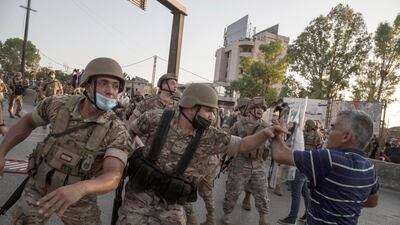
  • BEIRUT, LEBANON - SEPTEMBER 12: Anti-government protesters clash with security forces during a march toward the Presidential Palace, on September 12, 2020 in Baabda, Beirut, Lebanon. (Photo by Sam Tarling/Getty Images)
    BEIRUT, LEBANON - SEPTEMBER 12: Anti-government protesters clash with security forces during a march toward the Presidential Palace, on September 12, 2020 in Baabda, Beirut, Lebanon. (Photo by Sam Tarling/Getty Images)
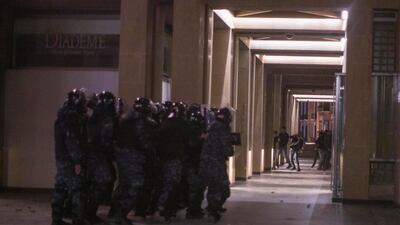
  • BEIRUT, LEBANON - JANUARY 22: Anti government protesters and riot police clash during a second day of violence, on January 22, 2020 in an upscale shopping district in Beirut, Lebanon. Weeks of bickering between the Hezbollah-allied political factions backing Lebanon's new Prime Minister Hassan Diab as to who gets which ministries has led protesters to decry his new government as partisan and political, and not the technocratic leadership they have been demanding since protests began on Oct 17th last year. (Photo by Sam Tarling/Getty Images)
    BEIRUT, LEBANON - JANUARY 22: Anti government protesters and riot police clash during a second day of violence, on January 22, 2020 in an upscale shopping district in Beirut, Lebanon. Weeks of bickering between the Hezbollah-allied political factions backing Lebanon's new Prime Minister Hassan Diab as to who gets which ministries has led protesters to decry his new government as partisan and political, and not the technocratic leadership they have been demanding since protests began on Oct 17th last year. (Photo by Sam Tarling/Getty Images)
  • BEIRUT, LEBANON - AUGUST 07: An aerial view of ruined structures near the city's port, the site of Tuesday's explosion, on August 7, 2020 in Beirut, Lebanon. By Friday, the official death toll from Tuesday's blast stood at 145, with thousands injured. Public anger swelled over the possibility that government negligence over the storage of tons of ammonium nitrate was behind the catastrophe. (Photo by Haytham Al Achkar/Getty Images)
    BEIRUT, LEBANON - AUGUST 07: An aerial view of ruined structures near the city's port, the site of Tuesday's explosion, on August 7, 2020 in Beirut, Lebanon. By Friday, the official death toll from Tuesday's blast stood at 145, with thousands injured. Public anger swelled over the possibility that government negligence over the storage of tons of ammonium nitrate was behind the catastrophe. (Photo by Haytham Al Achkar/Getty Images)
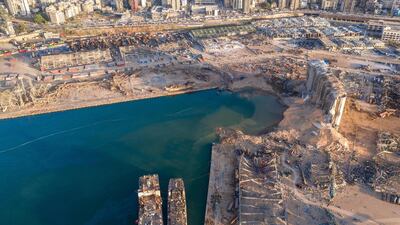
  • BEIRUT, LEBANON - AUGUST 05: An aerial view of ruined structures at the port, damaged by an explosion a day earlier, on August 5, 2020 in Beirut, Lebanon. As of Wednesday, more than 100 people were confirmed dead, with thousands injured, when an explosion rocked the Lebanese capital. Officials said a waterfront warehouse storing explosive materials, reportedly 2,700 tons of ammonium nitrate, was the cause of the blast. (Photo by Haytham Al Achkar/Getty Images)
    BEIRUT, LEBANON - AUGUST 05: An aerial view of ruined structures at the port, damaged by an explosion a day earlier, on August 5, 2020 in Beirut, Lebanon. As of Wednesday, more than 100 people were confirmed dead, with thousands injured, when an explosion rocked the Lebanese capital. Officials said a waterfront warehouse storing explosive materials, reportedly 2,700 tons of ammonium nitrate, was the cause of the blast. (Photo by Haytham Al Achkar/Getty Images)
  • BEIRUT, LEBANON - FEBRUARY 11: Anti-government protesters are hit by a water cannon as they pull down a concrete barricade during a failed attempt to block politicians from accessing Parliament where they will vote whether to accept Lebanon's new government, on February 11, 2020 in Beirut, Lebanon. (Photo by Sam Tarling/Getty Images)
    BEIRUT, LEBANON - FEBRUARY 11: Anti-government protesters are hit by a water cannon as they pull down a concrete barricade during a failed attempt to block politicians from accessing Parliament where they will vote whether to accept Lebanon's new government, on February 11, 2020 in Beirut, Lebanon. (Photo by Sam Tarling/Getty Images)
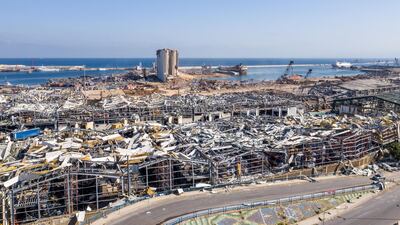
  • BEIRUT, LEBANON - AUGUST 5: Destroyed buildings are visible a day after a massive explosion occurred at the port on Aug. 5, 2020 in Beirut, Lebanon. As of Wednesday morning, more than 100 people were confirmed dead, with thousands injured, when an explosion rocked the Lebanese capital. Officials said a waterfront warehouse storing explosive materials, reportedly 2,700 tons of ammonium nitrate, was the cause of the blast. (Photo by Daniel Carde/Getty Images)
    BEIRUT, LEBANON - AUGUST 5: Destroyed buildings are visible a day after a massive explosion occurred at the port on Aug. 5, 2020 in Beirut, Lebanon. As of Wednesday morning, more than 100 people were confirmed dead, with thousands injured, when an explosion rocked the Lebanese capital. Officials said a waterfront warehouse storing explosive materials, reportedly 2,700 tons of ammonium nitrate, was the cause of the blast. (Photo by Daniel Carde/Getty Images)
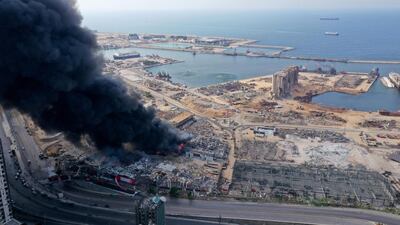
  • BEIRUT, LEBANON - SEPTEMBER 10: An aerial view of the black smoke following a fire that erupted in Beirut Ports Free Zone on September 10, 2020 in Beirut, Lebanon. The fire broke out in a structure in the city's heavily damaged port facility, the site of last month's explosion that killed more than 190 people. (Photo by Haytham Al Achkar/Getty Images)
    BEIRUT, LEBANON - SEPTEMBER 10: An aerial view of the black smoke following a fire that erupted in Beirut Ports Free Zone on September 10, 2020 in Beirut, Lebanon. The fire broke out in a structure in the city's heavily damaged port facility, the site of last month's explosion that killed more than 190 people. (Photo by Haytham Al Achkar/Getty Images)
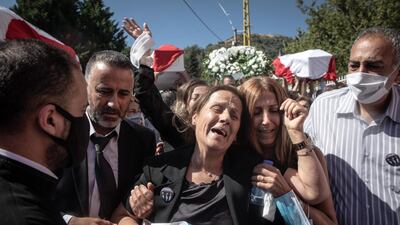
  • BEIRUT, LEBANON - AUGUST 17: Family members mourn as the coffins of firefighters Charbel Hetti, Najeeb Hetti and Charbel Karem who were killed in the August 4th, Beirut port explosion are carried to the church during their funeral service in their hometown of Qartaba on August 17, 2020 in Beirut, Lebanon. Najeeb Hetti, 27 his cousin Charbel Hetti, 22 and his sisters husband Charbel Karam, 37 were killed during the Beirut port explosion along with 7 other firefighters from the Karatina fire department, who were the first responders to the blaze. The remains of Najeeb and Charbel were found on August 13th, however the family refused to bury them until the body of Charbel Karam was found, his remains were recovered on August 15th. There has been little visible support from government agencies to help residents clear debris and help the displaced, although scores of volunteers from around Lebanon have descended on the city to help clean. (Photo by Chris McGrath/Getty Images)
    BEIRUT, LEBANON - AUGUST 17: Family members mourn as the coffins of firefighters Charbel Hetti, Najeeb Hetti and Charbel Karem who were killed in the August 4th, Beirut port explosion are carried to the church during their funeral service in their hometown of Qartaba on August 17, 2020 in Beirut, Lebanon. Najeeb Hetti, 27 his cousin Charbel Hetti, 22 and his sisters husband Charbel Karam, 37 were killed during the Beirut port explosion along with 7 other firefighters from the Karatina fire department, who were the first responders to the blaze. The remains of Najeeb and Charbel were found on August 13th, however the family refused to bury them until the body of Charbel Karam was found, his remains were recovered on August 15th. There has been little visible support from government agencies to help residents clear debris and help the displaced, although scores of volunteers from around Lebanon have descended on the city to help clean. (Photo by Chris McGrath/Getty Images)
  • BEIRUT, LEBANON - AUGUST 07: A general view of buildings heavily damaged in Tuesday's explosion, on August 7, 2020 in Beirut, Lebanon. By Friday, the official death toll from Tuesday's blast stood at 145, with thousands injured. Public anger swelled over the possibility that government negligence over the storage of tons of ammonium nitrate was behind the catastrophe. (Photo by Haytham Al Achkar/Getty Images)
    BEIRUT, LEBANON - AUGUST 07: A general view of buildings heavily damaged in Tuesday's explosion, on August 7, 2020 in Beirut, Lebanon. By Friday, the official death toll from Tuesday's blast stood at 145, with thousands injured. Public anger swelled over the possibility that government negligence over the storage of tons of ammonium nitrate was behind the catastrophe. (Photo by Haytham Al Achkar/Getty Images)
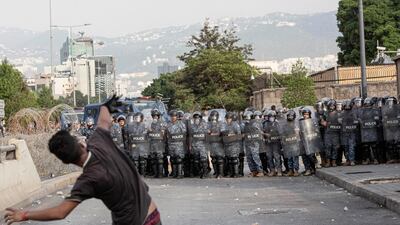
  • BEIRUT, LEBANON - OCTOBER 30: A demonstrator throws stones at police at an anti-France protest on October 30, 2020 in Beirut, Lebanon. Following a series of deadly attacks, France's President Macron declared a crackdown on Islamist extremism by shutting down mosques and other organisations accused of instigating violence. The comments sparked protests across the Muslim world and calls for a boycott of French goods. (Photo by Sam Tarling/Getty Images)
    BEIRUT, LEBANON - OCTOBER 30: A demonstrator throws stones at police at an anti-France protest on October 30, 2020 in Beirut, Lebanon. Following a series of deadly attacks, France's President Macron declared a crackdown on Islamist extremism by shutting down mosques and other organisations accused of instigating violence. The comments sparked protests across the Muslim world and calls for a boycott of French goods. (Photo by Sam Tarling/Getty Images)
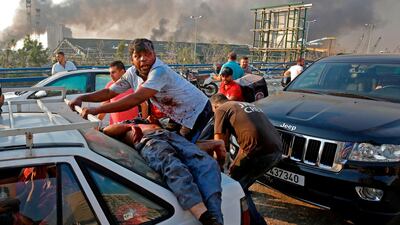
  • -- AFP PICTURES OF THE YEAR 2020 -- An injured man lies at the back of a car before being rushed away from the scene of a massive explosion at the port of Lebanon's capital Beirut on August 4, 2020. Two huge explosion rocked the Lebanese capital Beirut, wounding dozens of people, shaking buildings and sending huge plumes of smoke billowing into the sky. Lebanese media carried images of people trapped under rubble, some bloodied, after the massive explosions, the cause of which was not immediately known. - / AFP / Marwan TAHTAH
    -- AFP PICTURES OF THE YEAR 2020 -- An injured man lies at the back of a car before being rushed away from the scene of a massive explosion at the port of Lebanon's capital Beirut on August 4, 2020. Two huge explosion rocked the Lebanese capital Beirut, wounding dozens of people, shaking buildings and sending huge plumes of smoke billowing into the sky. Lebanese media carried images of people trapped under rubble, some bloodied, after the massive explosions, the cause of which was not immediately known. - / AFP / Marwan TAHTAH
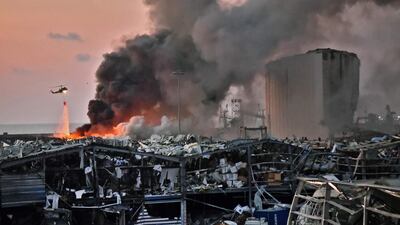
  • -- AFP PICTURES OF THE YEAR 2020 -- A helicopter puts out a fire at the scene of an explosion at the port of Lebanon's capital Beirut on August 4, 2020. AFP / STR
    -- AFP PICTURES OF THE YEAR 2020 -- A helicopter puts out a fire at the scene of an explosion at the port of Lebanon's capital Beirut on August 4, 2020. AFP / STR

Mr Saghieh fears the approved legal deadline could be too short to complete the audit.

“A Cabinet has first to be formed, and then it has to agree on the appointment of a new auditor who would have to complete the audit within the specified period, Mr Saghieh said.

In November, Alvarez & Marsal ended their contract with the government, citing the "insufficient provision of information" after BDL governor Riad Salameh refused to hand over all the requested documents, which he said would breach banking secrecy laws.

The withdrawal of the consultancy firm fuelled public anger, which has been building since the unravelling of the financial crisis that robbed many Lebanese of their life savings.

Mr Salameh previously offered to provide auditors with information on government accounts but maintained that offering details relating to the accounts of private banks or financial institutions would break banking laws.

BDL’s operations have long been shrouded in secrecy, prompting claims that the institution is facilitating corruption and cronyism in the country.

In a recent report, The Wall Street Journal said the US was considering sanctions against the Central Bank and senior BDL officials over links to Hezbollah.

The mere threat of sanctions could cause foreign banks to cut ties with Lebanese commercial banks, further deepening Lebanon's economic crisis, which caused the national currency to plunge by more than 80 per cent against the dollar.


The specs
Engine: 2.7-litre 4-cylinder Turbomax
Power: 310hp
Torque: 583Nm
Transmission: 8-speed automatic
Price: From Dh192,500
On sale: Now
Ten tax points to be aware of in 2026

1. Domestic VAT refund amendments: request your refund within five years

If a business does not apply for the refund on time, they lose their credit.

2. E-invoicing in the UAE

Businesses should continue preparing for the implementation of e-invoicing in the UAE, with 2026 a preparation and transition period ahead of phased mandatory adoption. 

3. More tax audits

Tax authorities are increasingly using data already available across multiple filings to identify audit risks. 

4. More beneficial VAT and excise tax penalty regime

Tax disputes are expected to become more frequent and more structured, with clearer administrative objection and appeal processes. The UAE has adopted a new penalty regime for VAT and excise disputes, which now mirrors the penalty regime for corporate tax.

5. Greater emphasis on statutory audit

There is a greater need for the accuracy of financial statements. The International Financial Reporting Standards standards need to be strictly adhered to and, as a result, the quality of the audits will need to increase.

6. Further transfer pricing enforcement

Transfer pricing enforcement, which refers to the practice of establishing prices for internal transactions between related entities, is expected to broaden in scope. The UAE will shortly open the possibility to negotiate advance pricing agreements, or essentially rulings for transfer pricing purposes. 

7. Limited time periods for audits

Recent amendments also introduce a default five-year limitation period for tax audits and assessments, subject to specific statutory exceptions. While the standard audit and assessment period is five years, this may be extended to up to 15 years in cases involving fraud or tax evasion. 

8. Pillar 2 implementation 

Many multinational groups will begin to feel the practical effect of the Domestic Minimum Top-Up Tax (DMTT), the UAE's implementation of the OECD’s global minimum tax under Pillar 2. While the rules apply for financial years starting on or after January 1, 2025, it is 2026 that marks the transition to an operational phase.

9. Reduced compliance obligations for imported goods and services

Businesses that apply the reverse-charge mechanism for VAT purposes in the UAE may benefit from reduced compliance obligations. 

10. Substance and CbC reporting focus

Tax authorities are expected to continue strengthening the enforcement of economic substance and Country-by-Country (CbC) reporting frameworks. In the UAE, these regimes are increasingly being used as risk-assessment tools, providing tax authorities with a comprehensive view of multinational groups’ global footprints and enabling them to assess whether profits are aligned with real economic activity. 

Contributed by Thomas Vanhee and Hend Rashwan, Aurifer

LILO & STITCH

Starring: Sydney Elizebeth Agudong, Maia Kealoha, Chris Sanders

Director: Dean Fleischer Camp

Rating: 4.5/5

MADAME%20WEB
%3Cp%3EDirector%3A%20S.J.%20Clarkson%3C%2Fp%3E%0A%3Cp%3EStarring%3A%20Dakota%20Johnson%2C%20Tahar%20Rahim%2C%20Sydney%20Sweeney%3C%2Fp%3E%0A%3Cp%3ERating%3A%203.5%2F5%3C%2Fp%3E%0A

England's all-time record goalscorers:
Wayne Rooney 53
Bobby Charlton 49
Gary Lineker 48
Jimmy Greaves 44
Michael Owen 40
Tom Finney 30
Nat Lofthouse 30
Alan Shearer 30
Viv Woodward 29
Frank Lampard 29

Key findings of Jenkins report
  • Founder of the Muslim Brotherhood, Hassan al Banna, "accepted the political utility of violence"
  • Views of key Muslim Brotherhood ideologue, Sayyid Qutb, have “consistently been understood” as permitting “the use of extreme violence in the pursuit of the perfect Islamic society” and “never been institutionally disowned” by the movement.
  • Muslim Brotherhood at all levels has repeatedly defended Hamas attacks against Israel, including the use of suicide bombers and the killing of civilians.
  • Laying out the report in the House of Commons, David Cameron told MPs: "The main findings of the review support the conclusion that membership of, association with, or influence by the Muslim Brotherhood should be considered as a possible indicator of extremism."
Results

1. New Zealand Daniel Meech – Fine (name of horse), Richard Gardner – Calisto, Bruce Goodin - Backatorps Danny V, Samantha McIntosh – Check In. Team total First round: 200.22; Second round: 201.75 – Penalties 12 (jump-off 40.16 seconds) Prize €64,000

2. Ireland Cameron Hanley – Aiyetoro, David Simpson – Keoki, Paul Kennedy – Cartown Danger Mouse, Shane Breen – Laith. Team total 200.25/202.84 – P 12 (jump-off 51.79 – P17) Prize €40,000

3. Italy Luca Maria Moneta – Connery, Luca Coata – Crandessa, Simone Coata – Dardonge, Natale Chiaudani – Almero. Team total 130.82/198.-4 – P20. Prize €32,000

Name: Peter Dicce

Title: Assistant dean of students and director of athletics

Favourite sport: soccer

Favourite team: Bayern Munich

Favourite player: Franz Beckenbauer

Favourite activity in Abu Dhabi: scuba diving in the Northern Emirates 


ESSENTIALS

The flights

Emirates flies direct from Dubai to Rio de Janeiro from Dh7,000 return including taxes. Avianca fliles from Rio to Cusco via Lima from $399 (Dhxx) return including taxes. 

The trip

From US$1,830 per deluxe cabin, twin share, for the one-night Spirit of the Water itinerary and US$4,630 per deluxe cabin for the Peruvian Highlands itinerary, inclusive of meals, and beverages. Surcharges apply for some excursions.

War 2

Director: Ayan Mukerji

Stars: Hrithik Roshan, NTR, Kiara Advani, Ashutosh Rana

Rating: 2/5

SERIES INFO

Cricket World Cup League Two
Nepal, Oman, United States tri-series
Tribhuvan University, Kathmandu
 
Fixtures
Wednesday February 5, Oman v Nepal
Thursday, February 6, Oman v United States
Saturday, February 8, United States v Nepal
Sunday, February 9, Oman v Nepal
Tuesday, February 11, Oman v United States
Wednesday, February 12, United States v Nepal

Table
The top three sides advance to the 2022 World Cup Qualifier.
The bottom four sides are relegated to the 2022 World Cup playoff

 1 United States 8 6 2 0 0 12 0.412
2 Scotland 8 4 3 0 1 9 0.139
3 Namibia 7 4 3 0 0 8 0.008
4 Oman 6 4 2 0 0 8 -0.139
5 UAE 7 3 3 0 1 7 -0.004
6 Nepal 0 0 0 0 0 0 0
7 PNG 8 0 8 0 0 0 -0.458