
Lebanon's central bank head Riad Salameh on Wednesday defended his record after being accused by the prime minister of failing to take action to stop a dire economic crisis and allowing a massive slide in the national currency.
In a rare, hour-long live television speech, the head of Banque Du Liban complained that there was a coordinated campaign against him, arguing that the bank’s role was to finance the state but that ultimately, politicians controlled how it was spent.
Mr Salameh called on politicians to take overdue economic reforms but said it was not BdL's fault if successive governments have failed to take action.
Lebanese law states that the central bank must finance the government at its request, he said. “We have contributed to reducing the cost of public debt by lending to the state at low-interest rates… The central bank has funded the state but not spent its money,” he said.
He said that BdL is attempting to stabilise the price of the Lebanese pound as much as possible as it trades at exchanges at nearly 60 per cent below the official peg. He added that it wasn't the bank's actions that had driven up the price of medicine, wheat or fuel and assured banks that their deposits with BdL are still there.
The central bank was not the only one to finance successive Lebanese governments, he pointed out. Lebanon has received financial support from international institutions and foreign countries in the past decades.
While this might be Mr Salameh’s strongest argument, it does not explain who will bear the losses caused by the current financial crisis, Lebanese economist Sami Nader said. “Who will bear the losses of a state accused of corruption, depositors?”
Rumours of a “haircut” – a reduction on holdings - on bank accounts have been circulating these past months in Lebanon, increasing fears that people’s hard cash has evaporated. Banks have restricted access to cash and banned international transfers since to the public since last October. The crisis sparked nation-wide demonstrations, with protesters accusing politicians of corruption.
In his speech, Mr Salameh attempted to reassure the public, saying there was no need for a haircut. However, the fact that the Lebanese cannot access their money, while the value of the local currency plummets, has in effect created an “indirect haircut,” said Mr Nader.
“There may not have been a haircut on deposits but there has been one on the Lebanese people’s purchasing power. It has resulted in a loss in actual wealth,” he said.
-
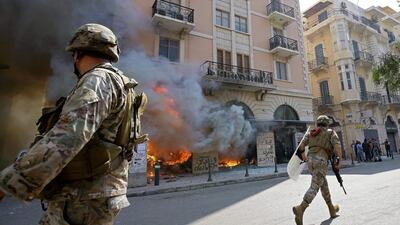
Lebanese soldiers clear the road next to a burning bank branch, set ablaze by demonstrators following the funeral of protester Fawaz al-Samman, in the northern port city of Tripoli. AFP -
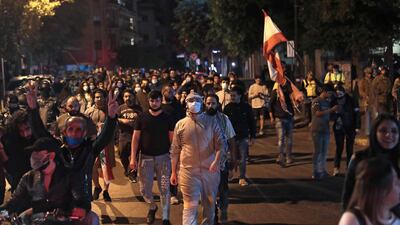
Lebanese demonstrators chant anti-government slogans while they walk through the streets of the capital Beirut. AFP -
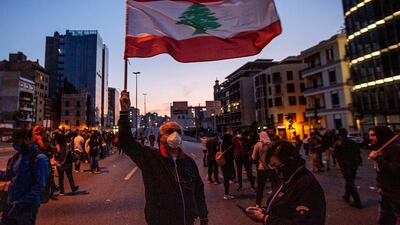
Anti-government protesters attend a protest against the collapsing Lebanese pound currency and the price hikes of goods in Beirut. EPA -
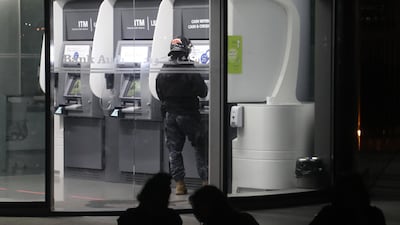
Riot police members withdraw money from an ATM at a local Bank Audi SAL bank branch during an anti-government demonstration in Beirut. Bloomberg -
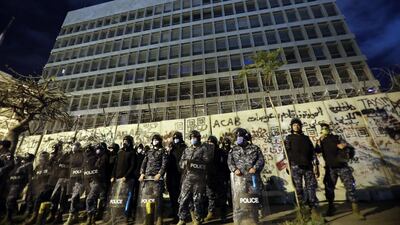
Riot police line up outside the headquarters of the Lebanese central bank during an anti-government demonstration in Beirut. Bloomberg -
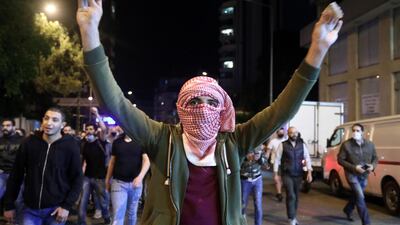
A demonstrator gestures during an anti-government demonstration outside the headquarters of the Lebanese central bank in Beirut. Bloomberg -
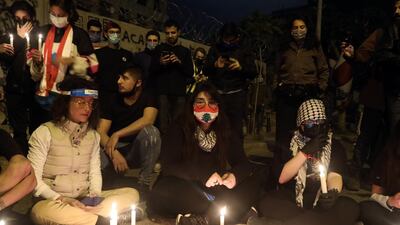
Protesters wearing protective face masks light candles during an anti-government demonstration outside the headquarters of the Lebanese central bank in Beirut. Bloomberg -
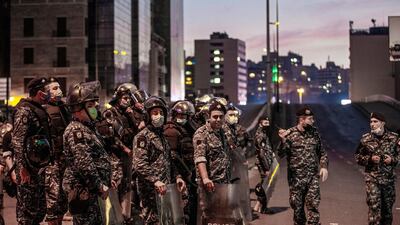
Lebanese riot police stand guard during an anti-government protest against the collapsing Lebanese pound currency and the price hikes of goods in Beirut. EPA -
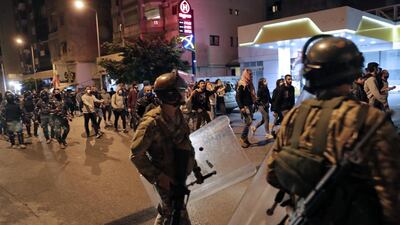
Lebanese army soldiers accompany demonstrators as they chant anti-government slogans while they walk through the streets of the capital Beirut. AFP -
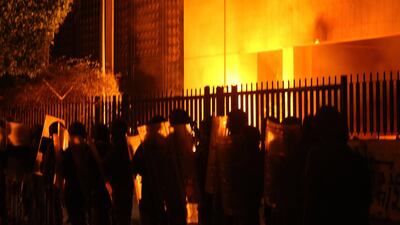
Lebanese police stand guard after demonstrators hurled petrol bombs at the central bank headquarters in the southern city of Sidon (Saida). AFP -
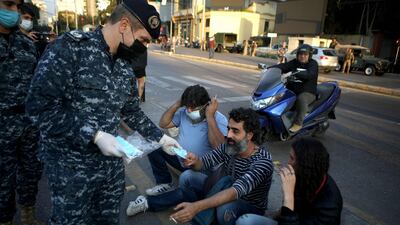
A Lebanese policeman, wearing a protective mask, distributes masks to protesters during a demonstration in the capital Beirut. AFP -
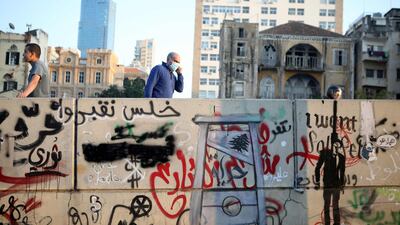
Lebanese protesters walk past a wall bearing graffiti of a hanging politician and a guillotine during a demonstration in the capital Beirut. AFP -
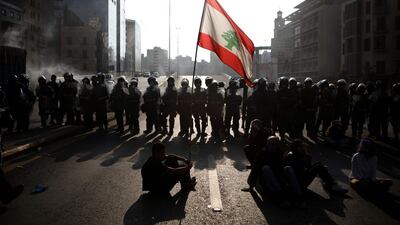
Lebanese protesters wave the national flag in front of riot police in the capital Beirut. AFP -
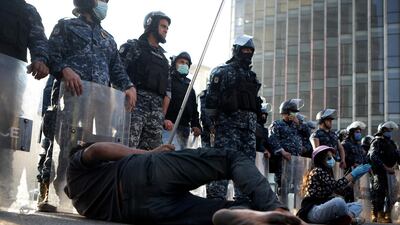
A barefoot Lebanese protester lies on the tarmac in front of riot police in the capital Beirut. AFP -

A Lebanese protester sits in front of riot police in the capital Beirut. AFP -
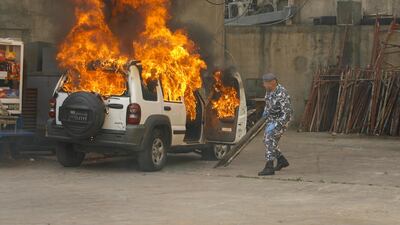
A Lebanese policeman reacts as his jeep is engulfed in flames during clashes between protesters and Lebanese soldiers in the northern port city of Tripoli. AFP -
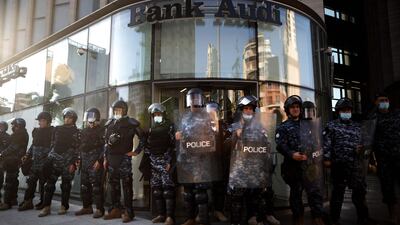
Lebanese riot police guard a bank in the capital Beirut. AFP -
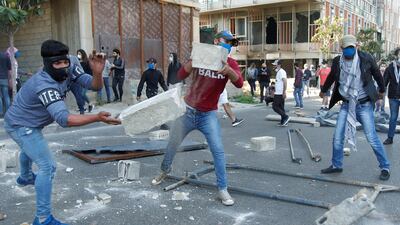
Demonstrators throw pieces of concrete during a protest against growing economic hardship in Beirut, Lebanon. REUTERS


As dollars disappear from the local market, the Lebanese pound’s value has been in a free fall and is currently negotiated at around 4,000 Lebanese pounds to a dollar though it remains officially pegged at 1505.7 pounds to the dollar. In parallel, inflation of basic goods, such as cooking oil and rice, has soared.
Public anger boiled over this week, with protesters torching at least a dozen banks around the country. Lebanon’s public debt is among the highest in the world, at about 92 billion dollars, or 170 per cent of its GDP.
Mr Salameh, who was appointed governor in 1993, said that the central bank is attempting to stabilise the price of the Lebanese pound as much as possible, but that prices ultimately depend on supply and demand.
Additionally, he boasted that the bank’s “usable liquidity” reached $20.9 billion dollars, said Reuters. However, this seems to contradict figures published by Fitch Ratings last February that estimated the central bank’s reserves between $5 and 10 billion, said Mr Nader.
“Mr Salameh is not revealing the net cash position of the central bank,” he observed. “This is what is important and that is why we need an audit on the central bank, especially because it has not published its profits and losses for the past 5 years,” he said.
Lebanon’s Prime Minister Hassan Diab, who has publicly attacked Mr Salameh for his management of Lebanon’s financial crisis, announced on April 6 that an audit of the central bank’s accounts would soon be implemented by international companies, including KPMG and Kroll.
The announcement was interpreted as an attempt to show transparency as Lebanon is negotiating with its creditors after defaulting on its debt for the first time in March.
“The Central Bank is either incapable, absent or directly inciting this dramatic depreciation," said Mr Diab said in a televised speech last week.
Mr Diab accused Mr Salameh of being uncooperative and of covering up losses estimated to be as high as $3 billion in the last month alone.
Several political parties, including Iran-backed Hezbollah, defended Mr Salameh, saying that he was not the only one responsible for the crisis. Pinpointing responsibility is difficult as most Cabinets since the end of the civil war in 1990 have been governments of “national consensus” and included all political formations.
Mr Salameh disputed Mr Diab’s figures on Wednesday. “We would have preferred that the government contact us before quoting these figures,” he said.
The bank’s “accounting systems are not hidden from anyone,” he said. “The central bank does not cost the government a single lira.”

