

Lebanese legislators approved a law on Tuesday legalising the cultivation of cannabis for medicinal and industrial use.
The decision, which makes Lebanon the first Arab country to legalise marijuana growing, offers economic incentives for the debt-ridden state.
It makes the state the sole proprietor for trading cannabis, which has been grown illicitly for decades in Bekaa, in the east of the country.
Lebanon's Parliament approved the bill in its session on Tuesday, despite opposition from Hezbollah representatives.
Hezbollah's allies in the government, including representatives of President Michel Aoun and Speaker Nabih Berri, supported the decision.
-

A farmer is seen tending to cannabis plants in a field in the Yammouneh area west of Baalbek, Lebanon, August 13, 2018. Reuters, file -
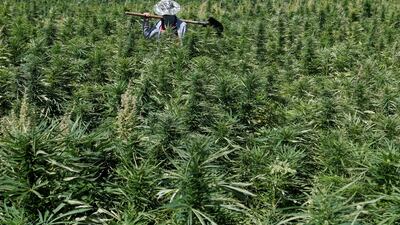
A farmer is seen in a cannabis field in the Yammouneh area west of Baalbek, Lebanon, August 13, 2018.Reuters, file -

Workers cultivating plants at a cannabis plantation in the village of Yammouneh in Lebanon's eastern Bekaa Valley. AFP, file -

Anti-government demonstrators wave Lebanese flags as they protest in their cars, amid a countrywide lockdown to combat the spread of the coronavirus disease in Beirut, Lebanon. Reuters -

An anti-government protester bangs a knife against a lid of a pot, as she covers her face with a national flag to help curb coronavirus pandemic during a protest the economic situation in downtown Beirut. EPA -

Anti-government demonstrators wearing face masks gesture as they pose during a protest, amid a countrywide lockdown to combat the spread of the coronavirus disease. Reuters -

Anti-government demonstrators wearing face masks gesture as they protest during a countrywide lockdown to combat the spread of the coronavirus disease. Reuters


A study by the global consultancy company McKinsey in 2018 recommended the move as a way to revitalise the Lebanese economy.
It estimated that it could generate as much as $1 billion (Dh3.67bn) in revenue a year, Bloomberg reported.
The UN Office on Drugs and Crime ranked Lebanon in 2018 as one of the world's top five producers of cannabis.
Firas Maksad, a policy analyst and professor at George Washington University in the US, said for the move to be successful, a lot would rely on implementation.
"If regulated and taxed properly, this is a net positive for Lebanon," Mr Maksad told The National.
But the decision was a reversal of policy.
“It is important to note that Lebanon spent many millions of foreign assistance dollars in the nineties to fight cannabis farming in the Bekaa,” Mr Maksad said.
He said that Hezbollah’s public opposition to the bill might be only posturing.
“Hezbollah took a principled position against it given the party's claimed Islamic credentials, but practically it signalled to its allies that they can vote for the legislation,” Mr Maksad said.
The party has strong presence in the Bekaa Valley, where most of the cultivation occurs.

