
Months after he was struck in the face by a rubber bullet during a protest in Beirut, Jean-Georges Prince’s scarred lip still hurts when he speaks.
It took 56 stitches in a six-hour surgery to repair his torn lower lip when a rubber bullet smashed into his jaw and broke six teeth in January .
The injury has stretched and pulled down the right side of his lip.
Mr Prince, 32, wears it as a badge of honour and a reminder of nationwide anti-government protests that started in Lebanon on October 17.
“Today it’s written on my face. This is something I see every day when I look at myself in the mirror. Instead of taking me back to a dark place which is the injury itself, it takes me to a very hopeful place which is the fight we put up on the ground,” he said.
“My lip is skewed so it’s actually not straight anymore. I will have to go through two different surgeries but I’m proud keeping it the way it is. It’s a scar that is a reminder of what happened, and also a scar of what we are still doing.”

The advertising professional was one of a dozen people hit with rubber bullets on January 18 during one of the most violent stand-offs with security forces in Beirut.
He had described to The National the intense pain and loss of blood he suffered after being shot but was back on the streets a month later as soon as the stitches were removed.
Mr Prince has since moved to Dubai to take up a job as a copywriter.
Although back on a regular diet, he continues to avoid food that is tough to chew.
“When they stitched my lip, they had to pull it to the side and it’s an uncomfortable feeling because my lip is constantly pulling to the right side and I can feel it when I speak,” he said.
“Some days when I speak or laugh a lot, it starts pulling badly and goes from uncomfortable to actually hurtful.”
Since his beard does not cover the scar, Mr Prince is often asked about the injury.
“The fact that I got injured within that movement has made it somehow easier for me to cope,” he said.
“It was a big shock but I kept reminding myself that this happened because I was fighting the right fight and the injury was for good reason. So psychologically it made it easier to deal with it.”
“It is still hurts today but it is a constant reminder and that makes it easier to live with.”
Mr Prince’s family and friends will join rallies planned this weekend to observe the one-year anniversary of the protests.
-
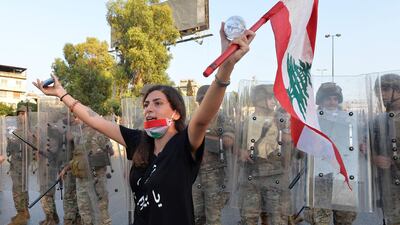
An anti-government protester carries a national flag as she shouts slogans in front of the Lebanese army soldiers during a protest on the road leading to the Presidential palace in Baabda, east Beirut, Lebanon. EPA -
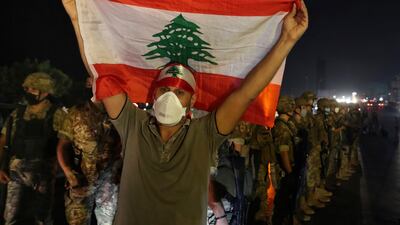
An anti-government protester holds up a Lebanese flag as army soldiers stand guard during a demonstration against deteriorating economic conditions as politicians are deadlocked over forming a new government, in the town of Jal el-Dib, north of Beirut, Lebanon. AP -
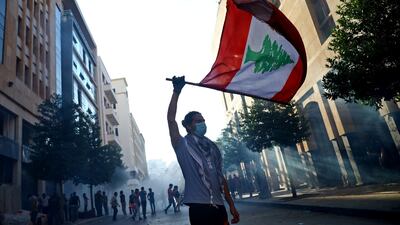
A demonstrator waves a Lebanese flag during anti-government protests on August 8, which were ignited by a massive explosion in Beirut's port. Lebanon's economy was already tanking due to a currency crisis, economic mismanagement and politicial turmoil when the blast hit. Reuters -
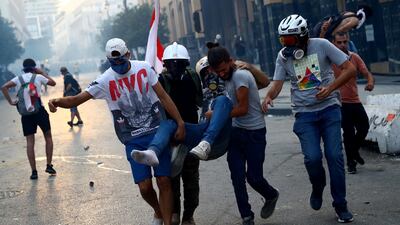
Demonstrators carry an injured man during anti-government protests that were ignited by a massive explosion in Beirut, Lebanon. Reuters -
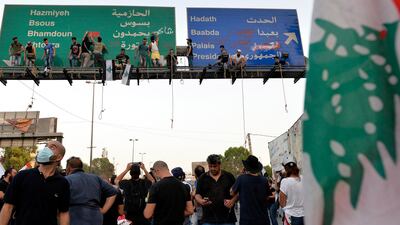
nti-government protesters write on a road sign as they hang mock gallows symbol to execute Lebanese politicians during a protest on the road leading to the Presidential palace in Baabda, east Beirut, Lebanon. EPA -
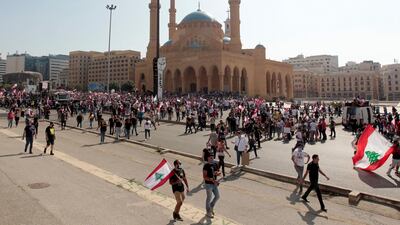
Demonstrators gather as they hold Lebanese flags during a protest against the government performance and worsening economic conditions, in Beirut, Lebanon. Reuters -
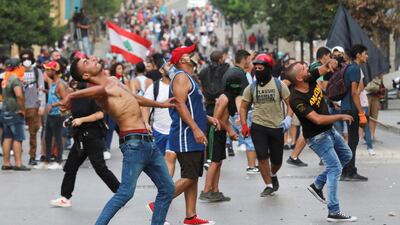
Demonstrators throw stones during anti-government protests in Beirut. A perfect storm of economic woes and political turmoil has given the country's well-educated, often multilingual, young people little hope of a viable future there. Reuters -
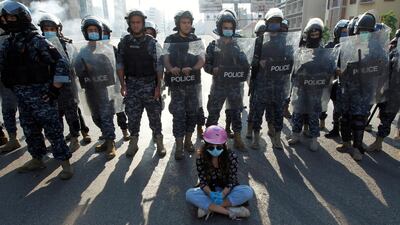
A demonstrator sits on the ground in front of Lebanese police officers during a protest against growing economic hardship in Beirut, Lebanon. Reuters -
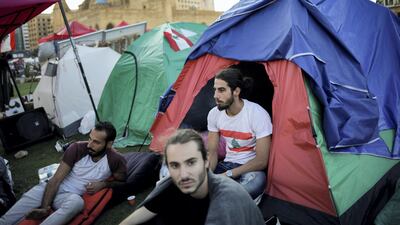
Protesters sit outside tents at Martyr's square in downtown Beirut in August. The Arab Youth Survey found 77 per cent of Lebanese 18 to 24-year-old's had considered or were actively trying to emigrate in hope of a better life. Reuters


They are part of repeated calls for change amid a deepening economic crisis.
People have raised their voices against corruption, fuel shortages, crumbling infrastructure and limited access to medical facilities.
Like thousands of Lebanese living overseas, Mr Prince will be checking updates on his phone and television.
“I’m going to be extremely worried because I know how things can go out of hand,” he said.
“I worry for my friends and family who are still on the ground in Beirut.”
His anxiety is mixed with pride for the spirit of his countrymen.
“It has been the fight of my life so far and I’m very proud of what we have done and to have been a part of this,” Mr Prince said.
“This is my biggest pride, to know that I’m part of a people that actually decided to sustain this fight.
“My heart is with every single person who will be on the street on October 17. It pains me very much not to be there and that stands for every Lebanese scattered around the world.”

