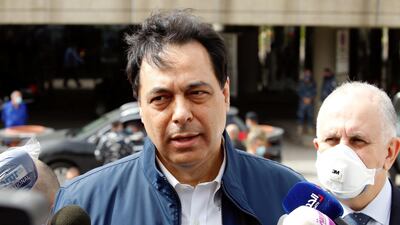
Lebanese Prime Minister Hassan Diab speaks to reporters outside Beirut's international airport on April 5, 2020 after it was shut down due to the coronavirus pandemic. Reuters

Lebanese Prime Minister Hassan Diab insists he will not resign


Sunniva Rose
  • English
  • Arabic

Lebanese Prime Minister Hassan Diab struck a defiant tone on Saturday, saying that he would “not resign” despite hitting a brick wall in negotiations for a bailout with the IMF as the country sinks deeper into its worst economic crisis.

“I will not resign,” Mr Diab, who has served as prime minister since January, told journalists after meeting Maronite Patriarch Bechara Rai.

Lebanese politicians, including two ministers affiliated with President Michel Aoun’s Free Patriotic Movement, have publicly discussed the possibility of the government’s resignation.

Government members questioned the “benefit of continuing in light of the lack of achievements”, Energy Minister Raymond Ghajar told a local radio station on July 4.

Others pushed for the return of former prime minister Saad Hariri, who stepped down on October 29 under the pressure of nationwide anti-government protests triggered by the economic crisis.

Mr Diab said that if he resigned, “an alternative would not be found easily. We will be a caretaker government for perhaps a year or two, and this is a crime against the country and against the Lebanese.”

Negotiations to form a government or appoint a president in Lebanon can take months or years as political parties must reach a consensus to maintain the country’s delicate sectarian balance.

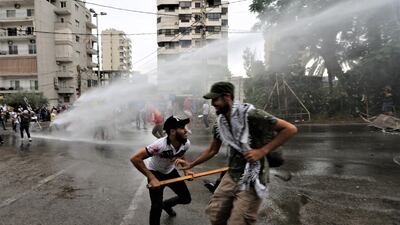
  • Protesters face water cannon from riot police during a demonstration organised by supporters of Hezbollah, Lebanese communist party, and other Lebanese national parties at the US embassy against US interference in Lebanon's affairs, in Awkar area north-east Beirut, Lebanon. EPA
    Protesters face water cannon from riot police during a demonstration organised by supporters of Hezbollah, Lebanese communist party, and other Lebanese national parties at the US embassy against US interference in Lebanon's affairs, in Awkar area north-east Beirut, Lebanon. EPA
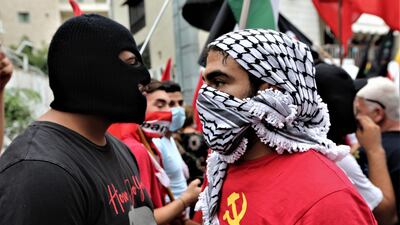
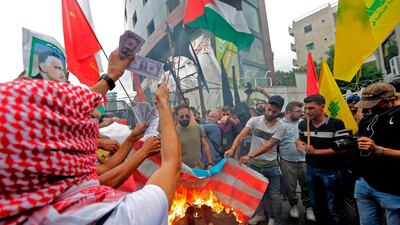
  • Protesters backed by Hezbollah, the Lebanese communist party and others during a demonstration against the United States' interference in Lebanon's affairs, near the US embassy in Awkar area, Beirut, Lebanon. EPA
    Protesters backed by Hezbollah, the Lebanese communist party and others during a demonstration against the United States' interference in Lebanon's affairs, near the US embassy in Awkar area, Beirut, Lebanon. EPA
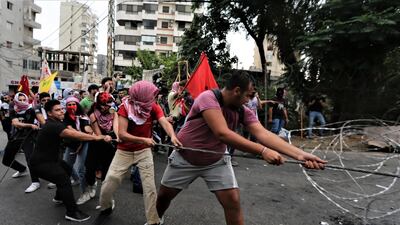
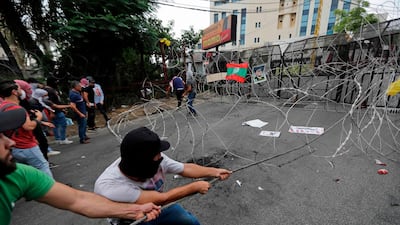
  • Protesters try to remove barbed wire during a demonstration by supporters of Hezbollah, Lebanese communist party, and other Lebanese national parties during a demonstration at the US embassy against US interference in Lebanon's affairs, in Awkar area north-east Beirut, Lebanon. EPA
    Protesters try to remove barbed wire during a demonstration by supporters of Hezbollah, Lebanese communist party, and other Lebanese national parties during a demonstration at the US embassy against US interference in Lebanon's affairs, in Awkar area north-east Beirut, Lebanon. EPA
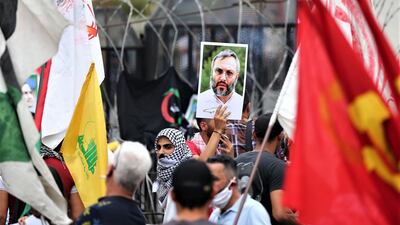
  • Protesters carry a picture of Hezbollah commander Imad Moughnyeh during a demonstration by supporters of Hezbollah, Lebanese communist party, and other Lebanese national parties at the US embassy against US interference in Lebanon's affairs, in Awkar area northeast Beirut, Lebanon. EPA
    Protesters carry a picture of Hezbollah commander Imad Moughnyeh during a demonstration by supporters of Hezbollah, Lebanese communist party, and other Lebanese national parties at the US embassy against US interference in Lebanon's affairs, in Awkar area northeast Beirut, Lebanon. EPA
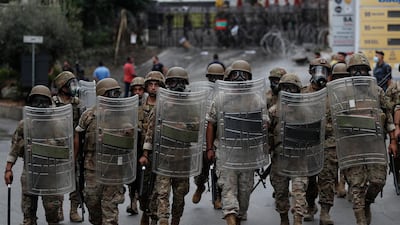
  • Lebanese army soldiers in riot gear arrive to the scene where supporters of Hezbollah and communist groups protest against US interference in Lebanon's affairs, near the American embassy, in Aukar north-east of Beirut, Lebanon. AP Photo
    Lebanese army soldiers in riot gear arrive to the scene where supporters of Hezbollah and communist groups protest against US interference in Lebanon's affairs, near the American embassy, in Aukar north-east of Beirut, Lebanon. AP Photo
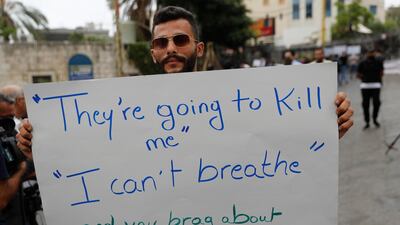
  • A Hezbollah supporter holds a placard during a protest against US interference in Lebanon's affairs, near the American embassy, in Aukar north-east of Beirut, Lebanon. AP Photo
    A Hezbollah supporter holds a placard during a protest against US interference in Lebanon's affairs, near the American embassy, in Aukar north-east of Beirut, Lebanon. AP Photo
  • Protesters pull barbed-wire fence off a street during an anti-US demonstration near the American embassy in Awkar, north-east Beirut. AFP
    Protesters pull barbed-wire fence off a street during an anti-US demonstration near the American embassy in Awkar, north-east Beirut. AFP
  • Protesters during an anti-US demonstration near the American embassy in Awkar, north-east of Lebanon's capital Beirut. AFP
    Protesters during an anti-US demonstration near the American embassy in Awkar, north-east of Lebanon's capital Beirut. AFP
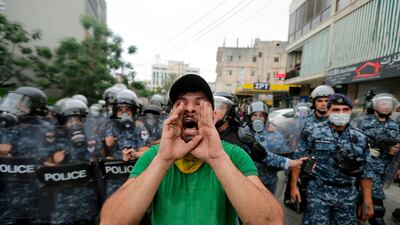
  • A protester chants slogans as he is flanked by Lebanese police during an anti-US demonstration outside the American embassy in Awkar, north-east of the capital Beirut. AFP
    A protester chants slogans as he is flanked by Lebanese police during an anti-US demonstration outside the American embassy in Awkar, north-east of the capital Beirut. AFP
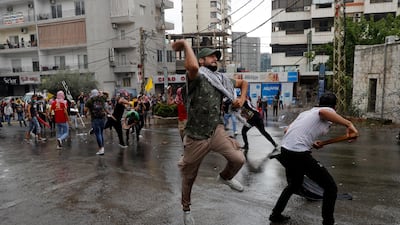
  • Hezbollah supporters and communist groups throw stones at riot police during a protest against US interference in Lebanon's affairs, near the American embassy in Aukar, north-east of Beirut, Lebanon. AP Photo
    Hezbollah supporters and communist groups throw stones at riot police during a protest against US interference in Lebanon's affairs, near the American embassy in Aukar, north-east of Beirut, Lebanon. AP Photo

Mr Diab formally requested IMF assistance in early May, after announcing that the country would default on its debt for the first time, but the negotiations on a bailout have not moved forward. The IMF has blamed the deadlock on the lack of a unified Lebanese position on the losses of the country’s banking sector.

Starting last summer, a cash crisis has pushed Lebanon, one of the world's most indebted countries, into the worst economic and financial crisis in its modern history. Half of the Lebanese population is now living in poverty and the value of the local currency has dropped by roughly 80 per cent.

Mr Diab’s statement came after increasing criticism from Mr Rai of the Shiite Muslim party Hezbollah, one of the government’s most influential backers and an ally of President Aoun.

In an interview with Vatican News on Thursday, the Maronite patriarch said Hezbollah “sidelines the state, and declares war and peace wherever it chooses. It helped precipitate war in Syria, Iraq and Yemen.”

Mr Rai said the United States, European Union and Arab Gulf countries would not help Lebanon because they did not want their financial aid to be used by Iran-backed Hezbollah.

“That’s why we’re paying the price,” he told Vatican News.

Earlier in the week, Mr Rai met Iranian Ambassador to Lebanon Mohammad-Jalal Firouznia, who said that his country “does not intervene in internal Lebanese affairs”.

On Saturday, the patriarch reiterated calls for Lebanon to remain “neutral”, in what has been widely interpreted by Lebanese media as a criticism of Hezbollah's military interventions in the region.

His calls have been well received by Mr Hariri and the Lebanese Forces, a Christian party, but was rejected by Shiite clerics in their sermons on Friday, local media reported.

Mr Diab dismissed claims that his government was controlled by Hezbollah, likening them to “a broken record”.

“The topic of neutrality is political and needs a deep political dialogue between all parties in Lebanon,” he said.


Ten tax points to be aware of in 2026

1. Domestic VAT refund amendments: request your refund within five years

If a business does not apply for the refund on time, they lose their credit.

2. E-invoicing in the UAE

Businesses should continue preparing for the implementation of e-invoicing in the UAE, with 2026 a preparation and transition period ahead of phased mandatory adoption. 

3. More tax audits

Tax authorities are increasingly using data already available across multiple filings to identify audit risks. 

4. More beneficial VAT and excise tax penalty regime

Tax disputes are expected to become more frequent and more structured, with clearer administrative objection and appeal processes. The UAE has adopted a new penalty regime for VAT and excise disputes, which now mirrors the penalty regime for corporate tax.

5. Greater emphasis on statutory audit

There is a greater need for the accuracy of financial statements. The International Financial Reporting Standards standards need to be strictly adhered to and, as a result, the quality of the audits will need to increase.

6. Further transfer pricing enforcement

Transfer pricing enforcement, which refers to the practice of establishing prices for internal transactions between related entities, is expected to broaden in scope. The UAE will shortly open the possibility to negotiate advance pricing agreements, or essentially rulings for transfer pricing purposes. 

7. Limited time periods for audits

Recent amendments also introduce a default five-year limitation period for tax audits and assessments, subject to specific statutory exceptions. While the standard audit and assessment period is five years, this may be extended to up to 15 years in cases involving fraud or tax evasion. 

8. Pillar 2 implementation 

Many multinational groups will begin to feel the practical effect of the Domestic Minimum Top-Up Tax (DMTT), the UAE's implementation of the OECD’s global minimum tax under Pillar 2. While the rules apply for financial years starting on or after January 1, 2025, it is 2026 that marks the transition to an operational phase.

9. Reduced compliance obligations for imported goods and services

Businesses that apply the reverse-charge mechanism for VAT purposes in the UAE may benefit from reduced compliance obligations. 

10. Substance and CbC reporting focus

Tax authorities are expected to continue strengthening the enforcement of economic substance and Country-by-Country (CbC) reporting frameworks. In the UAE, these regimes are increasingly being used as risk-assessment tools, providing tax authorities with a comprehensive view of multinational groups’ global footprints and enabling them to assess whether profits are aligned with real economic activity. 

Contributed by Thomas Vanhee and Hend Rashwan, Aurifer

Essentials

The flights
Etihad and Emirates fly direct from the UAE to Delhi from about Dh950 return including taxes.
The hotels
Double rooms at Tijara Fort-Palace cost from 6,670 rupees (Dh377), including breakfast.
Doubles at Fort Bishangarh cost from 29,030 rupees (Dh1,641), including breakfast. Doubles at Narendra Bhawan cost from 15,360 rupees (Dh869). Doubles at Chanoud Garh cost from 19,840 rupees (Dh1,122), full board. Doubles at Fort Begu cost from 10,000 rupees (Dh565), including breakfast.
The tours 
Amar Grover travelled with Wild Frontiers. A tailor-made, nine-day itinerary via New Delhi, with one night in Tijara and two nights in each of the remaining properties, including car/driver, costs from £1,445 (Dh6,968) per person.

RACE CARD

6.30pm: Maiden (TB) Dh82,500 (Dirt) 1,200m

7.05pm: Maiden (TB) Dh82,500 (D) 1,900m

7.40pm: Handicap (TB) Dh102,500 (D) 2,000m

8.15pm: Conditions (TB) Dh120,000 (D) 1,600m

8.50pm: Handicap (TB) Dh95,000 (D) 1,600m

9.25pm: Handicap (TB) Dh87,500 (D) 1,400m

Who's who in Yemen conflict

Houthis: Iran-backed rebels who occupy Sanaa and run unrecognised government

Yemeni government: Exiled government in Aden led by eight-member Presidential Leadership Council

Southern Transitional Council: Faction in Yemeni government that seeks autonomy for the south

Habrish 'rebels': Tribal-backed forces feuding with STC over control of oil in government territory

APPLE IPAD MINI (A17 PRO)

Display: 21cm Liquid Retina Display, 2266 x 1488, 326ppi, 500 nits

Chip: Apple A17 Pro, 6-core CPU, 5-core GPU, 16-core Neural Engine

Storage: 128/256/512GB

Main camera: 12MP wide, f/1.8, digital zoom up to 5x, Smart HDR 4

Front camera: 12MP ultra-wide, f/2.4, Smart HDR 4, full-HD @ 25/30/60fps

Biometrics: Touch ID, Face ID

Colours: Blue, purple, space grey, starlight

In the box: iPad mini, USB-C cable, 20W USB-C power adapter

Price: From Dh2,099

What is the FNC?

The Federal National Council is one of five federal authorities established by the UAE constitution. It held its first session on December 2, 1972, a year to the day after Federation.
It has 40 members, eight of whom are women. The members represent the UAE population through each of the emirates. Abu Dhabi and Dubai have eight members each, Sharjah and Ras al Khaimah six, and Ajman, Fujairah and Umm Al Quwain have four.
They bring Emirati issues to the council for debate and put those concerns to ministers summoned for questioning. 
The FNC’s main functions include passing, amending or rejecting federal draft laws, discussing international treaties and agreements, and offering recommendations on general subjects raised during sessions.
Federal draft laws must first pass through the FNC for recommendations when members can amend the laws to suit the needs of citizens. The draft laws are then forwarded to the Cabinet for consideration and approval. 
Since 2006, half of the members have been elected by UAE citizens to serve four-year terms and the other half are appointed by the Ruler’s Courts of the seven emirates.
In the 2015 elections, 78 of the 252 candidates were women. Women also represented 48 per cent of all voters and 67 per cent of the voters were under the age of 40.
 

TRAP

Starring: Josh Hartnett, Saleka Shyamalan, Ariel Donaghue

Director: M Night Shyamalan

Rating: 3/5

The low down on MPS

What is myofascial pain syndrome?

Myofascial pain syndrome refers to pain and inflammation in the body’s soft tissue. MPS is a chronic condition that affects the fascia (­connective tissue that covers the muscles, which develops knots, also known as trigger points).

What are trigger points?

Trigger points are irritable knots in the soft ­tissue that covers muscle tissue. Through injury or overuse, muscle fibres contract as a reactive and protective measure, creating tension in the form of hard and, palpable nodules. Overuse and ­sustained posture are the main culprits in developing ­trigger points.

What is myofascial or trigger-point release?

Releasing these nodules requires a hands-on technique that involves applying gentle ­sustained pressure to release muscular shortness and tightness. This eliminates restrictions in ­connective tissue in orderto restore motion and alleviate pain. ­Therapy balls have proven effective at causing enough commotion in the tissue, prompting the release of these hard knots.

Auron Mein Kahan Dum Tha

Starring: Ajay Devgn, Tabu, Shantanu Maheshwari, Jimmy Shergill, Saiee Manjrekar

Director: Neeraj Pandey

Rating: 2.5/5

RESULTS

6.30pm Al Maktoum Challenge Round-1 Group One (PA) US$65,000 (Dirt) 1,600m

Winner RB Money To Burn, Fabrice Veron (jockey), Eric Lemartinel (trainer).

7.05pm Handicap (TB) $175,000 (Turf) 1,200m

Winner Ekhtiyaar, Jim Crowley, Doug Watson.

7.40pm UAE 2000 Guineas Trial Conditions (TB) $100,000 (D) 1,600m

Winner Commanding, Richard Mullen, Satish Seemar.

8.15pm Singspiel Stakes Group Two (TB) $250,000 (T) 1,800m

Winner Benbatl, Christophe Soumillon, Saeed bin Suroor.

8.50pm Handicap (TB) $135,000 (T) 1,600m

Winner Zakouski, William Buick, Charlie Appleby.

9.25pm Al Maktoum Challenge Round-1 Group Two (TB) $350,000 (D) 1,600m

Winner Kimbear, Pat Dobbs, Doug Watson.

10pm Dubai Trophy Conditions (TB) $100,000 (T) 1,200m

Winner Platinum Star, Christophe Soumillon, Saeed bin Suroor.

10.35pm Handicap (TB) $135,000 (T) 1,600m

Winner Key Victory, James Doyle, Charlie Appleby.

Name: Peter Dicce

Title: Assistant dean of students and director of athletics

Favourite sport: soccer

Favourite team: Bayern Munich

Favourite player: Franz Beckenbauer

Favourite activity in Abu Dhabi: scuba diving in the Northern Emirates 


UAE v Gibraltar

What: International friendly

When: 7pm kick off

Where: Rugby Park, Dubai Sports City

Admission: Free

Online: The match will be broadcast live on Dubai Exiles’ Facebook page

UAE squad: Lucas Waddington (Dubai Exiles), Gio Fourie (Exiles), Craig Nutt (Abu Dhabi Harlequins), Phil Brady (Harlequins), Daniel Perry (Dubai Hurricanes), Esekaia Dranibota (Harlequins), Matt Mills (Exiles), Jaen Botes (Exiles), Kristian Stinson (Exiles), Murray Reason (Abu Dhabi Saracens), Dave Knight (Hurricanes), Ross Samson (Jebel Ali Dragons), DuRandt Gerber (Exiles), Saki Naisau (Dragons), Andrew Powell (Hurricanes), Emosi Vacanau (Harlequins), Niko Volavola (Dragons), Matt Richards (Dragons), Luke Stevenson (Harlequins), Josh Ives (Dubai Sports City Eagles), Sean Stevens (Saracens), Thinus Steyn (Exiles)