
As lower oil prices and a coronavirus-driven downturn batter Iraq's economy, availability of safe water is eroding and could fuel greater tensions, security experts warned on Wednesday.
Hospitalisations due to worsening contamination from sewage, agricultural runoff and chemical dumping are high, especially in southern Iraq, and families now reliant on bottled water may struggle to afford it as incomes dive, they said.
"There are layers and layers and layers of problems," said Azzam Alwash, founder of Nature Iraq, an environmental organisation that has helped restore drained marshes in southern Iraq, during an online event.
The conflict-riven country has seen its water infrastructure degrade over decades both from neglect and war damage, said Tobias von Lossow, a water security expert at the Clingendael Institute, a Dutch international relations think-tank.
-
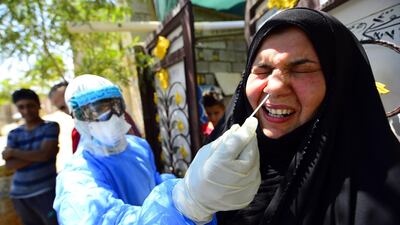
An Iraqi medic takes a nasal swab from a woman in Iraq's central shrine city of Najaf, during the nationwide lockdown to stem the spread of the novel coronavirus. AFP -

An Iraqi man reads the Koran in an almost empty mosque, following the outbreak of the coronavirus disease (COVID-19), during the holy month of Ramadan in the holy city of Najaf, Iraq. REUTERS -

A street at Karada district in central Baghdad, Iraq. The Iraqi authorities announced that coronavirus curfew will be lifted partially in all Iraq during the holy month of Ramadan. EPA -

A nurse wearing protective suit and face mask sprays a girl who was infected with the coronavirus disease (COVID-19) and has recovered, with sterile water, in quarantine ward, at a hospital in the holy city of Najaf, Iraq. REUTERS -
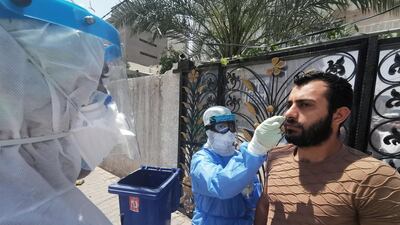
A member of a medical team that works with mobile coronavirus disease (COVID-19) testing units wears protective gear as he takes a swab from a person to track new cases of COVID-19, in Najaf, Iraq. REUTERS -
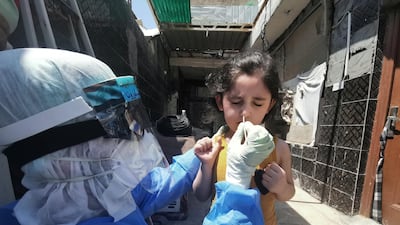
A member of a medical team that works with mobile coronavirus disease (COVID-19) testing units wears protective gear as he takes a swab from a child to track new cases of COVID-19, in Najaf, Iraq. REUTERS -
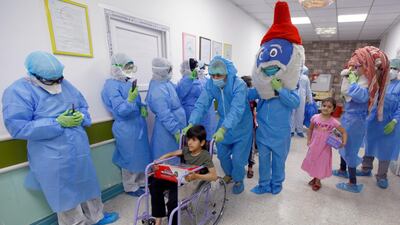
Nurses and volunteers wearing protective suits and face masks are seen, as puppets perform to entertain children who were infected with the coronavirus disease (COVID-19) and have recovered in a quarantine ward, at a hospital in the holy city of Najaf, Iraq. REUTERS -

Chinese embassy officials attend the arrival of medical aid at Baghdad Airport in Iraq. Medical aid from the People's Republic of China arrived in Baghdad on Monday to help Iraq curb the spread of the coronavirus. AP -

An Iraqi medic takes the temperature of a woman in Iraq's central shrine city of Najaf, during the nationwide lockdown to stem the spread of the novel coronavirus. AFP -
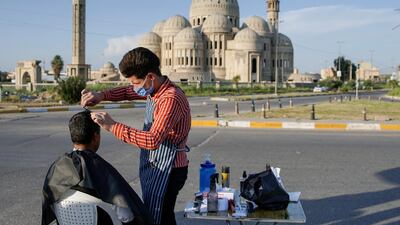
A barber wearing a protective face mask cuts the hair of a policeman, following the outbreak of the coronavirus disease (COVID-19), near the old bridge in the old city of Mosul, Iraq. REUTERS -
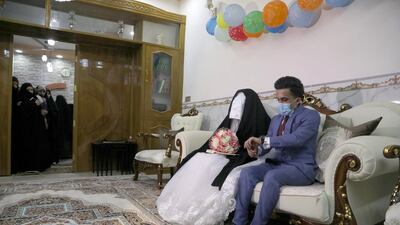
An Iraqi couple is seen at their wedding during a curfew imposed to prevent the spread of coronavirus disease (COVID-19), in the holy city of Kerbala, Iraq. REUTERS -
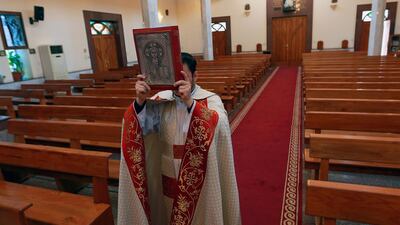
Priest Martin Beni takes part in a Holy Friday ceremony, the Deposition of Christ, held during a curfew to help fight the spread of the coronavirus in almost empty Our Lady of Salvation Church in Baghdad, Iraq. AP -
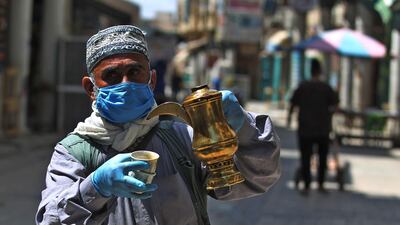
An Iraqi man sells coffee in the capital Baghdad's now deserted al-Mutanabbi street known for its book sellers, during the novel coronavirus pandemic crisis that urged authorities to shut down social gathering places in a bid to slow its spread among the population. AFP -
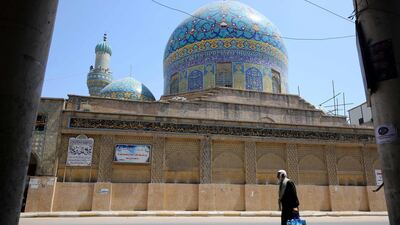
An Iraqi man walks past the closed Haydar-Khana mosque in the capital Baghdad, during the novel coronavirus pandemic crisis that urged authorities to shut down social gathering places in a bid to slow its spread among the population. AFP -
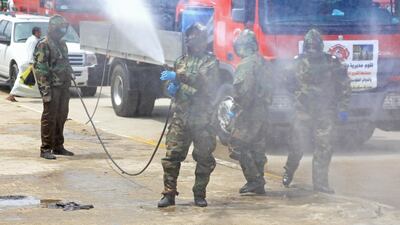
Iraqi civil defence workers sanitise the Tweirij district between Hilla and the southern Iraqi shrine city of Karbala against the spread of the coronavirus pandemic,. According to the last toll published this week by Iraq's health ministry there have been so far 1,378 COVID-19 confirmed cases of coronavirus in the country, of which 78 have die. Iraq has imposed a country-wide curfew since March 17, closed schools and shops and banned all international travel as well as movement between the country's provinces. AFP -
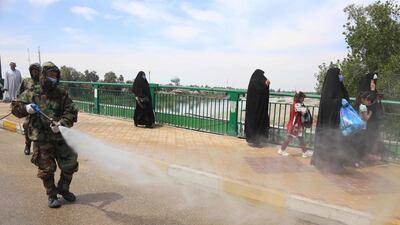
Iraqi civil defence workers sanitise the Tweirij district between Hilla and the southern Iraqi shrine city of Karbala against the spread of the coronavirus pandemic. According to the last toll published this week by Iraq's health ministry there have been so far 1,378 COVID-19 confirmed cases of coronavirus in the country, of which 78 have died. Iraq has imposed a country-wide curfew since March 17, closed schools and shops and banned all international travel as well as movement between the country's provinces. AFP


Construction of new dams over the decades in upstream Turkey, Syria and Iran has choked off some of the flow of the Tigris and Euphrates rivers the country depends on, he said.
Now climate change is making temperatures hotter and rainfall more erratic, adding to fears of water shortages, he added, even as the Covid-19 pandemic slows efforts to deal with the threats and saps the country's financial resources.
Low oil prices, in particular, are "a financial existential threat for Iraq", Mr von Lossow said, with the country facing predictions its economy could decline 9-10 per cent this year.
Khaled Sulaiman, a Kurdish journalist who published a book earlier this year on water issues in Iraq, said he believed growing water shortages could further destabilise the country, which is "facing a serious crisis with water".
Shortages are already driving many Iraqi villagers into larger cities "because there's not any way to survive" as water supplies dry up, he added.
Some communities are battling Covid-19 and water-borne diseases at the same time, he said, even as water is wasted in inefficient irrigation projects or grabbed by the well-connected.
"All this could put Iraq on the edge," he warned, especially with its population predicted to double by 2080.
Maha Yassin, an Iraqi-born outreach officer for the Planetary Security Initiative, a group of think-tanks working on security issues, said frustration was growing among the country's youth over a lack of basic services.
Young people "just want to have tap water in their house, some air-conditioning ... during summertime," said Ms Yassin, who was born in Basra where the average summer high is 45 degrees Celsius.
Families in the region are in some cases already spending US$56 a month on bottled or filtered water, but as people lose jobs in the downturn, securing sufficient water is likely to become even more difficult, she warned.
Mr Alwash said addressing Iraq's growing water shortages remains a huge challenge as political upheaval, disputes with neighbouring states and a resurgence of extremist group ISIS soak up attention and resources.
"We are a war theatre and Iraqis are the victims," he said. "Until there is stability in our region, none of our problems are really going to be resolved."
After years of talking about those problems, "it seems to me everything is getting worse and worse", he said.
He called for efforts to help Iraqis understand the gravity of looming water shortages, to create a groundswell of support for action. "What's needed is political will," he said.
"It's about people understanding the problem is right around the corner, and if we don't address it now, it's too late."

