

Iraq’s Joint Operations Command has denied a claim by a member of its security and defence committee that France, Germany and Australia asked Baghdad to prepare for their forces to leave.
The office of Badr Al Ziyadi told The National on Monday that Paris, Berlin and Canberra had officially submitted a letter to set a timetable for the exit of their troops.
“Their request has been to set up a timetable for the withdrawal of their troops. The next government will take the responsibility of setting the timetable and the exit strategy for foreign troops.”
But Major General Tahsin Al Khafaji, the spokesperson of the Joint Operations Command, denied that the three nations had submitted any such request.
When contacted again by The National, Mr Al Ziyadi's office said the request was only made verbally by commanders from the three countries to the Iraqi Joint Operations Command, and not communicated by letter.
France denied the claim that it had sent a request to Iraq to announce a schedule for withdrawing their troops from the country.
"It is a baseless rumour," a foreign ministry spokesperson told The National.
Germany's defence ministry spokesperson Christina Routsi denied any suggestion that Germany many be on the brink of withdrawal from Iraq.
"We are carrying out training in Erbil as normal. A few days ago we had people on the ground in Taji to explore how the security situation has changed there."
Ms Routsi said that "we will of course, as usual, first inform Parliament and then the public," in the case of a troop withdrawal. "You can assume that the safety of our women and men on site is always the most important thing for us," she said.
There was no immediate comment about the verbal request from Canberra, and any proposed timetable for the withdrawal remains unclear.
Mr Al Ziyadi is a member of parliament from the Sairoon bloc headed by the populist cleric Moqtada Al Sadr.
Mr Al Sadr's Mahdi army fought American and British forces in Baghdad and the city of Najaf following the US-led invasion in 2003. Last month, his supporters staged a march in Baghdad to demand that US troops leave Iraq along with other foreign forces. They also want Iraq’s security agreements with the US to be cancelled, and the closure of Iraqi airspace to American military and surveillance aircraft.
Germany has a training mission in Iraq and its Defence Minister Annegret Kramp-Karrenbauer made a surprise visit to Baghdad on January 15 to meet Iraqi military chiefs amid uncertainty over Berlin’s military presence in the country.
Questions about the presence of foreign troops in Iraq comes at a time of heightened tensions between the US and Iran following the assassination of Qassem Suleimani, the head of Iran’s elite Quds Force, in a US drone strike at Baghdad International Airport last month.
The killing prompted mass protests in Iran and revenge attacks against US bases in Iraq.
-
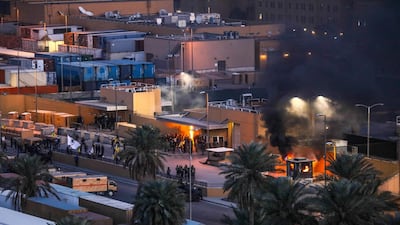
Protesters set fire to an entry control point at the US embassy in Baghdad, Iraq. Reuters -
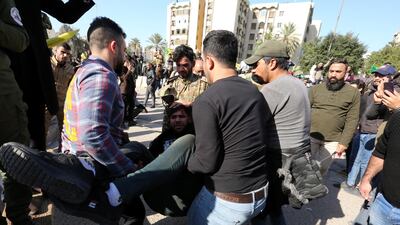
Members of Iraqi Popular Mobilisation Forces and their supporters help their comrade who was wounded during their attempt to attack the US embassy in Baghdad. EPA -
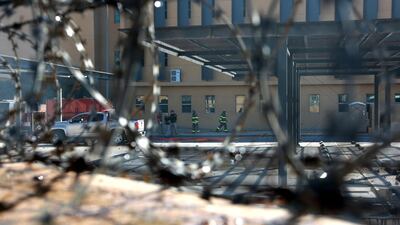
US embassy staff and guards are seen through the barbed wire fence as members of the Popular Mobilisation Forces and their supporters attack the entrance of the US embassy in Baghdad. EPA -
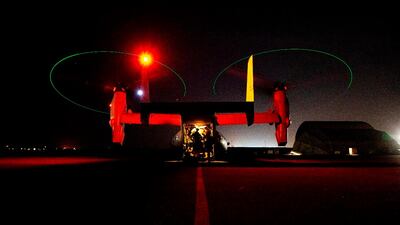
A US Army Apache helicopter from 1st Battalion, 227th Aviation Regiment, 34th Combat Aviation Brigade, prepares to conduct overflights of the US embassy in Baghdad. AP -

A US soldier mans an observation post at Forward Operating Base Union III in Baghdad. Reuters -

US soldiers man a defensive position at Forward Operating Base Union III in Baghdad. Reuters -

US Apache helicopters launch flares as they conduct overflights of the US embassy in Baghdad. Reuters -

US Marines arrive from an Osprey transport aircraft at the US embassy in Baghdad. Reuters -
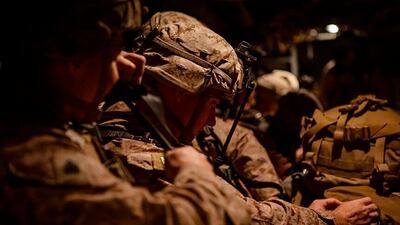
US Marines prepare to fly into Iraq from Kuwait in support of a crisis response mission. AP -

Members of the Popular Mobilisation Forces and their supporters attack the entrance of the US embassy in Baghdad. EPA -

Members of the Iraqi Popular Mobilisation Forces, which is comprised of some Iran-backed militias, and their supporters throw stones as they attack the US embassy during a protest in Baghdad. EPA


Suleimani is believed to have ordered the brutal crackdown on mass protests in Baghdad and southern cities that threatened the rule of the government.
The Iraqi parliament voted last month to call for the withdrawal of US forces from the country. Germany said it would reduce its troop numbers in Iraq for security reasons following the death of Suleimani. Canada said it would move some of its 500 troops in Iraq to Kuwait.
The US sent a letter to the Iraqi military joint operations command last month concerning a possible withdrawal of its troops from the country, but it did not state that all of its troops would be immediately withdrawn.

