
Iran's economy is poised to shrink by as much as 20 per cent in the coming weeks, which will force more, deeper cuts to Tehran's defence spending.
Under the pressures of the coronavirus outbreak, falling oil prices and US sanctions on Tehran, 10 to 20 per cent of Iran’s GDP could be wiped out in the coming months, a conference hosted by the International Institute for Strategic Studies heard on Thursday.
Every sector of the Iranian economy is under pressure because of Covid-19, the online conference was told.
And despite Tehran's “very lean system of defence” and spending increases after the assassination of general Qassem Suleimani in Iraq in January, cuts would continue.
The pressure could drive Iran back to the negotiating table with western powers, experts said.
But it would largely depend on how the US addressed the possibility of rapprochement with Tehran.
-

An employee wearing protective gear disinfects a shopping mall as a preventive measure against the coronavirus in Caxias do Sul, Brazil. AFP -
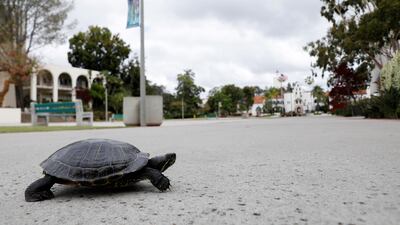
A turtle makes its way across the empty campus of San Diego State University, California, US. Reuters -

A medical worker prepares to test a man for the coronavirus in Wuhan, in China’s central Hubei province. AFP -

Members of a sanitising crew clean the hemicycle ahead to plenary session of the European Parliament in Brussels. AFP -

People wearing a face mask walk past a mural by Art Flase depicting St Gennaro, Patron of Naples, with a face mask, in downtown Naples. AFP -

Russian serviceman of the Russian National Guard detains a man in front of a supermarket in Moscow. To avoid an escalation in the number of infections, the city authorities have made it mandatory to wear gloves and a mask on public transport, shops and other pubic places, or pay a fine of 5,000 rubles. AFP -

MoveOn.org stages a protest against the handling of the coronavirus pandemic by US President Donald Trump near the US Capitol in Washington, DC. AFP -

A person walks inside the Southwest Airlines waiting area at Dallas Love Field Airport in Dallas, Texas, US. EPA -

Employees of Rome's Municipal Environment Company (AMA), wearing protective overall and mask, sanitize the Santuario della Madonna del Divino Amore church in the southern Castel di Leva district of Rome. AFP -

An employee wearing protective gear disinfects a shopping mall as a preventive measure against the coronavirus in Caxias do Sul, Brazil. AFP -

Brazil's President Jair Bolsonaro adjusts his mask as he leaves Alvorada Palace, amid the coronavirus disease outbreak in Brasilia, Brazil. Reuters -

Nursing home workers and residents release balloons in the air as a tribute to the residents who passed away and to celebrate that they have remained the coronavirus disease free for over two weeks at the nursing home Centro Casaverde in Navalcarnero, outside Madrid, Spain. Reuters -

A woman and child wearing masks to help protect against the coronavirus stand out on the streets of Beijing. AP Photo


Despite the squeeze, Iran would be expected to keep spending on areas “key to survival”, including its network of regional proxies and ballistic missile and nuclear programmes.
These elements are considered by leadership in Iran to be bargaining chips in future negotiations with the US.
Proxies such as Hezbollah in Lebanon, the Popular Mobilisation Forces in Iraq or the Houthis in Yemen were considered likely to retain much of their funding.
Iran’s oil exports have sunk to a record low as the coronavirus crisis compounds the effect of US sanctions limiting shipments.
Iran has been hit harder than any other nation in the Middle East by the pandemic.
The country has recorded almost 115,000 cases of Covid-19 and 6,854 deaths during the outbreak, although the figures are believed to be much higher.
The US on Wednesday publicly threatened to trigger a return of all UN sanctions if the Security Council did not extend an arms embargo on Tehran that is due to expire in October under the nuclear deal between Iran and world powers.
Tehran was given sanctions relief under the 2015 deal with the US, Russia, China, Germany, Britain and France that stops it developing nuclear weapons.
The deal allowed for a return of sanctions if Iran breached the deal.
In 2018, US President Donald Trump withdrew Washington from the deal.
The US drone strike in January that killed Suleimani took tension to a new peak.
In retaliation, Tehran launched a ballistic missile attack aimed at American soldiers stationed in Iraq.
Iran has repeatedly broken central limits of the deal, including on its stock of enriched uranium, in response to the US withdrawal and reimposition of sanctions.
Britain, France and Germany are trying to save the deal but have made little progress.

