
Fireworks were stored in the same hangar as the 2,750 tonnes of ammonium nitrate that caused the huge explosion and destruction in Beirut, two former port employees told The National.
The workers said the warehouse was one of Beirut port’s most closely guarded areas.
One, Yusuf Shehadi, said warnings of the dangers posed by the warehouse stock were frequently made by his colleagues and other bureaucrats.
But repeated pleas for action were caught up in infighting among bureaucracies, or vetoed by higher powers, pointing to negligence as the cause of the August 4 blast that killed at least 163 people and injured more than 6,000.
Fireworks were seen exploding in video footage captured seconds before the second explosion.
Their claims raise further questions about how the fireworks came to be there, why they were stored so close to the explosive material, and why they remained there for years until disaster hit.
The Lebanese elite’s perceived negligence and response to the disaster eventually brought down the government of Prime Minister Hassan Diab on Monday, as he announced his Cabinet had resigned.
As the government on Monday asked Lebanon's highest judicial authority to investigate the case, the focus shifted to what was responsible for the blast.
The ammonium nitrate was stored at Hangar 12 after Customs officials confiscated the chemical load from the Russian-owned Rhosus vessel in 2013.
It was lying in storage for years on the edge of a city of 2.4 million people.
But the investigation is now trying to ascertain how the explosion, which caused shockwaves equal to a 3.3-magnitude earthquake, came to be.
Suspicion has fallen on a maintenance team that was given the task of fixing a gate to Hangar 12 shortly before the explosion.
Mr Shehadi, who worked at the port from 2009 until March this year and now lives in Canada, said he had spoken with a former colleague that afternoon.
He said his old workmate told him a welder was being used to seal a hole in the area to stop material being stolen.
"Around 5pm, the fire started," he told The National. "They had fixed the door, put it back and afterwards the fire ignited, within 10 to 15 minutes."
The fire set off the fireworks, which ignited the ammonium nitrate and caused the blast, Mr Shehadi said.
Those who fixed the doors were the first to be blamed by the Lebanese authorities.
“The workers who were fixing the door are Syrian,” he claimed. “The Lebanese government arrested them.”

Mr Shehadi on Friday told British newspaper The Guardian that in his early months on the job, in late 2009 or early 2010, he had been asked to move fireworks and other goods confiscated by port authorities into Hangar 12.
He said that about four years later, he helped to move from the Moldovan-flagged Rhosus of 2,750 tonnes of material, which turned out to be the ammonium nitrate.
"When I was working at the port, in the maintenance department, the head of the department was Mustafa Farshoukh," he told The National.
A judicial source confirmed that authorities have arrested Mr Farshoukh, frozen his assets and prevented him from leaving the country.
“He took an order from Hassan Quraitem, the man in charge of the port, and we were told to empty the ship’s cargo.
"It took us four to five days to empty everything as it was carrying a lot of load. We placed everything in Hangar 12.”
Lebanese police have also placed Mr Quraitem under arrest and frozen his assets in relation to the disaster, a list of suspects released by prosecutors shows.
Mahmoud Ali, a second worker at the port whose name has been changed for security reasons, told The National that Hangar 12 was not in regular use.
He said it was kept as a place to store banned or dangerous material, or material that had been confiscated by the government.
His claim suggests knowledge of the explosive materials at the highest levels of government, specifically the justice ministry.
-
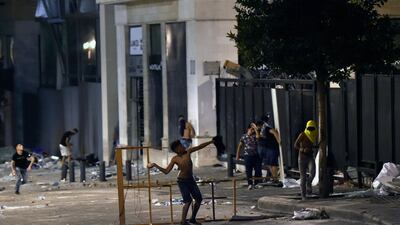
Anti-government protesters hurl stones at Lebanese riot police during a protest against the Lebanese politicians who have ruled the country for decades, outside of the Lebanese Parliament in downtown Beirut, Lebanon. EPA -
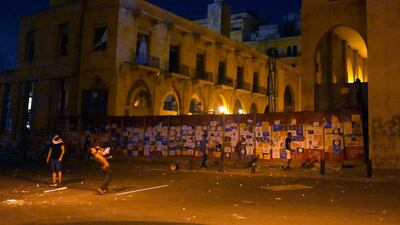
Anti-government protesters hurl stones at Lebanese riot police during a protest against the Lebanese politicians who have ruled the country for decades. EPA -
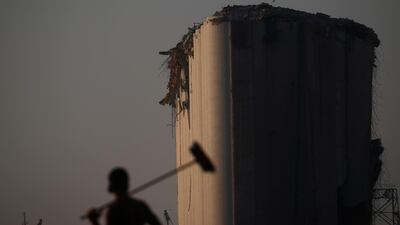
People view the damage at the site of Tuesday's blast in Beirut's port area, Lebanon. Reuters -
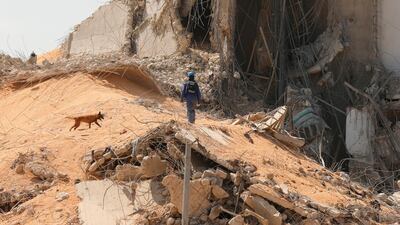
French rescue team member and a search and rescue dog walk near the damaged grain silo at the site of Tuesday's blast, at Beirut's port area, Lebanon. Reuters -
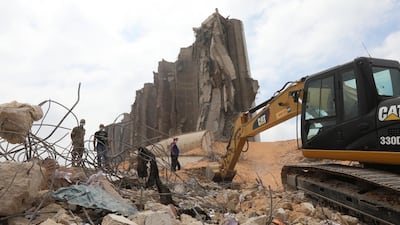
An excavator cleans debris near the damaged grain silo at the site of Tuesday's blast, at Beirut's port area, Lebanon. Reuters -
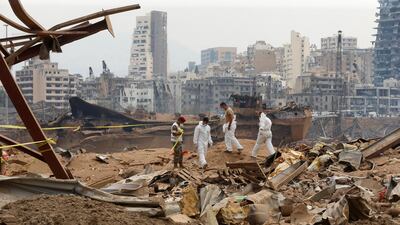
Members of forensic team walk near rubble at the site of Tuesday's blast, at Beirut's port area, Lebanon. Reuters -
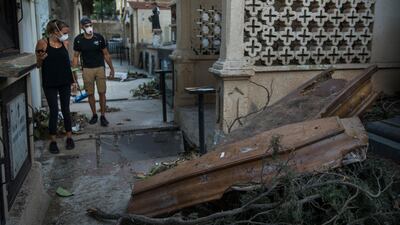
People observe two coffins, damaged by Tuesday's massive explosion that rocked the city, in Beirut, Lebanon. Getty Images -
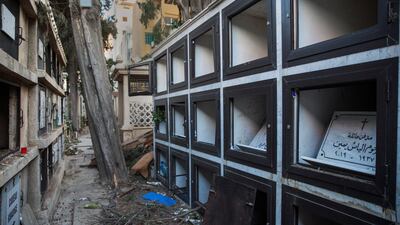
Structural damage, caused by Tuesday's massive explosion that rocked the city, is visible at St Michel Maronite Churchs cemetery in Beirut, Lebanon. Getty Images -

Lebanese army member stands at the site of Tuesday's blast, at Beirut's port area, Lebanon. Reuters -
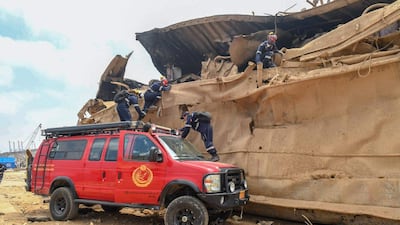
A handout picture obtained from Qatar's Internal Security Force, shows members of its search and rescue unit assisting their Lebanese counterparts in seeking survivors on the site of a massive blast at the Beirut port. AFP -

A handout picture obtained from Qatar's Internal Security Force shows members of its search and rescue unit assisting their Lebanese counterparts in seeking survivors on the site of a massive blast at the Beirut port. AFP -
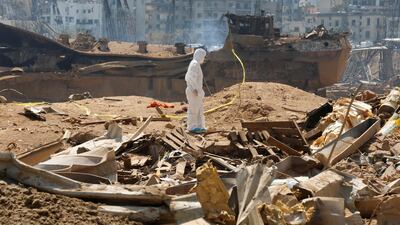
A forensic inspector walks on rubble at the site of Tuesday's blast, at Beirut's port area, Lebanon. Reuters -
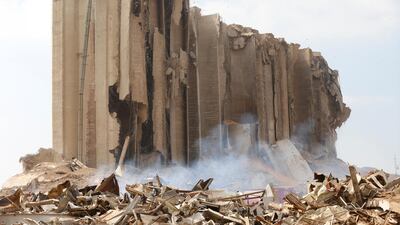
A view of rubble near the damaged grain silo at the site of Tuesday's blast, at Beirut's port area, Lebanon. Reuters -
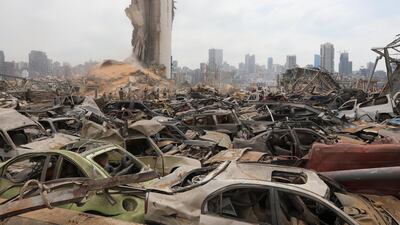
Damaged cars are seen at the site of Tuesday's blast, at Beirut's port area, Lebanon. Reuters -
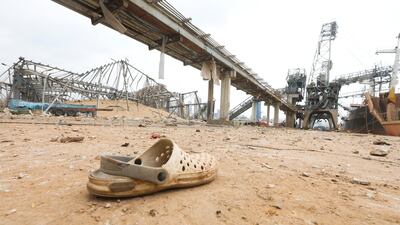
An abandoned shoe is seen at the site of Tuesday's blast, at Beirut's port area, Lebanon. Reuters


"[The warehouse] was constantly closed by locks. Nobody knew what was stacked inside," Mr Ali said.
"However, those in charge only used to open the warehouse to stack inside it materials confiscated upon judicial orders or perilous products such as firecrackers and explosive devices.
"I have been working in the port for over 20 years, during which I never heard there were any weapons or artillery inside.”
The highest authority at the port is Customs, and they hold a copy of keys for any of the port doors or ships, Mr Shehadi said.
Customs handed down the order to unload the firecrackers in 2009 and later the ammonium nitrate, to the head of operations of the port, in co-ordination with Mohammad Al Mawla, the head of administration there.
Lebanon’s head of Customs, Badri Daher has blamed Mr Al Mawla for allowing the shipment to enter the country.
State Prosecutor Ghassan Oueidat was not immediately available for comment when contacted by The National.
Establishing the chain of command in the port, one of Lebanon’s most sensitive strategic sites, is considered an important step in establishing responsibility for the catastrophe.
But uncovering the political decisions that led to the disaster is likely to prove far more difficult and is central to the demands of protesters.
With confidence low in the integrity of any local investigation, the public testimony of port workers and others with first-hand knowledge is likely to prove instructive in any broader investigation.
An international investigation into the disaster is being widely called for in Lebanon.
Protesters have fought running battles with riot police and soldiers around the Parliament building in central Beirut.
In a bid to placate the anger, four ministers – of information, finance, environment and justice – resigned before Mr Diab’s announcement.
Before his resignation, he said he would call early elections in two months.
That concession was widely seen as a placatory gesture designed to buy time as the country’s leaders face withering criticism and scrutiny over their role in the debacle at the port.
What comes next for Lebanon remains unclear as months of political wrangling and chaos could lie ahead.
But what is certain is that residents across Beirut have little faith in the authorities’ ability to hold senior officials to account for the devastation the explosion caused, or to harness and distribute aid for the recovery effort.
“They will not get away with it this time,” said Jumah Maahmoud, a shopkeeper in the Sodeco neighbourhood.
“If they did, how would we look? We as Lebanese have to start to seize our rights and our destiny.”
Bassam Zaazaa contributed reporting from Beirut.

