
The leaders of Britain, France and Germany have condemned recent attacks on coalition forces in Iraq and called for a de-escalation in the region, two days after the US killed Iran's most senior military general in an air strike in Baghdad.
French President Emmanuel Macron, German Chancellor Angela Merkel and British Prime Minister Boris Johnson spoke on Sunday amid heightened tension in the Gulf after the killing of Qassem Suleimani in a US rocket strike at Baghdad International Airport on Friday.
"We have condemned the recent attacks on coalitions forces in Iraq and are gravely concerned by the negative role Iran has played in the region, including through the IRGC and the Quds Force under the command of Suleimani," a joint statement from the three European countries said.
"There is now an urgent need for de-escalation. We call on all parties to exercise utmost restraint and responsibility. The current cycle of violence in Iraq must be stopped.
"We specifically call on Iran to refrain from further violent action or proliferation and urge Iran to reverse all measures inconsistent with the JCPOA (Joint Comprehensive Plan of Action)."
-
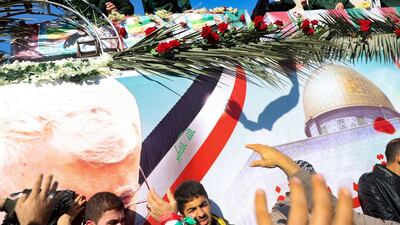
The coffins of Qassem Suleimani and Abu Mahdi Al Muhandis are transported atop a vehicle upon their arrival at Ahvaz International Airport in southwestern Iran. AFP -
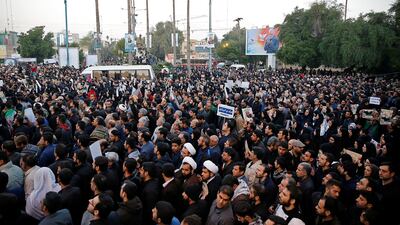
People attend a funeral procession for Iranian Major-General Qassem Suleimani, head of the elite Quds Force, and Iraqi militia commander Abu Mahdi Al Muhandis, who were killed in an air strike at Baghdad airport, in Ahvaz, Iran. Reuters -
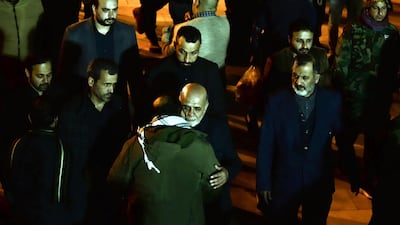
Iraj Masjedi (centre) Iran's ambassador to Iraq, receives condolences as the coffins of military commander Qassem Suleimani is carried toward the Imam Ali Shrine, in the shrine city of Najaf in central Iraq during a funeral procession. AFP -
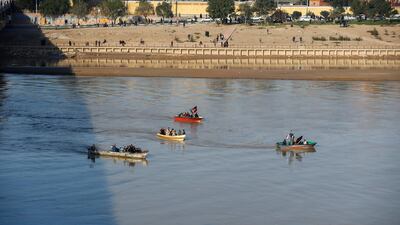
People in boats sail during a funeral procession for Qassem Suleimani, head of the elite Quds Force, and Iraqi militia commander Abu Mahdi Al Muhandis, who were killed in an air strike at Baghdad airport, in Ahvaz, Iran. Reuters -
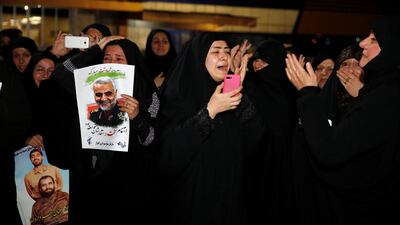
Iranian mourners react upon the arrival of bodies of the Iranian Major-General Qassem Suleimani, head of the elite Quds Force, and the Iraqi militia commander Abu Mahdi Al Muhandis, who were killed in an air strike at Baghdad airport, at Ahvaz international airport, in Ahvaz, Iran. Reuters -
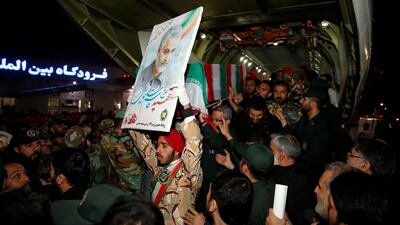
Iranian mourners carry the coffin of the Iranian Major-General Qassem Suleimani, head of the elite Quds Force, who was killed in an air strike at Baghdad airport, at Ahvaz international airport, in Ahvaz, Iran. Reuters -
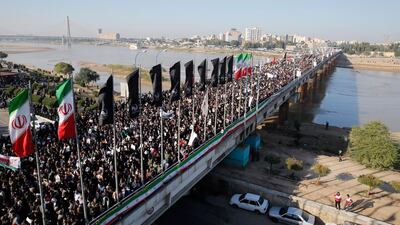
Iranians take part during the funeral ceremony of Qassem Suleimani in the city of Ahvaz southern Iran. EPA -
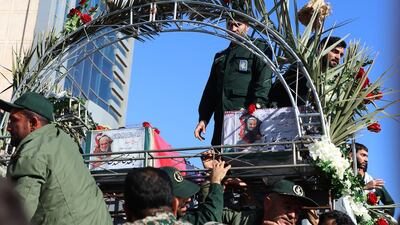
The coffins of Qassem Suleimani (right) and Abu Mahdi Al Muhandis are transported atop a vehicle upon their arrival at Ahvaz International Airport in southwestern Iran. AFP -
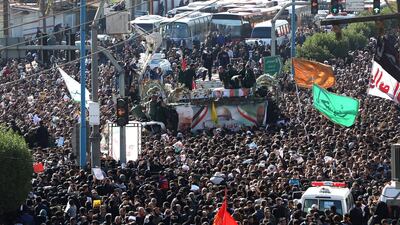
A large crowd surrounds the coffins of Qassem Suleimani and Abu Mahdi Al Muhandis as they are transported atop a vehicle after their arrival at Ahvaz International Airport in southwestern Iran. AFP -
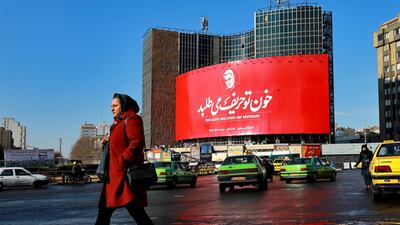
A woman crosses a street in front of a billboard showing a portrait of Qassem Suleimani, who was killed in a US airstrike early on Friday in Iraq, in Tehran, Iran. AP Photo


Earlier on Sunday, Iran said it planned to further roll back its commitments to the 2015 nuclear deal it signed with global powers, but claimed it intended to continue to co-operate with the UN nuclear watchdog, the IAEA.
On Sunday, Iran's state television cited a government statement as saying Iran would not respect any limits set out in the pact on the number of uranium enrichment centrifuges it could use.
This would mean there would be no limit on Iran’s enrichment capacity, the level to which uranium could be enriched, or its nuclear research and development. These limits would now be based on Iran's technical needs.
But the report said Tehran decision to roll back its commitments to the nuclear deal could be reversed if the US lifts its sanctions.
Iran has previously broken the terms of the 2015 deal. It said that was in response to renewed US sanctions on the country.
The US withdrew from the nuclear accord in 2018, but the other parties to the deal - Britain, France, Germany, China and Russia - have tried to preserve it.
But the recent attacks in Iraq have made relations fragile. The head of Tehran-backed Iraqi militia Kataib Hezbollah, Abu Mahdi Al Muhandis, was also killed in the strike that killed Suleimani, a move ordered by US President Donald Trump.
The Associated Press reported there were several air strikes that targeted Iraqi militias north of Baghdad on Friday. The US has denied responsibility for those attacks.
The deaths of Suleimani and Al Muhandis have brought tension between Tehran and Washington to new heights. Iran said it would respond to the US air strikes with “harsh revenge”.
Several rockets launched in Baghdad late on Saturday fell inside or near the Green Zone, which covers government offices and foreign offices including the US embassy.
About 5,000 US troops remain in Iraq, most in an advisory role. But on Sunday, Iraq’s parliament voted in favour of the expulsion of foreign troops from the country.
In their statement, the leaders of France, Germany and Britain issued a warning that another crisis in Iraq could jeopardise years of efforts to achieve stability in the country.
The three countries reaffirmed their commitment to the fight against ISIS, before urging the Iraqi authorities to continue providing coalition forces with support.
On Sunday, Mr Johnson said Suleimani had a destabilising effect on the Middle East but that threats of reprisals would only lead to more violence.
“Qassem Suleimani posed a threat to all our interests and was responsible for a pattern of disruptive, destabilising behaviour in the region,” Mr Johnson said.
“Given the leading role he has played in actions that have led to the deaths of thousands of innocent civilians and western personnel, we will not lament his death.
“It is clear, however, that all calls for retaliation or reprisals will simply lead to more violence in the region and they are in no one’s interest.”

