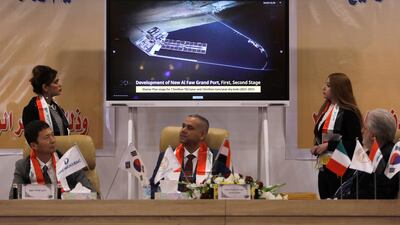
The signing of the construction contract for Iraq's Grand Al Faw Port on the Arabian Gulf improves prospects for residents in its southern province of Basra.
Building the port was one of the key demands of protests in Basra that were part of wider anti-government demonstrations that broke out in central and southern Iraq in October 2019.
“It’s a victory not only for Basra, but also for all Iraq,” said Sameer Rahim, an activist who has campaigned for reforms in his home province for years.
Under the $2.62 billion deal signed on Wednesday, South Korea’s Daewoo Engineering and Construction company will build the first phase of the giant port with a capacity to handle three million containers a year, the director general of Iraq’s state-run General Company for Ports, Farhan Al Fartousi, told Reuters.
This includes five berths in which to unload ships, a container yard, and dredging and drilling work to create an access navigation channel, Mr Al Fartousi said. Construction is scheduled to be completed in about four years.
The port has been planned since the latter half of the past century as a way for Iraq to diversify its oil-reliant economy.
Bypassing the Suez Canal with air, road and rail links passing through Turkey, it will make the country a trade corridor between the Middle East and Europe.
But it was only in 2009 that the Iraqi government started working on the feasibility study and design. Work began in earnest in 2012, when Daewoo started building the breakwaters for the port under a separate contract.
Mr Rahim told The National he had hoped the port construction would be awarded to China Machinery Engineering, which also entered a bid for the contract.
He said this was not only because the Chinese company offered deferred loan payments for building the port, but also because it would have accelerated Iraq’s entry to China’s Belt and Road Initiative.
“Oil will vanish sooner or later, but the port and the income from it will continue for years if we managed to join forces with China,” Mr Rahim said.
“Those who will win in the future are the partners of the Chinese dragon, not other countries, as it continues to emerge as a superpower with a strong economy.”
Iraq took steps to join the Belt and Road initiative – a global development strategy involving infrastructure development and investments in almost 70 countries in Asia, Africa and Europe.
In September 2019, Iraq reached a deal with Beijing to fund infrastructure and other projects by Chinese companies. The deal, known as Oil for Reconstruction, involved creating a fund with the revenue from Iraq’s sale of 100,000 barrels of oil a day to two Chinese companies, and loans from Chinese banks up to a limit to $10 billion.
The deal was delayed amid the social unrest and a political vacuum created by the protest movement that began the next month, compounded by the economic crisis caused by plummeting oil prices and the pandemic.
The political and security turmoil after the US-led 2003 invasion affected the plans for Al Faw. The first stage, to receive one million containers a year, was to have been completed by 2019, with capacity increasing gradually to 25 million containers by 2041.
Even the construction of the breakwaters was delayed by lack of funds and the suspension of work after the sudden death in October of a Daewoo executive working on the project.
Mr Rahim is happy that the project is at last moving ahead.
“At least we have some development on the ground that can give us some hope for the future,” he said.
According to the General Company for Ports, Al Faw will create as many as 100,000 jobs.
Basra is Iraq’s second-largest province and has at least 70 per cent of the country’s proven oil reserves of 153 billion barrels. Its location on the Gulf makes it Iraq’s only outlet to the sea and the route for most of its oil exports. But its residents have long complained that they do not get their fair share of revenues from the federal government in Baghdad.
Some residents, including Mr Rahim, are pushing for the creation of a self-ruled region like the Kurdish autonomous region in northern Iraq.
“The region is the only solution for Basra people and we will not give up,” he said.
“Today, we wait for Baghdad to issue decisions on almost everything that are not necessarily in our benefit; we want to take these decisions ourselves to better serve our city.”

DIVINE%20INTERVENTOIN
%3Cp%3EStarring%3A%20Elia%20Suleiman%2C%20Manal%20Khader%2C%20Amer%20Daher%3C%2Fp%3E%0A%3Cp%3EDirector%3A%20Elia%20Suleiman%3C%2Fp%3E%0A%3Cp%3ERating%3A%204.5%2F5%3C%2Fp%3E%0A
Avatar: Fire and Ash
Director: James Cameron
Starring: Sam Worthington, Sigourney Weaver, Zoe Saldana
Rating: 4.5/5
Jetour T1 specs
Engine: 2-litre turbocharged
Power: 254hp
Torque: 390Nm
Price: From Dh126,000
Available: Now
Disability on screen
Empire — neuromuscular disease myasthenia gravis; bipolar disorder; post-traumatic stress disorder (PTSD)
Rosewood and Transparent — heart issues
24: Legacy — PTSD;
Superstore and NCIS: New Orleans — wheelchair-bound
Taken and This Is Us — cancer
Trial & Error — cognitive disorder prosopagnosia (facial blindness and dyslexia)
Grey’s Anatomy — prosthetic leg
Scorpion — obsessive compulsive disorder and anxiety
Switched at Birth — deafness
One Mississippi, Wentworth and Transparent — double mastectomy
Dragons — double amputee
Company%20profile
%3Cp%3EName%3A%20Cashew%0D%3Cbr%3EStarted%3A%202020%0D%3Cbr%3EFounders%3A%20Ibtissam%20Ouassif%20and%20Ammar%20Afif%0D%3Cbr%3EBased%3A%20Dubai%2C%20UAE%0D%3Cbr%3EIndustry%3A%20FinTech%0D%3Cbr%3EFunding%20size%3A%20%2410m%0D%3Cbr%3EInvestors%3A%20Mashreq%2C%20others%0D%3C%2Fp%3E%0A
The%20specs
%3Cp%3E%3Cstrong%3EEngine%3A%20%3C%2Fstrong%3E2.0-litre%20turbocharged%204-cyl%0D%3Cbr%3E%3Cstrong%3ETransmission%3A%20%3C%2Fstrong%3E8-speed%20auto%0D%3Cbr%3E%3Cstrong%3EPower%3A%20%3C%2Fstrong%3E300bhp%20(GT)%20330bhp%20(Modena)%0D%3Cbr%3E%3Cstrong%3ETorque%3A%20%3C%2Fstrong%3E450Nm%0D%3Cbr%3E%3Cstrong%3EPrice%3A%20%3C%2Fstrong%3EDh299%2C000%20(GT)%2C%20Dh369%2C000%20(Modena)%3Cbr%3E%3Cstrong%3EOn%20sale%3A%20%3C%2Fstrong%3Enow%3C%2Fp%3E%0A
Mercer, the investment consulting arm of US services company Marsh & McLennan, expects its wealth division to at least double its assets under management (AUM) in the Middle East as wealth in the region continues to grow despite economic headwinds, a company official said.
Mercer Wealth, which globally has $160 billion in AUM, plans to boost its AUM in the region to $2-$3bn in the next 2-3 years from the present $1bn, said Yasir AbuShaban, a Dubai-based principal with Mercer Wealth.
“Within the next two to three years, we are looking at reaching $2 to $3 billion as a conservative estimate and we do see an opportunity to do so,” said Mr AbuShaban.
Mercer does not directly make investments, but allocates clients’ money they have discretion to, to professional asset managers. They also provide advice to clients.
“We have buying power. We can negotiate on their (client’s) behalf with asset managers to provide them lower fees than they otherwise would have to get on their own,” he added.
Mercer Wealth’s clients include sovereign wealth funds, family offices, and insurance companies among others.
From its office in Dubai, Mercer also looks after Africa, India and Turkey, where they also see opportunity for growth.
Wealth creation in Middle East and Africa (MEA) grew 8.5 per cent to $8.1 trillion last year from $7.5tn in 2015, higher than last year’s global average of 6 per cent and the second-highest growth in a region after Asia-Pacific which grew 9.9 per cent, according to consultancy Boston Consulting Group (BCG). In the region, where wealth grew just 1.9 per cent in 2015 compared with 2014, a pickup in oil prices has helped in wealth generation.
BCG is forecasting MEA wealth will rise to $12tn by 2021, growing at an annual average of 8 per cent.
Drivers of wealth generation in the region will be split evenly between new wealth creation and growth of performance of existing assets, according to BCG.
Another general trend in the region is clients’ looking for a comprehensive approach to investing, according to Mr AbuShaban.
“Institutional investors or some of the families are seeing a slowdown in the available capital they have to invest and in that sense they are looking at optimizing the way they manage their portfolios and making sure they are not investing haphazardly and different parts of their investment are working together,” said Mr AbuShaban.
Some clients also have a higher appetite for risk, given the low interest-rate environment that does not provide enough yield for some institutional investors. These clients are keen to invest in illiquid assets, such as private equity and infrastructure.
“What we have seen is a desire for higher returns in what has been a low-return environment specifically in various fixed income or bonds,” he said.
“In this environment, we have seen a de facto increase in the risk that clients are taking in things like illiquid investments, private equity investments, infrastructure and private debt, those kind of investments were higher illiquidity results in incrementally higher returns.”
The Abu Dhabi Investment Authority, one of the largest sovereign wealth funds, said in its 2016 report that has gradually increased its exposure in direct private equity and private credit transactions, mainly in Asian markets and especially in China and India. The authority’s private equity department focused on structured equities owing to “their defensive characteristics.”
More from Neighbourhood Watch:
The biog:
From: Wimbledon, London, UK
Education: Medical doctor
Hobbies: Travelling, meeting new people and cultures
Favourite animals: All of them
The specs: 2018 Nissan 370Z Nismo
Price, base / as tested: Dh182,178
Engine: 3.7-litre V6
Power: 350hp @ 7,400rpm
Torque: 374Nm @ 5,200rpm
Transmission: Seven-speed automatic
Fuel consumption, combined: 10.5L / 100km
