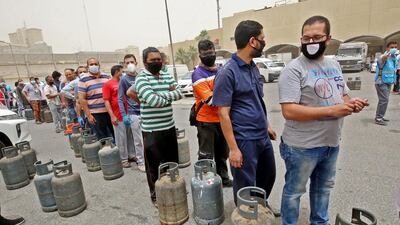
Kuwait recorded 1,000 new coronavirus cases in a day for the first time on Sunday, as nine patients died and the emir warned of an economic squeeze.
Authorities closed Kuwait's Co-op supermarkets after 40 per cent of the chain’s 260 employees tested positive for the coronavirus, local media said.
The infections at one of the country’s main retail outlets raised fears that large numbers of customers had been also infected.
That prompted authorities to impose a 24-hour lockdown from 4pm on Sunday until May 30.
All but essential businesses will remain closed and public sector services will be available only online.
The 1,065 new cases reported on Sunday raised the number of people infected in the country to 8,688, of whom 58 have died.
The Kuwaiti emir, Sheikh Sabah, said the coronavirus-related drops in oil price would affect the solvency of the state and the government must take steps to contain public spending.
In an address to the country on Saturday, Sheikh Sabah said Kuwait faced “a big and unprecedented challenge to preserve the safety and solidity of our national economy from the external shocks as a result of this contagion”.
He said the government should “work on a programme to streamline public expenditure” amid the drop in oil prices and and decrease in the value of assets and investments, which will harm Kuwait's financial solvency.
On oil, Sheikh Sabah called on the government to implement "plans to lessen dependence on one depleting resource so our sons and the next generations enjoy the dignified life.”
Saudi Arabia continued to report sharp increases in cases since it allowed businesses to reopen 10 days ago.
The Saudi Health Ministry announced 1,912 new cases on Sunday, bringing the official total to 39,048 people infected and 246 deaths.
Qatar also reported a big jump in infections, with 1,189 new cases raising the total past 22,000 on Sunday.
The Health Ministry said there was one death and 254 recoveries in the previous 24 hours, raising the death toll to 14 and the number of recoveries to 2,753.
Oman, where restrictions on movement have been relatively light, recorded 175 new cases, bringing the total to 3,399.
Bahrain reported 82 new infections on Sunday. Of the country's 4,856 cases so far, 2,783 are still under treatment, including two in intensive care, health officials said.
_______________
Coronavirus in the Middle East
-

Indian nationals check in at the Muscat International Airport before leaving the Omani capital on a flight to return to their country. AFP -

Indian citizens queue at Kuwait International Airport before boarding a repatriation flight to India, in Kuwait City. AFP -

A cat stands at Istanbul's old bazaar Tahtakale during curfew in Istanbul, Turkey. EPA -

Closed shops at Istanbul's old bazaar Tahtakale during curfew in Istanbul, Turkey. EPA -
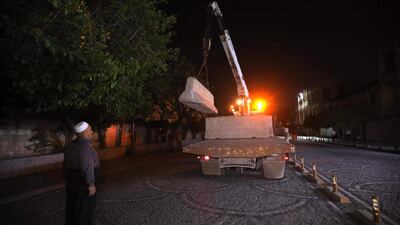
Arbil municipal workers prepare to remove concrete barriers previously placed around the citadel of Arbil, the capital of the autonomous Kurdish region of northern Iraq as authorities ease restrictions put in place for the COVID-19 coronavirus pandemic. AFP -
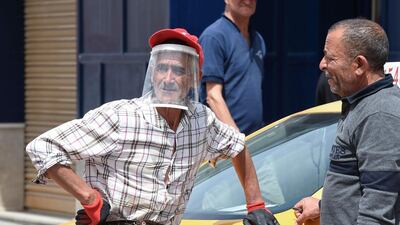
A Tunisian man wearing protective gear amid the COVID-19 pandemic looks on as he chats with another on a street in the Kram area of the capital Tunis, as authorities begin a gradual sector and region-based process to mitigate lockdown measures. AFP -

Hamra street is empty during the curfew imposed by the government to fight the spread of the COVID-19 coronavirus, in Beirut, Lebanon. EPA -
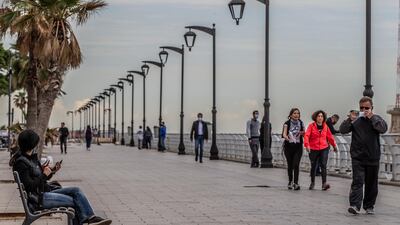
Citizens walk on the seafront on the Mediterranean coast during the curfew imposed by the government to fight the spread of the COVID-19 coronavirus, in Beirut, Lebanon. EPA -

Indian nationals check in at the Muscat International Airport before leaving the Omani capital on a flight to return to their country. AFP -

A man passes through a self-sterilisation gate set up at an entrance of the Kaaba and the Grand Mosque, as a preventive measure amid the the COVID-19 pandemic during the Muslim month of Ramadan in the Saudi holy city of Mecca. AFP



