
Only on Friday did Hussein Ibrahim finally relax, after 72 hours following the death of his cousin that seemed to last forever.
Mr Ibrahim, a government employee in Iraq's Babel province, said he had no chance to sleep or eat, nor did his phone leave his hand, after his cousin Talib died from the novel coronavirus on Tuesday morning.
"I had no time to be sad or think about our loss," he told The National. "Our biggest concern was how to bury Talib, and where."
Disposal of the bodies of coronavirus victims has become a contentious issue in Iraq, especially after campaigns on social media inciting people not to allow their burial in public cemeteries or in areas close to cities and towns.
On Wednesday there were protests in Nahrawan, east of Baghdad, and Hasswa, 40 kilometres south of capital, to prevent health workers from burying coronavirus victims in unpopulated areas near these towns.
"Unfortunately, people refuse to allow us to bury the bodies in the areas we have chosen because of fear and ignorance," Dr Jasib Al Hijami, director general of Karkh Health Directorate in Baghdad, told The National.
"Ignorance is our greatest enemy now. People think that these bodies will give the infection to them. They do not want to understand that the body will be treated in a scientific way that prevents the transmission of infection as the virus will die under the soil.”
-

A soldier wears a protective face mask as he stands guard on a street during a curfew imposed to prevent the spread of coronavirus disease (COVID-19) in Baghdad, Iraq. Reuters -
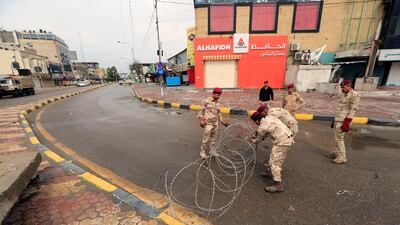
Soldiers place barbed wire on a street during a curfew in Baghdad. Reuters -
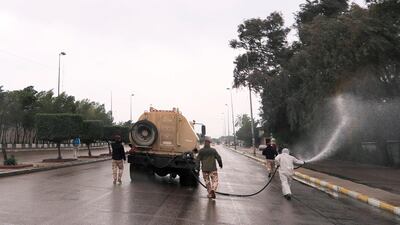
A soldier wearing a protective suit sprays disinfectants on a street. Reuters -
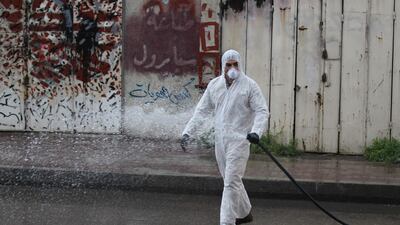
A soldier disinfects an area in the capital Baghdad. AFP -
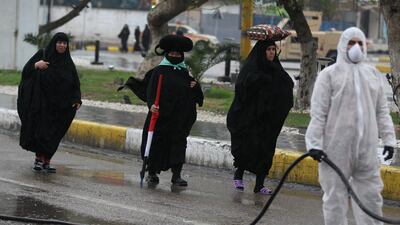
Soldiers disinfect an area in the capital Baghdad amidst efforts against the spread of COVID-19. AFP -
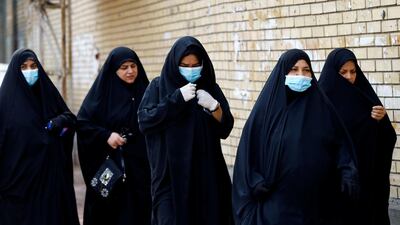
Shi'ite pilgrims make their way to Kadhimiya during a curfew imposed to prevent the spread of coronavirus. Reuters -
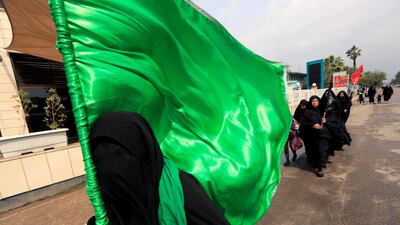
Shi'ite pilgrims make their way to Kadhimiya during a curfew. Reuters -
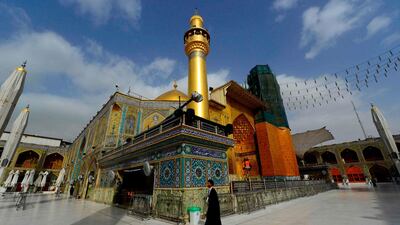
The usually busy Imam Ali Shrine in the central Iraqi holy city of Najaf is pictured empty. AFP -
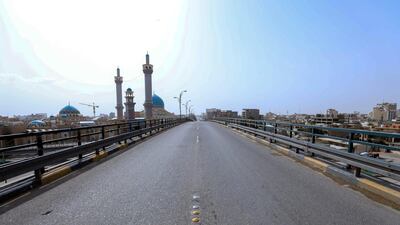
A general view of an empty street during precautionary measures against the novel coronavirus outbreak in the holy Shite city of Najaf. EPA -
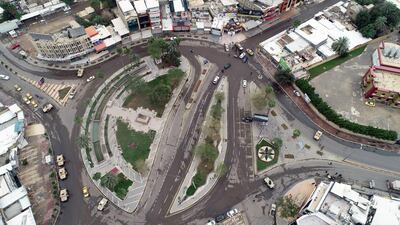
An aerial picture shows empty streets during precautionary measures against the novel coronavirus outbreak in central Baghdad. EPA -
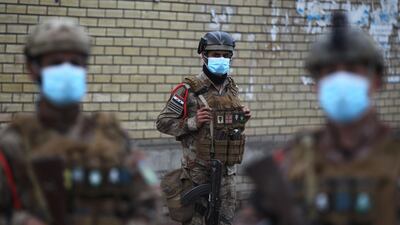
Soldiers deploy in the streets of Baghdad after the capital and some areas of the country imposed a week's curfew. AFP


Instead of cremating the victims, as is done in some countries, Iraqi health authorities, in consultation with the World Health Organisation, have modified the burial procedures to conform with Islamic practice, health officials told The National.
The corpse is dusted with earth and placed in a thick plastic bag with moisture-absorbing chemicals. The bag is placed in a coffin and both are sprinkled with more dirt before being placed in a grave two to four metres deep.
Public resistance continues despite a call from Grand Ayatollah Ali Al Sistani, Iraq's top Shiite cleric, to let health workers bury the coronavirus victims.
None of the 12 people who died in Baghdad hospitals have been buried yet, health officials told The National.
Meanwhile, the toll from the virus is mounting. Forty-two people have died from Covid-19, the disease caused by the coronavirus, since the first infection was detected on February 24, while the number of cases reached 506, according to figures released by the Health Ministry on Saturday.
Talib, 56, was diagnosed with coronavirus after being tested at the border while returning with his brother from Iran, which has reported more that 30,000 cases across the country. He died nearly two weeks later at Al Murjan General Hospital in Babel, 100km south of Baghdad, where he was being treated.
“Talib's family and his brother have all been confined since his infection was confirmed, so the burden on me was great,” said Mr Ibrahim.
But the controversy and rumours swirling around burials for people like Talib created another nightmare.
"People were telling us that the [health] ministry would cremate them, or bury them in places unknown to anyone," Mr Ibrahim said.
"All we wanted was to bury him in a place that his children and wife could visit later.
"There was no one I know, from officials to the clergy, that I did not appeal to for their intervention.”
Talib was finally laid to rest at a special site for coronavirus victims in an unpopulated area of northern Babel, but only after authorities were able to reach an agreement with opponents of the plan.
“Talib was buried like other people. We were allowed to attend his burial and pray for his soul,” Mr Ibrahim said.
"Thank God, the nightmare is over and now we can grieve.”

