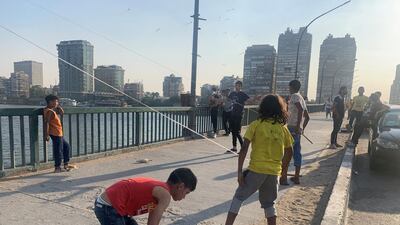

“It took me just a few minutes to make it,” said the chubby 12-year-old boy, exaggerating as he launched his modest yellow-and-white kite off a Nile bridge in Egypt’s capital.
“It was 15 Egyptian pounds (Dh 3.5) for the wicker sticks, five pounds for the plastic sheets and another 10 for the rope. That’s 30 pounds spent,” he explained. “It’s my third kite. I lost two when they fell in the water,” he said.
Though small, his kite was flying in no time, sharing space with bigger and more ornate designs.
The boy was among some two dozen people – men, children and a handful of women – who went to Cairo’s famous University Bridge to fly kites on a recent evening, taking advantage of the wind and the open space over the river. As night fell, there were several dozen kites in the air, soaring over the water and fluttering in a light evening wind, with the sky lit by a bright half-moon.
Born out of boredom during months of a pandemic lockdown, kite flying has taken Egypt by storm, with thousands of colours crowding Cairo’s skies every evening.
-
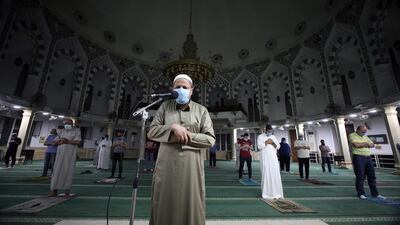
People pray while observing safe distancing at the Al Emam Aly Mosque in Cairo. EPA -
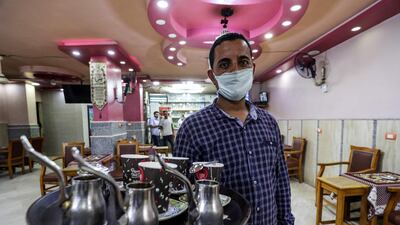
A waiter carries an order at a cafe in the Egyptian capital Cairo after authorities relaxed the lockdown measures in place to curb the spread of coronavirus. AFP -
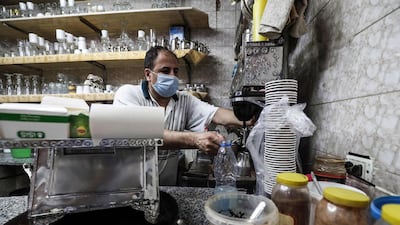
A worker prepares an order at a cafe in the Egyptian capital Cairo after authorities relaxed the lockdown measures in place to curb the spread of coronavirus. AFP -
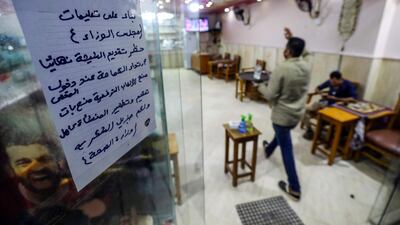
A note asking people to follow the instructions of the Health Ministry is pictured on the door of a cafe in the Egyptian capital Cairo. AFP -

A worker disinfects the door of a cafe in the Egyptian capital Cairo. AFP -
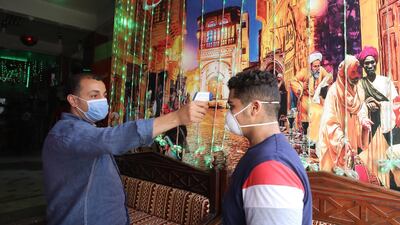
A customer gets his temperature measured by a worker in a cafe in Cairo. EPA -
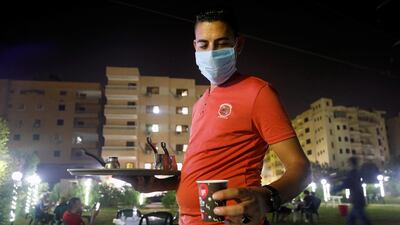
A waiter serves customers in a cafe after months of lockdown in Cairo. Reuters -
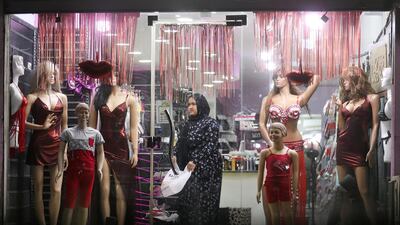
A woman looks at clothes at a store after months of lockdown in Cairo. Reuters -
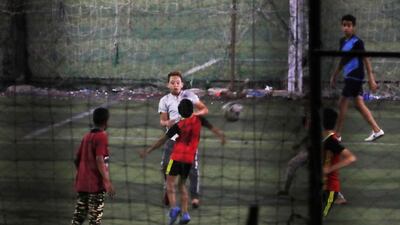
Youth play football at a local sport centre after months of lockdown in Cairo. Reuters -
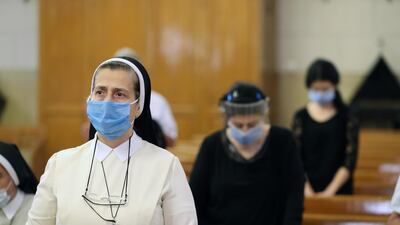
Churchgoers wear face masks and maintain a minimum social distance between each other as they attend a mass at the Armenian Catholic Church in Cairo. EPA -
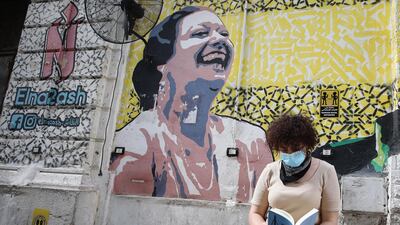
A girl reads a book in a cafe in Cairo. EPA -
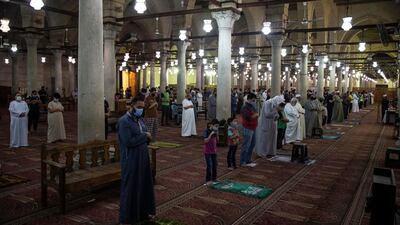
People take part in a dawn prayer inside Amr Ibn Al-As mosque in Cairo on June 27, 2020 as Egypt eased restrictions on public prayers, imposed to contain its coronavirus outbreak. EPA -
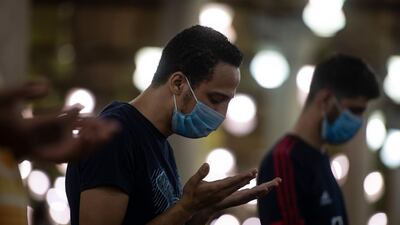
Worshippers are required to wear masks alongside other safety guidelines such as limited capacity at mosques, the use of personal prayer mats, temperature screening and social distancing. EPA -
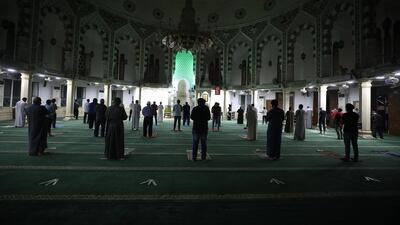
People pray while observing safe distancing at the Al Emam Aly Mosque in Cairo. EPA -
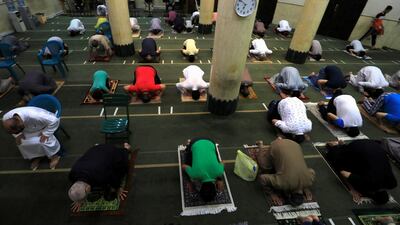
Egyptians attend the Fajr prayer inside the Al Rahman Mosque in the Cairo's Maadi neighbourhood. Reuters -
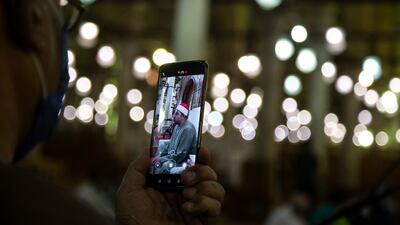
A worshipper records the dawn prayer inside Amr Ibn Al-As mosque in Cairo. EPA -
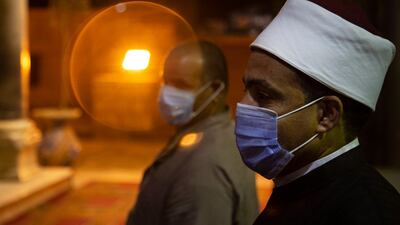
Worshippers wait to perform dawn prayers at the Amr Ibn Al-As in Cairo. EPA -
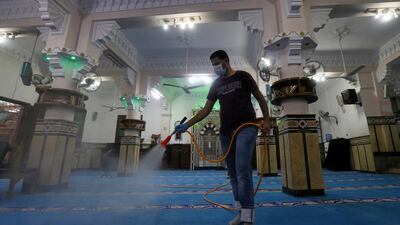
A volunteer wearing a face mask sprays disinfectant inside a mosque before it reopens to the public after three months. Reuters -
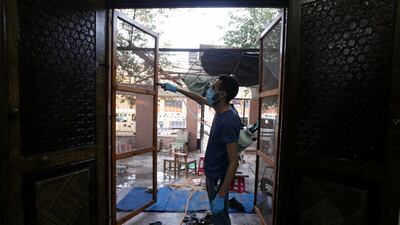
A volunteer disinfects the entrance to a mosque in Cairo. Reuters -
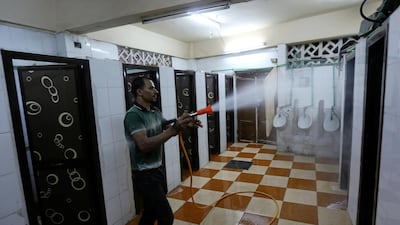
A volunteer sprays disinfectant in bathrooms at a Cairo mosque as it prepares to receive worshippers. Reuters -
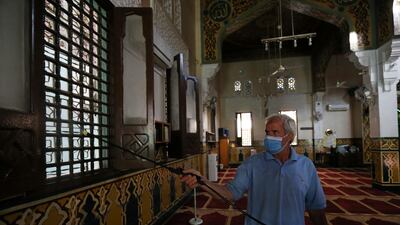
A volunteer wearing a face mask sprays disinfectant inside a mosque in Cairo. Reuters


The sport is not new to Cairo, but never in living memory have there been so many. A drive across Cairo shows just how wide the craze has spread, with kites flying over densely populated neighbourhoods, Nile bridges, highways, busy streets and high-rise rooftops.
It’s the latest pastime among Cairo’s working and middle class – surpassing popular pursuit, like fishing in the Nile or raising pigeons on rooftops. And it’s drawing people of all ages and backgrounds, not just from their homes, but away from their mobile phones and television sets, the two devices that many in this nation of 100 million relied on during a lockdown that included a nighttime curfew and the closure of cafes, tea houses, eateries, cinemas, public parks and theatres.
The evening skies have become so crowded with kites that a lawmaker last week found it necessary to express concerns in a letter to the prime minister that they could pose a security risk if fitted with tiny cameras to spy on sensitive installations.

Kite flyers dismissed the legislator, Khaled Abu Bakr, as a spoilsport and his intensely publicised fears were rejected as paranoid and ludicrous. He retracted his comments on Tuesday, saying his concern was not about national security as such, but rather about the safety of the kite flyers.
He said as many as 18 children have in recent weeks fallen to their death from rooftops while flying kites. His claim could not be immediately confirmed by the police.
Unmoved by the lawmaker’s warnings, kite flying appears to be attracting an increasing body of enthusiasts. A small cottage industry has emerged to satisfy the growing appetite for new kites, with entrepreneurial youths manufacturing and selling different models for anywhere between 30 and 200 pounds apiece, depending on the size.
To enable them to see the kites at nighttime, flyers say they tape tiny bulbs with a matching battery to the frames.
Ropes for bigger kites can be up to 200 meters long and sell for up to 35 pounds. Some of the largest kites require up to four flyers to handle them.
Prices also depend on appearance. Kites with attractive and colourful motifs, or those bearing images of superheroes from the Avengers movies, can fetch as much as 200 pounds. Those featuring an image of Egypt’s Liverpool star Mohamed Salah can sell for even more.
The hobby has also spilled over into the virtual sphere. Videos showing beginners how to make a kite are going viral, with views in the hundreds of thousands. One online video that spread quickly showed a crowd of hundreds of teens gathered in a large field to see the launch of what the narrator said was the largest kite ever made in Egypt.
Cairo neighbourhoods are also locked in rivalries, with flyers competing to prove the superiority of their skills. Zealous kite fliers try to trap others by entangling the ropes to bring a rival's kite down. The unwritten rule among these combatants is that captured kites are kept by the victor. Those who breach the rule and try to reclaim their kites are treated with the collective contempt of the kite-flying community.
“Sometimes those games lead to fistfights,” says Abdel-Rahman Khalil, a 31-year-old kite enthusiast from Cairo’s Shubra district. “Sometimes, flyers find their kites fighting for space in crowded spots so they are tempted to bring down other kites. It’s very provocative.”
But for bystanders, the spectacle from bridges is serene, watching the different colours flutter over the water in the balmy breeze of a summer evening by the Nile.

