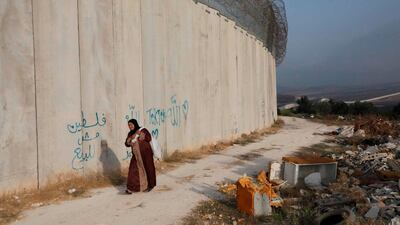
Resolving the decades-long Arab-Israel conflict remains vital to people across the Middle East and Israel, but a new survey found those in Arab states are more optimistic a resolution is possible in the coming years than their Israeli counterparts.
More than 8 in 10 of the 3,600 respondents in Egypt, Jordan, Palestine, Saudi Arabia and the UAE and the 1,005 Israelis surveyed for the new report by Zogby Research Services and Sky News Arabia said that agreeing on a resolution to the conflict remained important.
But the poll found 53 per cent of respondents in Jordan, 57 in Palestine and 76 per cent in the UAE said that peace could be established in the next five years compared with just 15 per cent of Israelis even as 89 per cent there said it was important to find a resolution.
Outside of Palestine, 40 per cent of respondents in Arab states said they wanted to see new proposals to push for a peace deal – including normalising ties with Israel, even before the terms of the Arab Peace Initiative had been met.
The polling was done before the announcements by the UAE, Bahrain and Israel last month that they would establish ties but highlights recent optimism on pushing for a new peace settlement.
But it also shows how public attitudes on the ground may have played into why successive rounds of talks have failed to get sufficient concessions to finalise a deal.

Pollster James Zogby, the founder of Zogby Research Services, said that the reaction to the UAE, Bahrain and Israel agreements, known as the Abraham Accords, had been “hyperbolic” in Israel and elsewhere but the idea that the Palestinian cause is being abandoned was not borne out by the data.
“…Palestinians [are] saying this is the end, ‘our cause has been abandoned’ and I don’t think that is true. In all our polling, Arab sensitivity towards Palestine is still high, Arab frustration with Israel behaviour is still high. What they don’t see is that the current leadership is providing any strategy or vision or direction how to get there and that is the frustration,” Mr Zogby said at a discussion on his findings hosted by the Middle East Institute.
“It is in no way the end of the cause and no way does it indicate that Arabs don’t care what happens to Palestinians, what it does say is that they are frustrated that nothing is happening and are looking for alternatives and this seemed one within reach.”
-
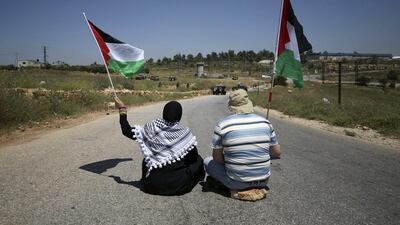
Palestinian protesters wave flags as Israeli troops take position during a protest against Jewish settlements in the West Bank village of Nabi Saleh, near Ramallah. Reuters -
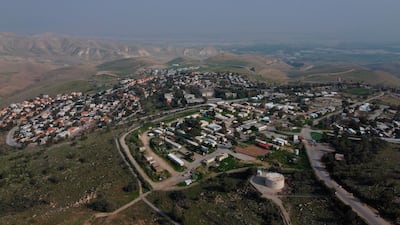
Now that Prime Minister Benjamin Netanyahu has secured a new term in office, there’s little to prevent him from annexing large parts of the West Bank as early as this summer. AP -

An Israeli soldier stands guard during a tour made by Israeli parliament members in the Jordan Valley near the Jewish settlement of Maale Efrayim. Reuters -
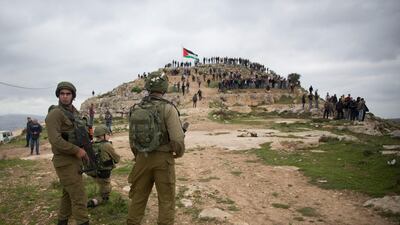
Israeli soldiers take position as Palestinian demonstrators gather during a protest against expansion of Israeli settlements in the West Bank. AP -
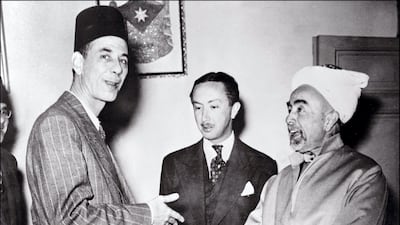
King Abdullah (r) of Transjordan on May 13, 1948 in Amman with Abed Al Rahman Azzam, the secretary general of the Arab League and Abd Al Elah Ibn Ali, the Prince Regent of Iraq, the day before the beginning of the first Arab-Israeli War. AFP -
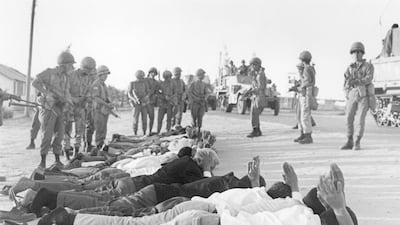
Palestinians surrender to Israeli soldiers in June 1967 in the occupied territory of the West Bank after Israel launched a pre-emptive attack on Egypt and Syria and seized the Gaza Strip, Sinai Peninsula and the Golan Heights in Syria as well as the West Bank and Arab East Jerusalem. AFP -
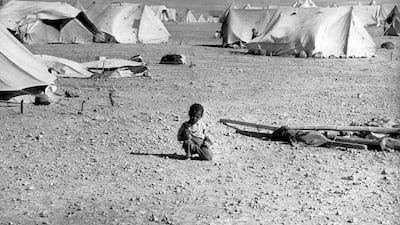
A Palestinian child plays in a refugee camp in Jordan on June 23, 1967. AFP -
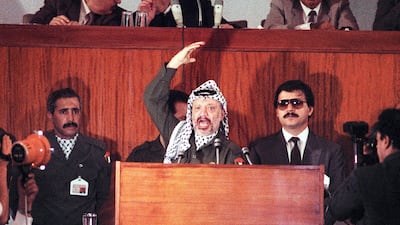
PLO chairman Yasser Arafat delivers a speech to the Palestine National Council meeting to make the historic proclamation of a Palestinian state in the Israeli-occupied territories and to recognize Israel in the Palace of Nations conference hall on November 12, 1988, in Algiers. AFP -

US President Bill Clinton stands between PLO leader Yasser Arafat and Israeli Prime Minister Yitzahk Rabin as they shake hands for the first time on September 13, 1993 at the White House. AFP -
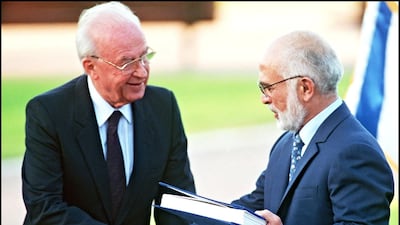
Hussein Ibn Talal, King of Jordan and Israeli Premier Yitzhak Rabin shake hands after they exchanged the documents of the Peace Treaty at Beit Gabriel conference centre on November 10, 1994 on the southern shore of the Sea of Galilee. AFP -
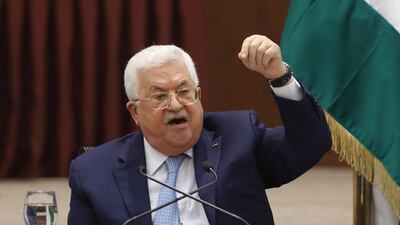
Palestinian President Mahmoud Abbas speaks during the Palestinian leadership meeting and threatened to end security coordination with Israel and the United States, saying Israeli annexation would ruin chances for peace. AFP -
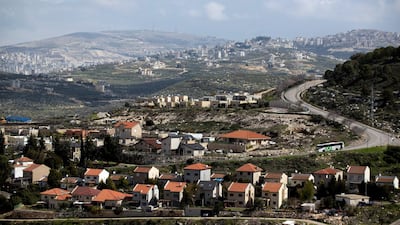
Houses in the Israeli settlement of settlement of Kedumim are seen in the foreground as part of the Palestinian city of Nablus is seen in the background (far left) in the Israeli-occupied West Bank. Reuters -

Israel's controversial concrete barrier (C) separating the Jewish settlement of Neve Yaakov (foreground) in the northern part of east Jerusalem and the Palestinian area of al-Ram (background) in the occupied West Bank. AFP -

An Israeli activist holds a banner during a protest against the US peace plan for the Middle East, in front of the US ambassador's residence in Jerusalem, on May 15, 2020, as Palestinians commemorate the 72nd anniversary of the 1948 Nakba or "catastrophe". AFP -

A Palestinian shepherd tends to his camels on arid land considered to be in "Area C" (under Israeli security and administrative control), southeast of Yatta town in the southern West Bank district of Hebron. AFP -
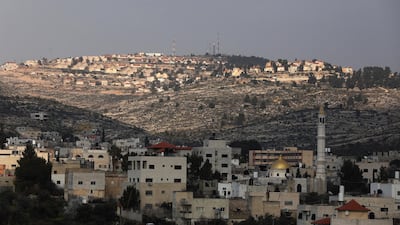
A general view of the Israeli settlement of Elon Moreh, as seen from the Palestinian village of Azmout near the West Bank City of Nablus. EPA -
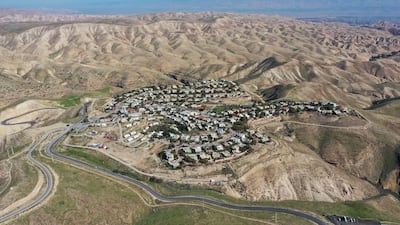
The West Bank Jewish settlement of Maale Michmash. AP


He found four in 10 Arabs outside of Palestine believe exploring new avenues to start talks on a lasting settlement to the conflict – including through normalisation – could do more to “convince Israel of the benefits of peace” than the status quo or that “with normal ties, Arabs would have greater leverage to help secure Palestinian rights.”
Until now, Arab states other than Egypt and Jordan – who already had normalised relations with Israel – have followed the 2000 Arab Peace initiative that makes ties with Israel contingent on a final settlement. But backing in the polling for the plan was not overwhelming.
“I believe if there is a convincing normalisation process, there will be a good chance to establish a Palestinian state,” one respondent said. Another touched on the main motivation expressed in the region for wanting a resolution. “I do not want normalisation, but our children and mothers die every day. Safety is better,” another respondent to the survey said.
The survey highlighted frustration with a lack of progress with the Arab Peace Initiative two decades after it was agreed. Across the Arab states, the UAE had the highest number of respondents saying that the plan was still relevant and should be maintained but that was only 36 per cent. By contrast, 47 per cent of Emiratis said that it was still relevant, but that Arabs should do more to convince Israelis of the benefits to making peace. Across the Arab states polled, more people held this view than any other.
While the number one reason to back normalisation in Jordan, Egypt and Saudi Arabia was “to stop the killing”, in the UAE the number one reason was to give greater leverage to convince Israel to sit at the table.
But this view is not unconditional. If Israel were to push ahead with the annexation of Palestinian lands in the West Bank and Jordan Valley, more than 70 per cent of respondents in all Arab states said all efforts at co-operation with Israel should stop.
On the opinion article written in Israel’s largest daily newspaper in Hebrew in June by UAE Ambassador to the US and Minister of State Yousef Al Otaiba, warning that annexation would make the possibility of relations more difficult, the survey found “two-thirds of Egyptians, Saudis, and Emiratis are favourable towards this UAE initiative.”
A key aspect of the UAE’s subsequent Abraham Accords with Israel was that it was conditional on a halt in annexation.
While the freeze in annexation is seen as effectively taking it off the table for good, another factor that could play into the Israeli government’s decision process will be local sentiment.
Half of Israeli responders said it was a bad time for annexation and cited rejection of such a move by Palestinians and Arab states as the main reason. Only 15 per cent of Israelis backed annexation of all Palestinian lands regardless of the outcomes.
Fifteen per cent of Israelis also said that they had supported annexation, but the UAE-Israel normalisation agreement caused them to change their minds.
The survey also highlighted a major divide within Israeli society.
Of those asked about annexation, 54 per cent of those who backed it identified as Orthodox or Ultra-Orthodox compared with just 11 per cent who identify as secular. On the flip side, 43 per cent of secular Israelis say they are opposed to annexation while only 14 per cent of as Orthodox or Ultra-Orthodox agree with holding off.
Last year, US President Donald Trump unveiled the White House’s new peace plan, dubbed "Peace to Prosperity: A Vision to Improve the Lives of the Palestinian and Israeli People". While the announcement was received lukewarmly, other major players commended any initiative that would restart negotiations. Palestinians roundly rejected the plan and called for a return to UN-led talks.
While more Arabs in the survey said they knew a lot about the proposal than their Israeli counterparts, support for the deal was mixed.
Those in the UAE and Saudi Arabia had a more favourable view of the proposal than those in Jordan, Egypt and Palestine. But most who backed the plan did so as a means to end the violence rather than for its merits.
In Israel, rejection of the Trump plan was predominantly due to the belief that Palestinians would never accept the deal (48 per cent) compared with 32 per cent of Israelis who did not back the deal because they felt that Palestinians should never be given any land between the Mediterranean Sea and the Jordan Valley.
Of the Israelis who backed the proposal, most did so because Mr Trump is in office and so they believe it is the best offer they will be made. Palestinians, who were most familiar with the details (87 per cent) also opposed it most widely (81 per cent).
The survey was conducted at the end of June using online panels, except in Palestine where face-to-face interviews were used. Zogby accepted that the use of online data collection tended to skew the respondents to include more younger males, but they said they did not weight the results as they found little difference in attitude between younger and older respondents. In Israel, the survey did not poll Arab Israelis, only Jewish Israeli nationals.

