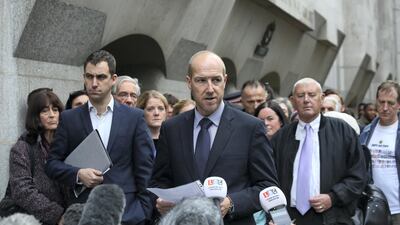
Former detective superintendent Nick Wallen, of West Yorkshire Police, outside the Old Bailey in London after Thomas Mair was found guilty of the murder of Jo Cox. PA Images via Getty

Jo Cox murder probe detective raises fears over the hunt for accomplices


Nicky Harley
  • English
  • Arabic

A retired detective who led the investigation into the murder of British politician Jo Cox has said there is an unexplained mystery at the heart of the case that needs to be solved.

Ms Cox, a Labour Party member of the UK parliament, was shot and stabbed as she entered her constituency office in Birstall, West Yorkshire five years ago, by neo-Nazi extremist Thomas Mair.

An unanswered question in her murder is how Mair, who appeared to be a social recluse, got hold of the .22 sawn-off rifle that he used to kill her.

The weapon had been stolen 17 miles away in the town of Keighley, and modified in an underground workshop.

Mair owned a mobile phone from which he had sent only three messages in three years. Most of his correspondence was online with US and South African far-right organisations.

Former detective superintendent Nick Wallen, who led the investigation into the murder of Jo Cox, described Mair as an "antisocial loner, in the truest sense of the word".

Mr Wallen told The National the only unsolved aspect of the case was how Mair obtained the gun.

Speaking on the fifth anniversary of Ms Cox's death, Mr Wallen described what happened as a “tragedy” and urged those with information about the missing piece of the puzzle to come forward.

“I cannot underline how important it is for anyone with information about how Mair obtained the firearm to come forward and share that information with the police,” he said.

“That was the one aspect of the investigation that, at the time I left the police, remained unsolved.”

Mr Wallen said acquiring a stolen firearm is not easy, unless a person is a criminal and knows how to get one.

"He was not somebody who was immersed in criminality, making calls, wheeling and dealing, trying to get himself a firearm," he said.

“That begs the question ... ‘How did you, Thomas Mair, get that gun?’"

Officers have made repeated attempts to interview Mair, but despite asking him why he did it and telling him that Jo Cox's family want to know why she's dead, he refuses to answer any questions.

During his trial Mair maintained his silence, only asking to read a statement after his conviction.

The judge refused him permission, out of concerns that  he would deliver a political rant.

West Yorkshire Police told The National the force has "exhausted" all lines of enquiry but would re-investigate if new evidence is received.

“A lengthy investigation was carried out to try and establish how Thomas Mair acquired this firearm,” a police official said.

“All lines of enquiry have for the time being been exhausted but the investigation will be revisited if further information comes to light.”

After the murder, the UK security services put the far right under more intense scrutiny.

Right-wing group National Action was banned only months later.

Experts have criticised the police for not taking the far-right threat more seriously previously and believe they are now playing "catch-up".

The murder of Jo Cox was a turning point and a wake up call for the security services to up their game

"The murder of Jo Cox was a turning point and a wake up call for the security services to up their game," chairman of Muslims Against Anti-Semitism, Ghanem Nuseibeh, told The National.

"It clearly was a failure and the time it has taken ... demonstrates how much the police are effectively playing catch-up.

“This is not good enough in a world of rapidly changing tactics by terrorists. Things are changing but they are not changing fast enough.”

Keighley has been a hotbed for the far right, with the British National Party once having its headquarters there.

But Mair's only known connection to the far right in Britain was that he once attended a BNP event in London. No link between him and Keighley was found.
Publisher and former editor of the regional newspaper The Press, Danny Lockwood, who attended Mair's trial, said the far-right motive came as a shock to the community.

“Jo Cox’s murder is still what it was in the hour after her death – unbelievably tragic,” he said.

“The community were stunned. There was no far-right presence.

“The prosecution did their best in court to portray Mair as a white supremacist, with his links to South Africa and the US. They then tried to tie him in the most tenuous way to British groups. No one knows how he got that gun, if it was given to him by a far-right sympathiser.

“Could it have been a far-right conspiracy? It probably could have been but I think, unless Mair confesses, we will never know the truth.”

Terror attacks in Paris, November 13, 2015

- At 9.16pm, three suicide attackers killed one person outside the Atade de France during a foootball match between France and Germany- At 9.25pm, three attackers opened fire on restaurants and cafes over 20 minutes, killing 39 people- Shortly after 9.40pm, three other attackers launched a three-hour raid on the Bataclan, in which 1,500 people had gathered to watch a rock concert. In total, 90 people were killed- Salah Abdeslam, the only survivor of the terrorists, did not directly participate in the attacks, thought to be due to a technical glitch in his suicide vest- He fled to Belgium and was involved in attacks on Brussels in March 2016. He is serving a life sentence in France

THE BIO: Martin Van Almsick

Hometown: Cologne, Germany

Family: Wife Hanan Ahmed and their three children, Marrah (23), Tibijan (19), Amon (13)

Favourite dessert: Umm Ali with dark camel milk chocolate flakes

Favourite hobby: Football

Breakfast routine: a tall glass of camel milk

How the bonus system works

The two riders are among several riders in the UAE to receive the top payment of £10,000 under the Thank You Fund of £16 million (Dh80m), which was announced in conjunction with Deliveroo's £8 billion (Dh40bn) stock market listing earlier this year.

The £10,000 (Dh50,000) payment is made to those riders who have completed the highest number of orders in each market.

There are also riders who will receive payments of £1,000 (Dh5,000) and £500 (Dh2,500).

All riders who have worked with Deliveroo for at least one year and completed 2,000 orders will receive £200 (Dh1,000), the company said when it announced the scheme.

UAE currency: the story behind the money in your pockets
COMPANY%20PROFILE
%3Cp%3E%3Cstrong%3EName%3A%20%3C%2Fstrong%3EQureos%0D%3Cbr%3E%3Cstrong%3EBased%3A%20%3C%2Fstrong%3EUAE%0D%3Cbr%3E%3Cstrong%3ELaunch%20year%3A%20%3C%2Fstrong%3E2021%0D%3Cbr%3E%3Cstrong%3ENumber%20of%20employees%3A%20%3C%2Fstrong%3E33%0D%3Cbr%3E%3Cstrong%3ESector%3A%20%3C%2Fstrong%3ESoftware%20and%20technology%0D%3Cbr%3E%3Cstrong%3EFunding%3A%20%3C%2Fstrong%3E%243%20million%0D%3Cbr%3E%3C%2Fp%3E%0A
India squad

Virat Kohli (captain), Rohit Sharma, Mayank Agarwal, K.L. Rahul, Shreyas Iyer, Manish Pandey, Rishabh Pant, Shivam Dube, Kedar Jadhav, Ravindra Jadeja, Yuzvendra Chahal, Kuldeep Yadav, Deepak Chahar, Mohammed Shami, Shardul Thakur.

Mercer, the investment consulting arm of US services company Marsh & McLennan, expects its wealth division to at least double its assets under management (AUM) in the Middle East as wealth in the region continues to grow despite economic headwinds, a company official said.

Mercer Wealth, which globally has $160 billion in AUM, plans to boost its AUM in the region to $2-$3bn in the next 2-3 years from the present $1bn, said Yasir AbuShaban, a Dubai-based principal with Mercer Wealth.

Within the next two to three years, we are looking at reaching $2 to $3 billion as a conservative estimate and we do see an opportunity to do so,” said Mr AbuShaban.

Mercer does not directly make investments, but allocates clients’ money they have discretion to, to professional asset managers. They also provide advice to clients.

“We have buying power. We can negotiate on their (client’s) behalf with asset managers to provide them lower fees than they otherwise would have to get on their own,” he added.

Mercer Wealth’s clients include sovereign wealth funds, family offices, and insurance companies among others.

From its office in Dubai, Mercer also looks after Africa, India and Turkey, where they also see opportunity for growth.

Wealth creation in Middle East and Africa (MEA) grew 8.5 per cent to $8.1 trillion last year from $7.5tn in 2015, higher than last year’s global average of 6 per cent and the second-highest growth in a region after Asia-Pacific which grew 9.9 per cent, according to consultancy Boston Consulting Group (BCG). In the region, where wealth grew just 1.9 per cent in 2015 compared with 2014, a pickup in oil prices has helped in wealth generation.

BCG is forecasting MEA wealth will rise to $12tn by 2021, growing at an annual average of 8 per cent.

Drivers of wealth generation in the region will be split evenly between new wealth creation and growth of performance of existing assets, according to BCG.

Another general trend in the region is clients’ looking for a comprehensive approach to investing, according to Mr AbuShaban.

“Institutional investors or some of the families are seeing a slowdown in the available capital they have to invest and in that sense they are looking at optimizing the way they manage their portfolios and making sure they are not investing haphazardly and different parts of their investment are working together,” said Mr AbuShaban.

Some clients also have a higher appetite for risk, given the low interest-rate environment that does not provide enough yield for some institutional investors. These clients are keen to invest in illiquid assets, such as private equity and infrastructure.

“What we have seen is a desire for higher returns in what has been a low-return environment specifically in various fixed income or bonds,” he said.

“In this environment, we have seen a de facto increase in the risk that clients are taking in things like illiquid investments, private equity investments, infrastructure and private debt, those kind of investments were higher illiquidity results in incrementally higher returns.”

The Abu Dhabi Investment Authority, one of the largest sovereign wealth funds, said in its 2016 report that has gradually increased its exposure in direct private equity and private credit transactions, mainly in Asian markets and especially in China and India. The authority’s private equity department focused on structured equities owing to “their defensive characteristics.”
