
Canadian staff at a university in Doha have been told they could be fired for leaving the country, despite Qatar having the highest rate of Covid-19 per capita in the world, Canadian media reported.
Several members of staff at the College of the North Atlantic campus in Doha told Canadian broadcaster CBC that they felt afraid and trapped, but feared reprisals if they tried to go home.
"Living in a country that has, for weeks, had the highest per capita number of positive Covid cases in the world is extremely stressful, and several employees are anxious to leave for summer," one employee told the news station.
Coronavirus in the Middle East
-
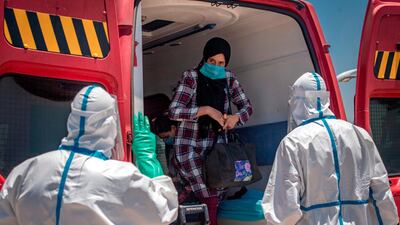
A Moroccan, who tested positing for Covid-19, arrives in a parking lot in the town of Moulay Bousselham, north of the capital Rabat, ahead of being transferred to a medical center in another city. AFP -
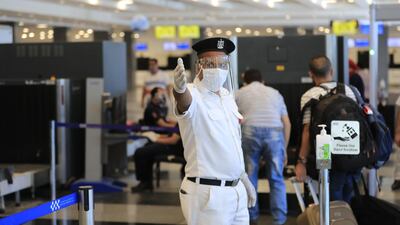
A policeman, wearing a protective face shield, signals to passengers at the Sharm el-Sheikh international airport in Egypt. AFP -
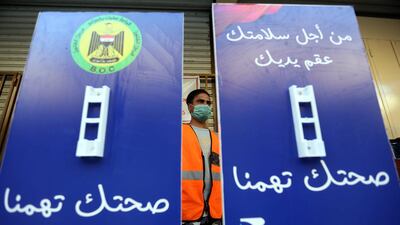
An Iraqi works on Informative signs with coronavirus guidelines reading in Arabic "Your health is important to us, sterility of your hand" at a local printing house in Baghdad. EPA -
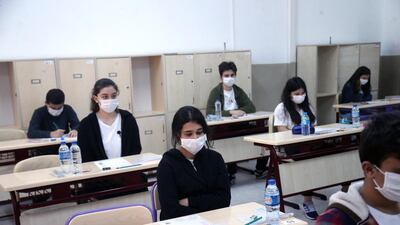
Students of 8th grade wearing masks waits for their High School Transition System (LGS) examination at the Fevzi Ozbey secondary school in Ankara, Turkey. EPA -

Travellers wearing face masks ride a bus, following the outbreak of the coronavirus disease in Manama, Bahrain. Reuters -

A man jumps into a swimming pool at Laguava Resort, in Rmaileh, south of Beirut as Lebanon has eased lockdown restrictions and reopened almost all businesses including beaches, pools, restaurants and cafes. AP Photo -

Domestic tourists visit the reopened Petra archeological site, in Petra, some 280 km south of Amman, Jordan. EPA


The university confirmed to the broadcaster that staff could be fired if they travelled and were unable to return despite classes being suspended since March.
"Employees who decide to leave Qatar and do not return to work when required may have their employment agreement terminated," a representative told CBC.
University president Elizabeth Kid told staff in an email that: "Accommodations will not be made for remote work or teaching from outside Qatar.
"If you choose to travel, you should plan accordingly."
Qatar has 86,488 confirmed cases of Covid-19 with 94 deaths.
More than 1,000 new cases have been recorded daily since May 8. So far, 66,000 have recovered.
Most of the 650 staff at the state-owned university operated by the Newfoundland company are Canadian citizens and many are seconded from the Stephenville main campus.
Qatar shut its borders to travellers to contain the spread of the virus but is allowing citizens and residents to return if they have a 14-day booking for a hotel that is being used for quarantine.
But CBC quoted staff asking why they would be required to undertake a costly hotel stay when they have housing in which they could complete the period of isolation.
One member of staff told CBC that the rules seemed strange as they had just successfully completed the summer semester using distance learning after the campus closed in March.
"Employees have been teaching online from mid-March and it's working," the employee said.
"Many employees can't understand why they can't continue to do this from the safety of their home country."

