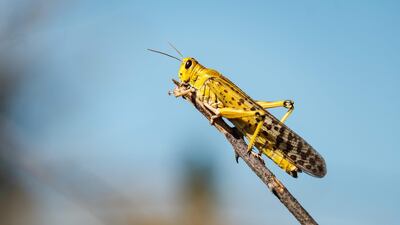
Swarms of locusts are making a comeback in Oman as government attention has diverted to the coronavirus outbreak, farmers say.
Locusts devastated crops across the Gulf and eastern Africa at the beginning of this year but numbers dramatically dropped in March after the government embarked on a pesticide spraying programme.
But in the last ten days, farmers in Al Buraimi, a town that borders the United Arab Emirates, have spotted the creatures once more and want the government to recommence spraying before it is too late for their crops.
“They are coming back to eat our crops. They were here two months ago but the government sprayed and they died,” said Hamood Al Kaabi, 31, a farmer in Al Buraimi.
“I think because of this pandemic, the government is now concentrating on infected people and not locusts.”
Oman’s Ministry of Agriculture and Fisheries had acted quickly against a larger-than-usual locust invasion this year, spraying pesticides in most parts of Oman from specially-designed aircraft. The action did not entirely eradicate the pests but farmers say the remnants did not cause a problem, until the coronavirus began to take hold.
“I think the survivors started breeding slowly and now they are back. Now we are fighting two battles. Covid-19 threatening our health and the locusts threatening our livelihoods,” Suleiman Al Mleihi, 38, a farmer in Mahda, another town close to the United Arab Emirates border, said.
The Food and Agriculture Organisation said on Monday that it had noted the likelihood of second-generation adult groups and some small swarms forming in the northern region and hopper groups continuing in Al Buraimi, but the overall number of the creatures would decline as the weather becomes drier and summer approaches.
Omani farmers working along the border with the UAE mainly grow carrots, melons, limes, cucumber, tomatoes, potatoes and onions. They say trade has continued to be lucrative across the border even as cases of Covid-19 in both nations grew and lockdowns were instituted.
“The two governments of Oman and the UAE protect our trades by allowing food to cross the borders. So Covid-19 is not stopping our crops from being exported by road to the UAE. But it looks like the locusts are going to do that,” Mr Kaabi explained.
A farmer in Al Wajajah, an Omani town close to the UAE’s Sharjah border, said he had already notified the Omani Ministry of Agriculture in Muscat by phone but was asked to wait until the lockdown is lifted.
“They say they are aware of the return of locusts but they cannot do anything now until the lockdown is over,” Qais Al-Hashmi, 44, said, adding he had taken matters into his own hands.
“I am using now a homemade spray mixed with bleach, fly killer and water to get rid of them. I have had limited success but it is not enough.”
The Ministry of Agriculture could not be reached by The National, but on Twitter assured those sharing videos of swarms that they could contact their local development departments to inform them and that spraying was ongoing,
Locusts have even been noticed even in the capital Muscat.
“There are a few in my garden eating away my plants. There are also flying around in the streets eating the leaves of the trees on the roads,” Nabil Al Shehi, 41, a resident in Muscat, said.
Muscat remains under lockdown and on Tuesday the government said it was extending stay at home measures to May 29. On Wednesday, Oman reported 168 new COVID-cases, the highest in any single day since the outbreak started. The total number of infected people is now 2,903 with 13 deaths and 888 recoveries.

Director: Laxman Utekar
Cast: Vicky Kaushal, Akshaye Khanna, Diana Penty, Vineet Kumar Singh, Rashmika Mandanna
Rating: 1/5
The biog
Siblings: five brothers and one sister
Education: Bachelors in Political Science at the University of Minnesota
Interests: Swimming, tennis and the gym
Favourite place: UAE
Favourite packet food on the trip: pasta primavera
What he did to pass the time during the trip: listen to audio books
CREW
%3Cp%3E%3Cstrong%3EDirector%3A%20%3C%2Fstrong%3ERajesh%20A%20Krishnan%3C%2Fp%3E%0A%3Cp%3E%3Cstrong%3EStarring%3A%20%3C%2Fstrong%3ETabu%2C%20Kareena%20Kapoor%20Khan%2C%20Kriti%20Sanon%26nbsp%3B%3C%2Fp%3E%0A%3Cp%3E%3Cstrong%3ERating%3A%3C%2Fstrong%3E%203.5%2F5%3C%2Fp%3E%0A
Napoleon
%3Cp%3E%3Cstrong%3EDirector%3C%2Fstrong%3E%3A%20Ridley%20Scott%3Cbr%3E%3Cstrong%3EStars%3C%2Fstrong%3E%3A%20Joaquin%20Phoenix%2C%20Vanessa%20Kirby%2C%20Tahar%20Rahim%3Cbr%3E%3Cstrong%3ERating%3C%2Fstrong%3E%3A%202%2F5%3Cbr%3E%3Cbr%3E%3C%2Fp%3E%0A
Mercer, the investment consulting arm of US services company Marsh & McLennan, expects its wealth division to at least double its assets under management (AUM) in the Middle East as wealth in the region continues to grow despite economic headwinds, a company official said.
Mercer Wealth, which globally has $160 billion in AUM, plans to boost its AUM in the region to $2-$3bn in the next 2-3 years from the present $1bn, said Yasir AbuShaban, a Dubai-based principal with Mercer Wealth.
“Within the next two to three years, we are looking at reaching $2 to $3 billion as a conservative estimate and we do see an opportunity to do so,” said Mr AbuShaban.
Mercer does not directly make investments, but allocates clients’ money they have discretion to, to professional asset managers. They also provide advice to clients.
“We have buying power. We can negotiate on their (client’s) behalf with asset managers to provide them lower fees than they otherwise would have to get on their own,” he added.
Mercer Wealth’s clients include sovereign wealth funds, family offices, and insurance companies among others.
From its office in Dubai, Mercer also looks after Africa, India and Turkey, where they also see opportunity for growth.
Wealth creation in Middle East and Africa (MEA) grew 8.5 per cent to $8.1 trillion last year from $7.5tn in 2015, higher than last year’s global average of 6 per cent and the second-highest growth in a region after Asia-Pacific which grew 9.9 per cent, according to consultancy Boston Consulting Group (BCG). In the region, where wealth grew just 1.9 per cent in 2015 compared with 2014, a pickup in oil prices has helped in wealth generation.
BCG is forecasting MEA wealth will rise to $12tn by 2021, growing at an annual average of 8 per cent.
Drivers of wealth generation in the region will be split evenly between new wealth creation and growth of performance of existing assets, according to BCG.
Another general trend in the region is clients’ looking for a comprehensive approach to investing, according to Mr AbuShaban.
“Institutional investors or some of the families are seeing a slowdown in the available capital they have to invest and in that sense they are looking at optimizing the way they manage their portfolios and making sure they are not investing haphazardly and different parts of their investment are working together,” said Mr AbuShaban.
Some clients also have a higher appetite for risk, given the low interest-rate environment that does not provide enough yield for some institutional investors. These clients are keen to invest in illiquid assets, such as private equity and infrastructure.
“What we have seen is a desire for higher returns in what has been a low-return environment specifically in various fixed income or bonds,” he said.
“In this environment, we have seen a de facto increase in the risk that clients are taking in things like illiquid investments, private equity investments, infrastructure and private debt, those kind of investments were higher illiquidity results in incrementally higher returns.”
The Abu Dhabi Investment Authority, one of the largest sovereign wealth funds, said in its 2016 report that has gradually increased its exposure in direct private equity and private credit transactions, mainly in Asian markets and especially in China and India. The authority’s private equity department focused on structured equities owing to “their defensive characteristics.”
The Cairo Statement
1: Commit to countering all types of terrorism and extremism in all their manifestations
2: Denounce violence and the rhetoric of hatred
3: Adhere to the full compliance with the Riyadh accord of 2014 and the subsequent meeting and executive procedures approved in 2014 by the GCC
4: Comply with all recommendations of the Summit between the US and Muslim countries held in May 2017 in Saudi Arabia.
5: Refrain from interfering in the internal affairs of countries and of supporting rogue entities.
6: Carry out the responsibility of all the countries with the international community to counter all manifestations of extremism and terrorism that threaten international peace and security
Last 10 NBA champions
2017: Golden State bt Cleveland 4-1
2016: Cleveland bt Golden State 4-3
2015: Golden State bt Cleveland 4-2
2014: San Antonio bt Miami 4-1
2013: Miami bt San Antonio 4-3
2012: Miami bt Oklahoma City 4-1
2011: Dallas bt Miami 4-2
2010: Los Angeles Lakers bt Boston 4-3
2009: Los Angeles Lakers bt Orlando 4-1
2008: Boston bt Los Angeles Lakers 4-2
