Spokesman of the Saudi-led coalition Colonel Turki Al Maliki during a press conference in Riyadh, Saudi Arabia. AFP

Arab Coalition says evidence points to use of Iranian arms in oil attacks


  • English
  • Arabic

Preliminary findings show the weapons used to strike Saudi oil plants were made by Iran, the Arab Coalition said on Monday.

The statement came hours after Iran claimed it had seized another vessel and its crew near the Strait of Hormuz.

Saudi Arabia's Foreign Ministry said later on Monday evening that the initial investigation into Saturday's strikes had indicated Iranian weapons were involved.

"The kingdom condemns this egregious crime, which threatens international peace and security, and affirms that the primary target of this attack are global energy supplies, as it is in line with the previous attacks against Saudi Aramco pumping stations using Iranian weapons," the ministry said.

Coalition spokesman Col Turki Al Malki said the investigation was continuing into the launch site of the attacks, which had been claimed by the Iran-backed Houthi rebels in Yemen.

"The preliminary results show that the weapons are Iranian and we are currently working to determine the location," Col Al Malki said in Riyadh.

"The terrorist attack did not originate from Yemen as the Houthi militia claimed."

The explosions, which took place on Saturday, set off fires that engulfed the Abqaiq plant, the world's largest oil processing plant, and nearby Khurais, which has a massive oilfield.

Col Al Malki said authorities would reveal the location from which the drones were launched at a future briefing.

Meanwhile, Iran seized another vessel and its crew near the Strait of Hormuz on Monday, the semi-official Iranian news agency Fars reported.

It said the vessel was carrying "smuggled diesel" and that its crew of 11 had been arrested.

"The ship, called Linch, sailed from the port of Lankah and was heading towards the UAE," an Islamic Revolutionary Guard Corps naval commander told the agency.

"It was stopped about 20 miles [30 kilometres] east of the island of Tunb."

The islands of Abu Musa and the Greater and Lesser Tunbs, a few kilometres off the UAE coastline, are regarded as strategically important points in the Strait of Hormuz, and were seized by Iran in 1971 on the eve of the UAE's formation.

If the ship seizure is confirmed, it would represent the latest move by Iran to hamper navigation in the waterway, one of the most vital routes for global energy supplies.

The US has blamed Iran for a series of attacks on oil tankers. Iran has seized at least one British-flagged tanker and approached another.

Washington withdrew from a nuclear deal signed between Iran and world powers in 2015.

It imposed two rounds of crippling sanctions on the Iranian economy to disrupt its malign activity across the Middle East.

Iran has proxies operating in Lebanon, Yemen, the Gaza Strip and Syria.

State television broadcast footage from the deck of a trawler-sized vessel with open hatches showing tanks full of what appeared to be fuel.

It is the second such seizure this month, after a boat Iran claimed was smuggling fuel was detained and its 12 Filipino crew members arrested in the Strait of Hormuz on September 7.

US officials earlier indicated that Iran was behind the weekend attacks. Iran denied any responsibility.

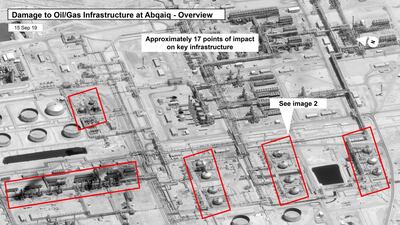
  • This image provided by the U.S. government and DigitalGlobe and annotated by the source, shows damage to the infrastructure at Saudi Aramco's Abaqaiq oil processing facility in Buqyaq, Saudi Arabia. The drone attack Saturday on Saudi Arabia's Abqaiq plant and its Khurais oil field led to the interruption of an estimated 5.7 million barrels of the kingdom's crude oil production per day, equivalent to more than 5% of the world's daily supply. AP
    This image provided by the U.S. government and DigitalGlobe and annotated by the source, shows damage to the infrastructure at Saudi Aramco's Abaqaiq oil processing facility in Buqyaq, Saudi Arabia. The drone attack Saturday on Saudi Arabia's Abqaiq plant and its Khurais oil field led to the interruption of an estimated 5.7 million barrels of the kingdom's crude oil production per day, equivalent to more than 5% of the world's daily supply. AP
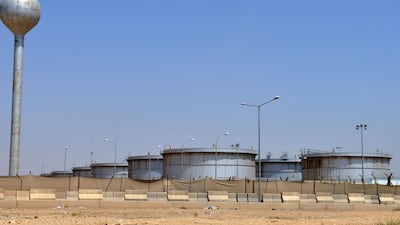
  • an Aramco oil facility at the edge of the Saudi capital Riyadh. Saudi Arabia raced today to restart operations at oil plants hit by drone attacks which slashed its production by half, as Iran dismissed US claims it was behind the assault. The Tehran-backed Huthi rebels in neighbouring Yemen, where a Saudi-led coalition is bogged down in a five-year war, have claimed thi weekend's strikes on two plants owned by state giant Aramco in eastern Saudi Arabia. AFP
    an Aramco oil facility at the edge of the Saudi capital Riyadh. Saudi Arabia raced today to restart operations at oil plants hit by drone attacks which slashed its production by half, as Iran dismissed US claims it was behind the assault. The Tehran-backed Huthi rebels in neighbouring Yemen, where a Saudi-led coalition is bogged down in a five-year war, have claimed thi weekend's strikes on two plants owned by state giant Aramco in eastern Saudi Arabia. AFP
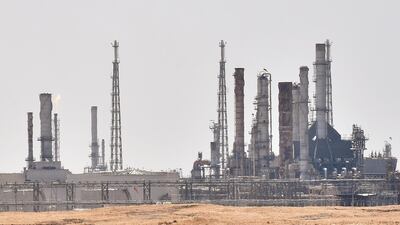
  • An Aramco oil facility near al-Khurj area, just south of the Saudi capital Riyadh. Saudi Arabia raced today to restart operations at oil plants hit by drone attacks which slashed its production by half, as Iran dismissed US claims it was behind the assault. The Tehran-backed Huthi rebels in neighbouring Yemen, where a Saudi-led coalition is bogged down in a five-year war, have claimed thi weekend's strikes on two plants owned by state giant Aramco in eastern Saudi Arabia. AFP
    An Aramco oil facility near al-Khurj area, just south of the Saudi capital Riyadh. Saudi Arabia raced today to restart operations at oil plants hit by drone attacks which slashed its production by half, as Iran dismissed US claims it was behind the assault. The Tehran-backed Huthi rebels in neighbouring Yemen, where a Saudi-led coalition is bogged down in a five-year war, have claimed thi weekend's strikes on two plants owned by state giant Aramco in eastern Saudi Arabia. AFP
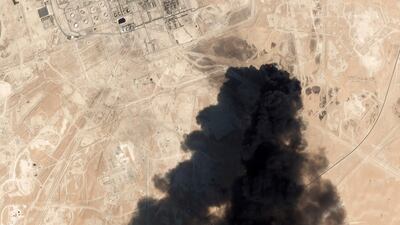
  • A satellite image from Planet Labs Inc., shows thick black smoke rising from Saudi Aramco's Abqaiq oil processing facility in Buqyaq, Saudi Arabia.The weekend drone attack on one of the world’s largest crude oil processing plants that dramatically cut into global oil supplies is the most visible sign yet of how Aramco’s stability and security is directly linked to that of its owner -- the Saudi government and its ruling family. AP
    A satellite image from Planet Labs Inc., shows thick black smoke rising from Saudi Aramco's Abqaiq oil processing facility in Buqyaq, Saudi Arabia.The weekend drone attack on one of the world’s largest crude oil processing plants that dramatically cut into global oil supplies is the most visible sign yet of how Aramco’s stability and security is directly linked to that of its owner -- the Saudi government and its ruling family. AP
  • A false-color image from the European Commission's Sentinel-2 satellite shows Saudi Aramco's Abqaiq oil processing facility in Buqyaq, Saudi Arabia. Yemen's Houthi rebels claimed to have launched drone attacks on the world's largest oil processing facility in Saudi Arabia and a major oil field Saturday, sparking huge fires and halting about half of the supplies from the world's largest exporter of oil. Black char marks at the center of the facility suggest the attack struck at the heart of the processing facility. AP
    A false-color image from the European Commission's Sentinel-2 satellite shows Saudi Aramco's Abqaiq oil processing facility in Buqyaq, Saudi Arabia. Yemen's Houthi rebels claimed to have launched drone attacks on the world's largest oil processing facility in Saudi Arabia and a major oil field Saturday, sparking huge fires and halting about half of the supplies from the world's largest exporter of oil. Black char marks at the center of the facility suggest the attack struck at the heart of the processing facility. AP
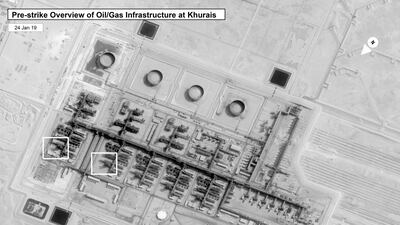
  • This image provided by the U.S. government and DigitalGlobe and annotated by the source, shows a pre-strike overview at Saudi Aramco's Khurais oil field in Buqyaq, Saudi Arabia. The drone attack Saturday on Saudi Arabia's Abqaiq plant and its Khurais oil field led to the interruption of an estimated 5.7 million barrels of the kingdom's crude oil production per day, equivalent to more than 5% of the world's daily supply. AP
    This image provided by the U.S. government and DigitalGlobe and annotated by the source, shows a pre-strike overview at Saudi Aramco's Khurais oil field in Buqyaq, Saudi Arabia. The drone attack Saturday on Saudi Arabia's Abqaiq plant and its Khurais oil field led to the interruption of an estimated 5.7 million barrels of the kingdom's crude oil production per day, equivalent to more than 5% of the world's daily supply. AP
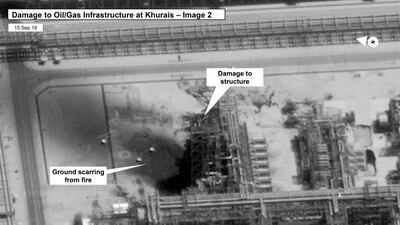
  • This image provided by the U.S. government and DigitalGlobe and annotated by the source, shows damage to the infrastructure at at Saudi Aramco's Kuirais oil field in Buqyaq, Saudi Arabia. The drone attack Saturday on Saudi Arabia's Abqaiq plant and its Khurais oil field led to the interruption of an estimated 5.7 million barrels of the kingdom's crude oil production per day, equivalent to more than 5% of the world's daily supply. AP
    This image provided by the U.S. government and DigitalGlobe and annotated by the source, shows damage to the infrastructure at at Saudi Aramco's Kuirais oil field in Buqyaq, Saudi Arabia. The drone attack Saturday on Saudi Arabia's Abqaiq plant and its Khurais oil field led to the interruption of an estimated 5.7 million barrels of the kingdom's crude oil production per day, equivalent to more than 5% of the world's daily supply. AP
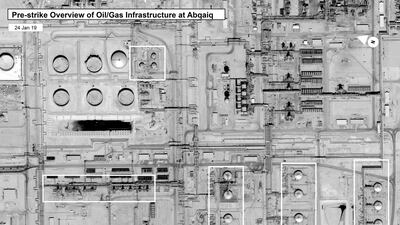
  • This image provided by the U.S. government and DigitalGlobe and annotated by the source, shows a pre-strike overview at Saudi Aramco's Abaqaiq oil processing facility in Buqyaq, Saudi Arabia. The drone attack Saturday on Saudi Arabia's Abqaiq plant and its Khurais oil field led to the interruption of an estimated 5.7 million barrels of the kingdom's crude oil production per day, equivalent to more than 5% of the world's daily supply. AP
    This image provided by the U.S. government and DigitalGlobe and annotated by the source, shows a pre-strike overview at Saudi Aramco's Abaqaiq oil processing facility in Buqyaq, Saudi Arabia. The drone attack Saturday on Saudi Arabia's Abqaiq plant and its Khurais oil field led to the interruption of an estimated 5.7 million barrels of the kingdom's crude oil production per day, equivalent to more than 5% of the world's daily supply. AP
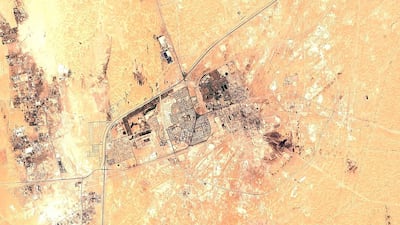
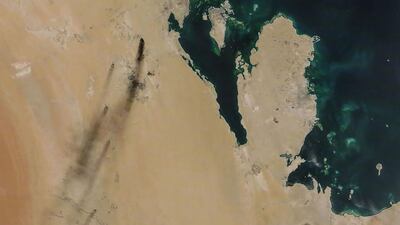
  • A satellite image provided by NASA Worldview shows fires following drone strikes on two major oil installation owned by the state giant Aramco, in eastern Saudi Arabia, and claimed by the Tehran-backed Huthi rebels in neighbouring Yemen, where a Saudi-led coalition is bogged down in a five-year war. Saudi Arabia raced on September 15, 2019 to restart operations at oil plants hit by drone attacks which slashed its production by half, as Iran dismissed US claims it was behind the assault. The peninsula in the image is Qatar and the island (top) is Bahrain. AFP PHOTO / NASA Worldview
    A satellite image provided by NASA Worldview shows fires following drone strikes on two major oil installation owned by the state giant Aramco, in eastern Saudi Arabia, and claimed by the Tehran-backed Huthi rebels in neighbouring Yemen, where a Saudi-led coalition is bogged down in a five-year war. Saudi Arabia raced on September 15, 2019 to restart operations at oil plants hit by drone attacks which slashed its production by half, as Iran dismissed US claims it was behind the assault. The peninsula in the image is Qatar and the island (top) is Bahrain. AFP PHOTO / NASA Worldview
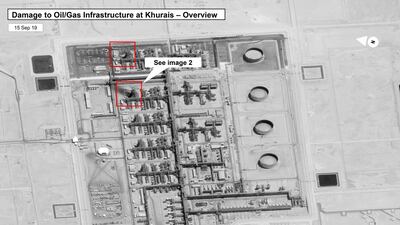
  • This image provided by the U.S. government and DigitalGlobe and annotated by the source, shows damage to the infrastructure at Saudi Aramco's Khurais oil field in Buqyaq, Saudi Arabia. The drone attack Saturday on Saudi Arabia's Abqaiq plant and its Khurais oil field led to the interruption of an estimated 5.7 million barrels of the kingdom's crude oil production per day, equivalent to more than 5% of the world's daily supply. AP
    This image provided by the U.S. government and DigitalGlobe and annotated by the source, shows damage to the infrastructure at Saudi Aramco's Khurais oil field in Buqyaq, Saudi Arabia. The drone attack Saturday on Saudi Arabia's Abqaiq plant and its Khurais oil field led to the interruption of an estimated 5.7 million barrels of the kingdom's crude oil production per day, equivalent to more than 5% of the world's daily supply. AP

US officials released satellite images of the damage at the heart of the kingdom's crucial Abqaiq oil processing plant and Khuraisa oilfield.

They claimed the pattern of destruction suggested Saturday's attack came from either Iraq or Iran, rather than Yemen.

In a tweet before the coalition’s announcement, US President Donald Trump said his country was primed to respond after the attacks that threatened global oil supplies.

“There is reason to believe that we know the culprit," Mr Trump tweeted on Sunday.

"We are locked and loaded depending on verification, but are waiting to hear from the kingdom as to who they believe was the cause of this attack, and under what terms we would proceed.”

Earlier on Sunday, US Secretary of State Mike Pompeo accused Tehran of carrying out the strikes, saying there was “no evidence” the drones had come from Yemen.

China on Monday urged the US and Iran to exercise restraint, with Foreign Ministry spokeswoman Hua Chunying saying it was not responsible to accuse others "in the absence of a conclusive investigation or verdict".

India and Britain condemned the attacks without apportioning blame.

A US official said there were 19 points of impact in the attack on the Saudi plants, and that evidence showed the launch area was west-north-west of the targets, not south from Yemen.

Iraq denied on Sunday that its territory had been used to carry out the attacks. Prime Minister Adel Abdul Mahdi received a call from Mr Pompeo on Monday, but his office did not specify what was discussed.

Saudi Aramco said the production of 5.7 million barrels of crude a day had been suspended after the attack but that work was under way to restore production.

A spokesman for the Houthi rebels, Yahia Sarie, said 10 drones had attacked the Aramco plants and more strikes were to be expected.

Mr Trump authorised the release of oil from the US's emergency oil reserves after the attacks knocked out half of the kingdom’s crude output.

In tweets, the president said the amount of oil released would be “sufficient to keep the markets well supplied”. He later said: “Plenty of oil.”

Sheikh Mohamed bin Zayed expressed the UAE’s solidarity with the kingdom in a phone call with Saudi Crown Prince Mohammed bin Salman on Sunday.

The Crown Prince of Abu Dhabi and Deputy Supreme Commander of the Armed Forces reaffirmed the country’s support for all of the measures taken by the kingdom to ensure the security and safety of its citizens, and all of those living on its soil.

“UAE and Saudi Arabia are standing as partners in facing besetting challenges. Our shared goals are the security of our nations," Sheikh Mohamed said in comments reported by Wam.

Satellite image from Planet Labs Inc. shows thick black smoke rising from Saudi Aramco's Abqaiq oil processing facility in Buqyaq. Planet Labs Inc via AP, File

Mr Trump called Prince Mohammed on Saturday to affirm his country’s "readiness to co-operate with the kingdom by all means to maintain its security and stability", the Saudi Press Agency reported.

As tension continues to rise between Washington and Tehran, Mr Trump has left open the possibility of meeting Iranian President Hassan Rounani.

But Iran on Monday ruled out any hope of that happening at the UN General Assembly in New York next week.

"Neither is such an event on our agenda, nor will it happen. Such a meeting will not take place," Foreign Ministry spokesman Abbas Mousavi said. Tehran has repeatedly rejected such a meeting.

Mr Mousavi rejected as "nonsense" remarks by the Republican Senator Lindsey Graham that it was time for the US "to put on the table an attack on Iranian oil refineries".


The bio

Favourite vegetable: Broccoli

Favourite food: Seafood

Favourite thing to cook: Duck l'orange

Favourite book: Give and Take by Adam Grant, one of his professors at University of Pennsylvania

Favourite place to travel: Home in Kuwait.

Favourite place in the UAE: Al Qudra lakes

SPECS
%3Cp%3EEngine%3A%20Supercharged%203.5-litre%20V6%0D%3Cbr%3EPower%3A%20400hp%0D%3Cbr%3ETorque%3A%20430Nm%0D%3Cbr%3EOn%20sale%3A%20Now%0D%3Cbr%3EPrice%3A%20From%20Dh450%2C000%0D%3Cbr%3E%3C%2Fp%3E%0A

Mercer, the investment consulting arm of US services company Marsh & McLennan, expects its wealth division to at least double its assets under management (AUM) in the Middle East as wealth in the region continues to grow despite economic headwinds, a company official said.

Mercer Wealth, which globally has $160 billion in AUM, plans to boost its AUM in the region to $2-$3bn in the next 2-3 years from the present $1bn, said Yasir AbuShaban, a Dubai-based principal with Mercer Wealth.

Within the next two to three years, we are looking at reaching $2 to $3 billion as a conservative estimate and we do see an opportunity to do so,” said Mr AbuShaban.

Mercer does not directly make investments, but allocates clients’ money they have discretion to, to professional asset managers. They also provide advice to clients.

“We have buying power. We can negotiate on their (client’s) behalf with asset managers to provide them lower fees than they otherwise would have to get on their own,” he added.

Mercer Wealth’s clients include sovereign wealth funds, family offices, and insurance companies among others.

From its office in Dubai, Mercer also looks after Africa, India and Turkey, where they also see opportunity for growth.

Wealth creation in Middle East and Africa (MEA) grew 8.5 per cent to $8.1 trillion last year from $7.5tn in 2015, higher than last year’s global average of 6 per cent and the second-highest growth in a region after Asia-Pacific which grew 9.9 per cent, according to consultancy Boston Consulting Group (BCG). In the region, where wealth grew just 1.9 per cent in 2015 compared with 2014, a pickup in oil prices has helped in wealth generation.

BCG is forecasting MEA wealth will rise to $12tn by 2021, growing at an annual average of 8 per cent.

Drivers of wealth generation in the region will be split evenly between new wealth creation and growth of performance of existing assets, according to BCG.

Another general trend in the region is clients’ looking for a comprehensive approach to investing, according to Mr AbuShaban.

“Institutional investors or some of the families are seeing a slowdown in the available capital they have to invest and in that sense they are looking at optimizing the way they manage their portfolios and making sure they are not investing haphazardly and different parts of their investment are working together,” said Mr AbuShaban.

Some clients also have a higher appetite for risk, given the low interest-rate environment that does not provide enough yield for some institutional investors. These clients are keen to invest in illiquid assets, such as private equity and infrastructure.

“What we have seen is a desire for higher returns in what has been a low-return environment specifically in various fixed income or bonds,” he said.

“In this environment, we have seen a de facto increase in the risk that clients are taking in things like illiquid investments, private equity investments, infrastructure and private debt, those kind of investments were higher illiquidity results in incrementally higher returns.”

The Abu Dhabi Investment Authority, one of the largest sovereign wealth funds, said in its 2016 report that has gradually increased its exposure in direct private equity and private credit transactions, mainly in Asian markets and especially in China and India. The authority’s private equity department focused on structured equities owing to “their defensive characteristics.”

The biog

First Job: Abu Dhabi Department of Petroleum in 1974  
Current role: Chairperson of Al Maskari Holding since 2008
Career high: Regularly cited on Forbes list of 100 most powerful Arab Businesswomen
Achievement: Helped establish Al Maskari Medical Centre in 1969 in Abu Dhabi’s Western Region
Future plan: Will now concentrate on her charitable work

Getting there

The flights

Flydubai operates up to seven flights a week to Helsinki. Return fares to Helsinki from Dubai start from Dh1,545 in Economy and Dh7,560 in Business Class.

The stay

Golden Crown Igloos in Levi offer stays from Dh1,215 per person per night for a superior igloo; www.leviniglut.net 

Panorama Hotel in Levi is conveniently located at the top of Levi fell, a short walk from the gondola. Stays start from Dh292 per night based on two people sharing; www. golevi.fi/en/accommodation/hotel-levi-panorama

Arctic Treehouse Hotel in Rovaniemi offers stays from Dh1,379 per night based on two people sharing; www.arctictreehousehotel.com

Specs

Engine: Dual-motor all-wheel-drive electric

Range: Up to 610km

Power: 905hp

Torque: 985Nm

Price: From Dh439,000

Available: Now

STAGE%201%20RESULTS
%3Cp%3E1)%20Tim%20Merlier%20(Soudal-Quick-Step)%2C%203h%2017%E2%80%99%2035%E2%80%9D%3Cbr%3E2)%20Caleb%20Ewan%20(Lotto%20Dstny)%20same%20time%3Cbr%3E3)%20Mark%20Cavendish%20(Astana%20Qazaqstan%20Team)%20same%20time%3Cbr%3E%3Cstrong%3EGeneral%20Classification%3A%3C%2Fstrong%3E%3Cbr%3E1)%20Tim%20Merlier%20(Soudal%20Quick-Step)%203%3A17%3A25%3Cbr%3E2%20-%20Caleb%20Ewan%20(Lotto%20Dstny)%20%2B4%22%3Cbr%3E3%20-%20Luke%20Plapp%20(Ineos%20Grenadiers)%20%2B5%22%3C%2Fp%3E%0A
The specs: 2018 Nissan 370Z Nismo

The specs: 2018 Nissan 370Z Nismo
Price, base / as tested: Dh182,178
Engine: 3.7-litre V6
Power: 350hp @ 7,400rpm
Torque: 374Nm @ 5,200rpm
Transmission: Seven-speed automatic
​​​​​​​Fuel consumption, combined: 10.5L / 100km

Avatar: Fire and Ash

Director: James Cameron

Starring: Sam Worthington, Sigourney Weaver, Zoe Saldana

Rating: 4.5/5

Uefa Nations League

League A:
Germany, Portugal, Belgium, Spain, France, England, Switzerland, Italy, Poland, Iceland, Croatia, Netherlands

League B:
Austria, Wales, Russia, Slovakia, Sweden, Ukraine, Republic of Ireland, Bosnia-Herzegovina, Northern Ireland, Denmark, Czech Republic, Turkey

League C:
Hungary, Romania, Scotland, Slovenia, Greece, Serbia, Albania, Norway, Montenegro, Israel, Bulgaria, Finland, Cyprus, Estonia, Lithuania

League D:
Azerbaijan, Macedonia, Belarus, Georgia, Armenia, Latvia, Faroe Islands, Luxembourg, Kazakhstan, Moldova, Liechtenstein, Malta, Andorra, Kosovo, San Marino, Gibraltar