
A leading health expert has praised Bahrain’s decision to establish “a war room” to help combat the coronavirus, one of a suite of “proactive” measures including strong public engagement that has so far forestalled community spread of the outbreak.
Britain’s former director of public health, professor John Ashton, has been advising the Crown Prince Salman bin Hamad on his country’s response to Covid-19 and has flown out to the Gulf state twice since the onset of the outbreak.
Prince Salman contacted Mr Ashton after he saw him giving media interviews where he called for openness and transparency when handling the new virus.
"I've been very critical about the fact they [Britain] haven't been doing that whereas Bahrain have been doing it there from the outset, publishing the data regularly, holding regular press conferences and generally seeking to engage the community. They are involving everybody in the war against the virus," he told The National.
There have been 189 cases of coronavirus found in Bahrain, and no deaths have been reported do far.
The state-run Bahrain News Agency reported on Saturday that a further 16 people had recovered from the virus, bringing the total number of recoveries to 60.
Mr Ashton's comments come after a meeting on Thursday in which senior government ministers sat with parliamentary heads to inform them of the latest developments to stop the spread of the virus in Bahrain. Interior minister, Shaikh Rashid bin Abdullah, said the meeting was at the direction of the king to inform politicians and then inform the public of all the latest news.
-

Employees of the Istanbul Municipality wearing protective gear disinfects a subway carriage to prevent the spread of the COVID-19, caused by the novel coronavirus, in Istanbul. Turkey announced on March 11, 2020 its first coronavirus case, a man who had recently travelled to Europe and is in good health. Turkey has announced several measures in recent weeks to try and stop the virus reaching the country, including thermal cameras at airports, cancelling flights to affected countries and closing its border with Iran. AFP -
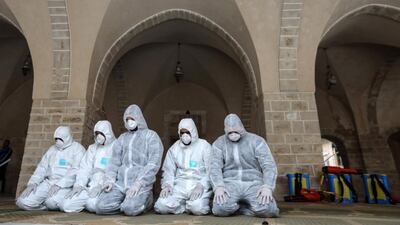
Palestinian workers wearing protective gear, pray in the courtyard of the al-Omari mosque, after spraying disinfectant products as a means of prevention against the spread of the coronavirus COVID-19, in Gaza City. AFP -

An Iranian couple use an escalator on a pedestrian bridge during coronavirus crises in Tehran, Iran. According to the last report by the Ministry of Health, 10,075 people were diagnosed with the Covid-19 coronavirus and 429 people have died in Iran. EPA -

A photograph taken on March 13, 2020 shows the entrance of a mosque that remains shut in the Iranian capital Tehran, after measures were taken to slow down the spread of the coronavirus COVID-19. The outbreak of the virus in Iran is one of the deadliest outside China, where the disease originated. Several politicians and officials both sitting and former have been infected, with some dying from the illness. AFP -
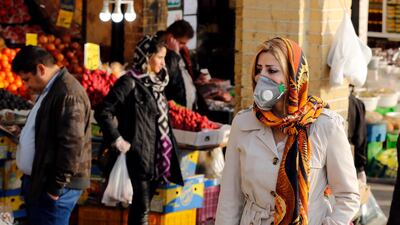
Iranians wearing face masks and protective gloves go shopping in a bazaar during the coronavirus pandemic in Tehran, Iran. Media reported the Iranian economy is effected by Covid-19 coronavirus crises as many people started to self-quarantine and to stop going out as much as they can. According to the last report by the Ministry of Health, 10,075 people were diagnosed with the Covid-19 coronavirus and 429 people have died in Iran. EPA -
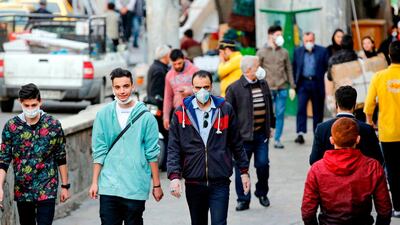
People, some wearing protective face masks, walk past shops along outside the Tajrish Bazaar in Iran's capital Tehran. Iran said on March 12 that it had asked the IMF for its first loan in decades to combat the COVID-19 coronavirus disease outbreak that has claimed 429 lives and infected more than 10,000 people. AFP -
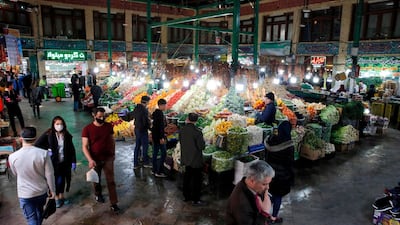
People, some wearing protective face masks, grocers stalls displaying produce at the Tajrish Bazaar in Iran's capital Tehran. Iran said on March 12 that it had asked the IMF for its first loan in decades to combat the COVID-19 coronavirus disease outbreak that has claimed 429 lives and infected more than 10,000 people. AFP -
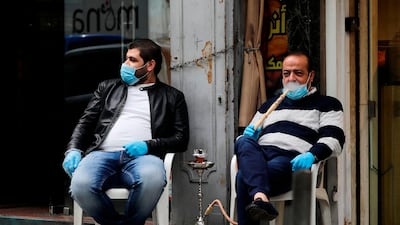
Lebanese men wearing protective masks smoke water pipe or nargileh in Beirut. Lebanon suspended flights from countries hit hardest by the novel coronavirus after announcing its second death from the pandemic in two days. The Mediterranean nation has recorded at least 61 cases of COVID-19. Prime Minister Hassan Diab said Lebanon would suspend all trips to and from Italy, South Korea, Iran and China, the hardest-hit countries. AFP -
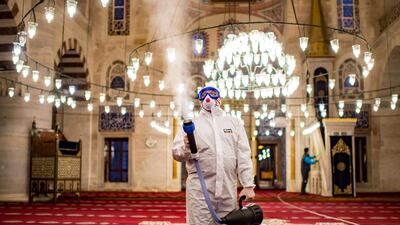
A member of the Istanbul's Municipality disinfects the Kilic Ali Pasa Mosque to prevent the spread of the COVID-19, the novel coronavirus, in Istanbul. Turkey announced on March 11, 2020 its first coronavirus case, a man who had recently travelled to Europe and is in good health. Turkey has announced several measures in recent weeks to try and stop the virus reaching the country, including thermal cameras at airports, cancelling flights to affected countries and closing its border with Iran. AFP -
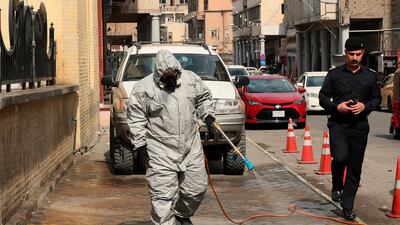
A civil defence worker sprays disinfectant as a precaution against the coronavirus, outside the Artists Syndicate in Baghdad, Iraq. The vast majority of people recover from the new coronavirus. According to the World Health Organization, most people recover in about two to six weeks, depending on the severity of the illness. AP Photo -
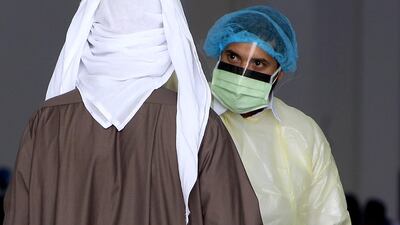
Kuwaiti healthy ministry workers scan expatriates living in Kuwait who returned from Egypt, Syria and Lebanon, as they arrive at a specified place to be tested for coronavirus in Kuwait City. AFP -

Qatari police stand outside a hotel in Doha where people have been quarantining over fears of coronavirus. Stock markets in energy-rich Gulf states tumbled today with Saudi shares down more than 4.0 per cent following worldwide losses amid fears over the coronavirus pandemic and an oil price war. Stocks in gas-rich Qatar dropped 5.2 per cent, while bourses in Bahrain and Oman were down 3.5 per cent and 2.2 per cent, respectively. AFP -

A Syrian refugee student takes part in a washing hands activity as part of an awareness campaign about coronavirus initiated by OXFAM and UNICEF at Al Zaatari refugee camp in the Jordanian city of Mafraq, near the border with Syria. Reuters -
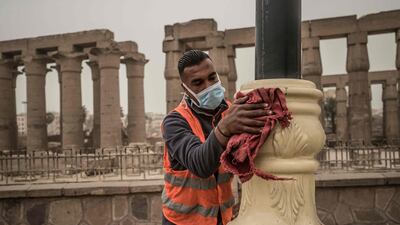
A municipality worker cleans lamp posts amid a sandstorm and coronavirus fears outside the Luxor Temple in Egypt's southern city of Luxor. AFP


Mr Ashton pointed out that almost all of the cases in Bahrain had visited Iran.
“Of the first 160 people that came in, 50 per cent of them turned out to be corona positive,” he said.
Mr Ashton described Bahrain as having set up “a war room” where health professionals triaged pilgrims and other groups suspected to have contracted coronavirus, under control of the Crown Prince.
“They’ve been very systematic, very proactive, very thorough and to date, they’ve got nearly 200 cases, but haven’t got any community spread. They haven’t lost anybody either,” he said.
“They have a very interesting treatment protocol, which is quite a complex mixture of treatments that they are using under the direction of the military doctor who’s running the war room,” he added.
Some Bahrainis are still stranded in Iran but the government is trying to return them on flights – the first one was on Tuesday.
The Bahraini government has insisted it will not leave any national stranded and will work to bring them home.

On Thursday, Prince Salman called on everyone to join the "nationwide campaign” against the virus and described every citizen as a soldier in the fight.
He particularly praised medical teams working to stem the flow of new cases, earning them international praise.
Mr Ashton said that the kingdom had also been more open with the public regarding the outbreak than he has seen in the UK.
Bahrain has been holding regular televised press briefings and the state-run Bahrain News Agency published regular updates on cases, treatments and those who have recovered.
“I’m impressed that after I identified some of the weak links in the chain of control for them, they immediately responded to deal with them,” he said, adding that it made him “embarrassed” about the British approach to tackling the virus.
He said the initial vulnerability for the kingdom was being able to tighten down on international arrivals and departures.
But he said the main challenge Bahrain has faced is all of the religious tourists that have travelled to Iran to visit holy sites.
The religious balance between Sunni and Shia in Bahrain means that many in the country travel frequently to religious sites in Iran.
“It’s the centenary of Bahrain this year and with those cultural differences between the two sides of Islam, they see this [the coronavirus outbreak] as an opportunity to get everyone together against a common threat,” he said.
The professor said Bahrainis were “transcending’ sectarian and political differences with measures to combat the outbreak.
Mr Ashton’s words echoed Shaikh Rashid’s comments on Thursday in which he warned that the current crisis shouldn’t be politicized and he rejected sectarianism.
But Mr Ashton also warned that like most countries, Bahrain still had challenges to come.
“They’ve got a big challenge ahead because they have a couple of thousands of these religious pilgrims need to come home. But they’ve been very committed to working in harmony with the public and sharing everything they know.”

