
As the death toll from the powerful earthquake that hit eastern Turkey on Friday evening mounted, many people took to social media to question the country’s readiness to deal with the disaster.
Lying on top of two major fault lines, the risk of a major earthquake in Turkey is an ever-present danger. Friday's Elazig quake, which left 39 dead and more than 1,600 injured, is just the latest in a series of deadly tremors to hit Turkey.
Questions over why some buildings collapsed while others remained intact or why groups such as the Turkish Red Crescent were calling for donations rather that using tax money led to a quick response from the government.
On a visit to the city of Elazig, near the epicentre of Friday's magnitude 6.8 quake, President Recep Tayyip Erdogan warned against "negative propaganda" and "rumours". The following day he condemned a social media "smear campaign" against the government's response as "immoral".
Meanwhile, a prosecutor in Ankara opened an investigation into “provocative” social media posts while Turkey’s broadcasting authority said it was to review media coverage of the quake.
At least two people have been arrested for criticising the response to the Elazig quake, Hurriyet newspaper reported on Sunday.
Despite the state’s reaction, the Union of Chambers of Turkish Engineers and Architects suggested there was obvious evidence of a lack of preparation.
“Even moderate-sized earthquakes cause a lot of damage to the building stock in the countryside, making it the clearest indication that the necessary measures for the earthquake have not been taken,” the union said in a statement after the Elazig quake. It called for stringent standards to be applied to building design, construction and inspection.
-

Rescue workers work at the scene of a collapsed building in Elazig, Turkey. Getty Images -
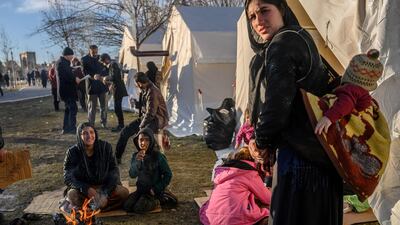
Women gather near a fire outside tents after leaving their homes following an earthquake in Elazig. AFP -
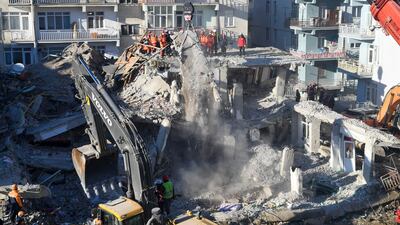
Rescue workers continue to look for people trapped under debris following a strong earthquake that destroyed several buildings on Friday, in Elazig, eastern Turkey. AP Photo -
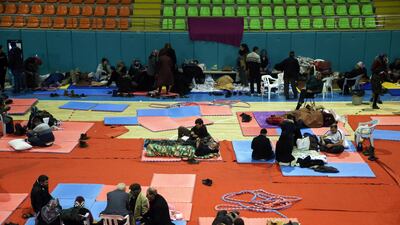
People rest at an indoor sports hall, a temporary shelter, after an earthquake hit Elazig, Turkey. EPA -

People try get warm around a fire after an earthquake hit Elazig, Turkey. EPA -
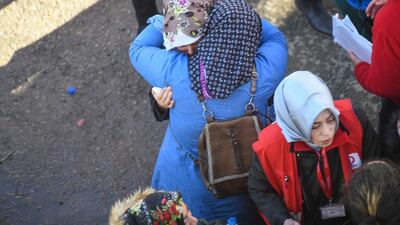
Two women embrace as rescue workers try to save people trapped under debris following a strong earthquake that destroyed several buildings on Friday, in Elazig, eastern Turkey. AP Photo -

Rescue workers retrieve a body from the rubble of a building after an earthquake hit Elazig, Turkey. EPA -

A relative grieves during a funeral ceremony of 5 members of the Aslan family in Elazig, Turkey. Getty Images -
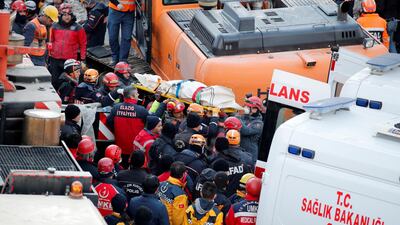
Rescue workers carry the body of an earthquake victim in Elazig, Turkey. REUTERS -

Rescuers search for people buried under the rubble on a collapsed building, after an earthquake struck Elazig, eastern Turkey. AP -
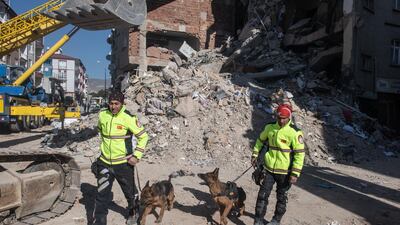
Rescue dogs search the scene of a collapsed building in Elazig, Turkey. Getty Images


Mohammad Heidarzadeh, assistant professor of civil engineering at Brunel University London, said that the same area has experienced 12 earthquakes with magnitude of more than 6.5 over the past 110 years. On average, a deadly earthquake like this one is expected every 10 years in this region.
"The cause of such large earthquake activity is the presence of the East Anatolia Fault Zone, which is a major fracture on Earth’s crust in this part of Turkey and has produced a number of deadly earthquakes in the past. The challenge for earthquake safety in this part of the world is that most of the buildings in the rural areas are non-engineered masonry buildings, defenceless against earthquakes with magnitude above 6," he said.
"It is essential that the governments in the region invest in replacing masonry buildings with engineered or semi-engineered buildings to save lives during earthquakes."
Over the course of the 20th century, Turkey's Marmara region was hit by five earthquakes of magnitude 7 or larger, including a devastating 1999 earthquake centred on Izmit, south of Istanbul, that killed 18,000 people. While Turkey bolstered its emergency agencies following the disaster, the standard of construction and the availability of assembly areas is a topic for debate.
According to Turkey’s Environment and Urbanisation Ministry, more than half of the country’s housing stock, or 13 million structures, contravene regulations.
While civil engineering bodies have called for these structures to be demolished, in 2018 the government introduced an amnesty that allowed property owners to pay to keep the buildings in their existing condition. Some 1.8 million applications were accepted.
Such buildings are often constructed using substandard practices or have additional storeys added without the foundations being sufficiently reinforced.
As Turkey underwent a construction boom, critics say corners were cut and urban spaces reserved for earthquake assembly points — areas where tents and field hospitals can be set up — disappeared.
Ayse Acar Basaran, an MP for the opposition Peoples’ Democratic Party (HDP), said profit had been put ahead of public safety.
"Natural disasters don’t [necessarily] bring death but, for the sake of [more] rent, the public’s health and the right to life is ignored," she said, referring to cheap construction work.
A call by head of the Turkish Red Crescent for people to donate to the Elazig victims prompted the Twitter hashtag “where did the earthquake taxes go?”.
Following the Izmit quake, the government imposed an “earthquake tax” to rebuild the area and improve plans for future disasters.
“Where’s this 50-60 billion Turkish lira (Dh31-37 billion) budget?” asked Prof Haluk Eyidogan, a seismologist at Istanbul Technical University. “We want to be informed but unfortunately we’re not informed. Someone responsible needs to tell the public about it.”
Some estimates put the figure set aside for earthquake preparations as high as 80 billion lira.
Okan Tuysuz, a professor at Istanbul Technical University who specialises in studying Anatolia’s seismic activity, suggested money allocated for major infrastructure projects, such as the proposed canal to divert ships from the Bosporus, should be given to earthquake planning.
“The money to be spent there should be used for earthquake preparation but this is a political choice,” he said. “If we have the money to build Canal Istanbul, with this budget Turkey can be properly earthquake ready.”

