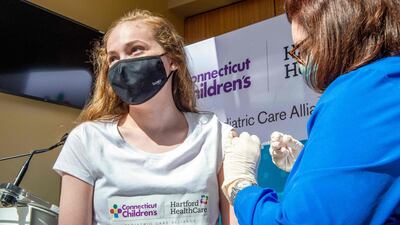

Countries with vaccines to spare should donate them to the global Covax scheme instead of immunising children, the head of the World Health Organisation said.
The US this week authorised the Pfizer vaccine for children aged 12 to 15, and the drug maker is seeking similar approvals in Britain and the EU.
But with the second year of the pandemic on track to be more deadly than the first, doses should be shared with developing countries instead, WHO director general Tedros Adhanom Ghebreyesus said.
“I understand why some countries want to vaccinate their children and adolescents, but right now I urge them to reconsider and to instead donate vaccines to Covax,” he said.
Covax, which is run by the WHO and other organisations, is aimed at ensuring that developing countries have access to vaccines.
It has so far shipped more than 53 million doses of Covid-19 vaccines to 121 participating countries and territories.
But vaccination rates are still far higher in wealthy countries, and it is feared that people in some countries may not be immunised until 2024.
At present, only 0.3 per cent of global vaccine supplies are going to low-income countries, Dr Tedros said.
In poorer countries, supplies have not been enough to immunise health workers, he said.
“In January, I spoke about the potential unfolding of a moral catastrophe. Unfortunately, we're now witnessing this play out,” he said.
“Trickle-down vaccination is not an effective strategy for fighting a deadly respiratory virus.”
US and Europe find new uses for vaccine supplies
While the US speeds ahead with vaccinating children, Britain is looking at throwing extra doses at areas where the B.1.617.2 variant first identified in India appears to be spreading rapidly.
Vaccines minister Nadhim Zahawi told Times Radio that the shots could be offered to younger people in multigenerational households.
Those receiving the Pfizer vaccine could have their second doses more quickly to boost protection.
In Germany, meanwhile, some states are throwing open vaccines to all age groups if they get a shot from a family doctor.
The AstraZeneca and Johnson & Johnson shots are already available to all age groups nationwide.
Some states, including Berlin and Bavaria, are now going further by opening up the Pfizer and Moderna vaccines to all adults as well.
Neighbouring France is urging the US to start exporting vaccines and the ingredients needed to make them.
-

Lea Wittenborg, right, tests her colleague Annika Tschirbs at the Engel pharmacy in Soest, Germany. Germany's coronavirus infection rate dropped to its lowest level in nearly two months on Friday. AP Photo -
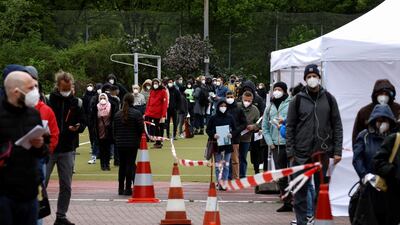
Residents queue at a sports hall to get vaccinated against the coronavirus disease in Berlin, Germany. Reuters -

A woman wearing a face mask walks on a bridge over the river Main in Frankfurt, Germany. AP Photo -
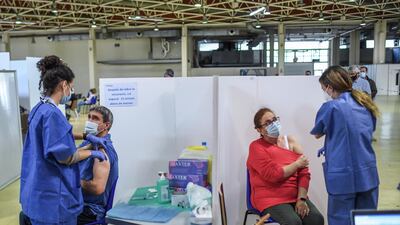
People are vaccinated with the Pfizer-BioNTech vaccine in Barcelona, Spain. Spaniards under 60 were invited to receive a vaccination this week, with a target set to vaccinate 70 percent of Spain's population by the end of August. Getty Images -

Tourists leave the international airport of Heraklion upon their arrival to spend their holidays on the island of Crete. Greece kickstarts its tourism season on May 14, with both the government and travel operators hoping the lure of sun, sand and sea will bring a sorely needed revenue boost. AFP -

People visit the Acropolis Museum, as museums open following the easing of measures against the spread of the coronavirus disease in Athens, Greece. Reuters -

A drone photo of participants of a march to express dissatisfaction with the coronavirus restrictive measures in Den Bosch, the Netherlands. EPA -
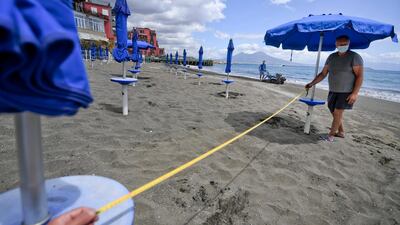
Preparations are underway on the beach of Bagno Elena in Naples, Italy, as the historic seaside resort of Posillipo will reopen to the public this weekend. EPA -
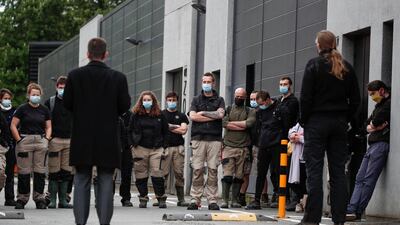
Employees attend a meeting at the Paris Zoological Park in the Bois de Vincennes before the reopening in France. Reuters -

People queue outside a mass vaccination center in Paris, France. Reuters


In India, the world's largest manufacturer of vaccines, authorities started distributing the Russian Sputnik V vaccine on Friday.
India has administered about 180 million shots but only 40 million people are fully vaccinated, 3 per cent of its population.
The programme was expanded to all adults on May 1, but many Indian states are unable to meet the surging demand.
India's Serum Institute produces about 60 to 70 million doses of AstraZeneca per month and is aiming for 100 million by July.
Companies in India have agreements to make other vaccines, including Johnson & Johnson's, but they could be months away.
Dr Tedros said the situation in India was hugely concerning, with several states recording worrying numbers of cases, hospital admissions and deaths.
He mentioned Nepal, Sri Lanka, Vietnam, Cambodia, Thailand and Egypt as other countries facing urges in case numbers and hospital admissions.
“Covid-19 has already cost more than 3.3 million lives and we’re on track for the second year of the pandemic to be far more deadly than the first,” he said.
“Saving lives and livelihoods with a combination of public health measures and vaccination – not one or the other – is the only way out.”

