For Shorsh Saleh, an Iraqi-Kurdish weaver and artist who is now a refugee in the UK, his trade is suffering in his home region after decades of war left carpet markers from the mountains displaced and their homes destroyed.
Born into a politically active family, Mr Saleh fled his home town in Sharazur, Iraqi Kurdistan, 18 years ago and took the treacherous path that millions of migrants have since undertaken in recent years, seeking safety in Europe.
At London’s Imperial War Museum, he’s now using his artistry to shed light on both the Kurdish issue and refugee crisis as part of a wider exhibition that tells the story of those who have faced persecution and conflict in their home countries over the last 100 years.
-

Shorsh Saleh's paintings look into the journey refugees take. IWM -
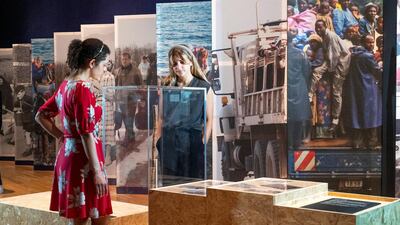
Refugees: Forced to Flee, the new exhibition at IWM London, explores a century of refugee experiences, from Nazi Germany’s persecution of Jews and the Kindertransport, to the Calais Jungle and the treacherous Mediterranean crossings. Taking place at IWM London and IWM North, Refugees explores refugee experiences throughout history and ongoing issues faced by those affected through two major exhibitions, a series of events and a new site-specific art commission at IWM London from world-renowned artist Ai Weiwei. Photographed 21st September 2020. -
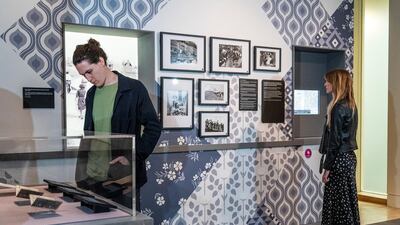
Refugees: Forced to Flee, the new exhibition at IWM London, explores a century of refugee experiences, from Nazi Germany’s persecution of Jews and the Kindertransport, to the Calais Jungle and the treacherous Mediterranean crossings. IWM -

One of the carpets that Shorsh Saleh designed. IWM -
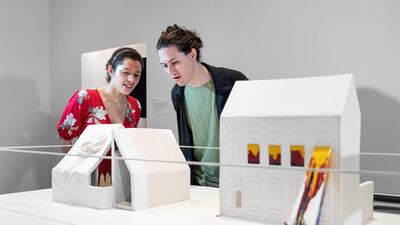
Taking place at IWM London and IWM North, Refugees explores refugee experiences throughout history and ongoing issues faced by those affected through two major exhibitions, a series of events and a new site-specific art commission at IWM London from world-renowned artist Ai Weiwei. IWM -

The opening of the exhibition was delayed because of Covid-19. IWM -
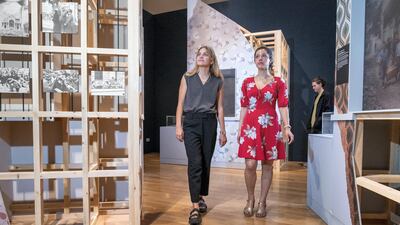
Iris Veysey, art curator at the Imperial War Museum, said the exhibition gave people a chance to look behind the headlines and learn more about the reality of being a refugee. IWM -

Portrait of Shorsh Saleh in his studio in South London. IWM commissioned Shorsh to create artwork for it’s upcoming Refugee exhibition season, running in 2020. Photographed 16th January 2020.


Iris Veysey, art curator at the Imperial War Museum, said it gave people a chance to look behind the headlines and learn more about the reality of being a refugee.
Two carpets Mr Saleh has designed – titled ‘Displacement’ and ‘Destruction’ – use traditional patterns and were wove by women in Iraqi Kurdistan. “In this work I want to show the story through the same craft,” he said.
Mr Saleh is using the Refugees: Forced to Flee exhibition to highlight the complex issue of Kurdish identity, Kurds often described as the world's largest stateless community.
“As a Kurdish people we have an issue with identity. If you ask me, where I come from I say Kurdistan, but nobody knows geographically where Kurdistan is. So you have to say, ‘no actually, I’m Iraqi but I’m Kurdish,’” he said.
“So it’s a very tricky question if you ask any Kurdish person where they come from. We are struggling with the answer. I think that was very challenging for me to take this identity theme and to put it in my works.”

Rough estimates put the Kurdish population in Iraq, Syria, Turkey and Iran at around 40 million, but despite this, only in Iraqi-Kurdistan do they have some semblance of autonomy. In Turkey they face oppression and in Syria any steps towards autonomous administration made in the north-east are at risk.
“We are struggling to have our own identity. We say it’s been stolen by the neighbours. So for me, it still is hard to express it because it’s very deep,” Mr Saleh said.
More broadly, Mr Saleh says any time is a good time to talk about the plight of refugees, adding: “When people are fleeing they just don’t flee for fun.” His five paintings tell the story of his own escape from Iraq and his subsequent struggle to find refuge.
“You just have a little bag on you with some food and some water, and maybe a sleeping bag if you are lucky. And then you deal with the smugglers and some smugglers basically, they just do whatever they want,” he said as he recalled his journey 18 years ago.
“So sometimes you end up living in a mountain for weeks under the rocks. You have to basically travel through the night most of the time which is very dangerous.”
Border guards in Iran, Iraq and Turkey have a reputation for shooting people trying to cross, Mr Saleh said.
During his journey to Europe he said that he sometimes went days without food because of a lack of money. He added: “So you have to travel days and nights to get in a safe place and then you end up in Turkey and then by boat you travel to Greece, and then from Greece you travel by boat to Italy.
“You have to sleep in the park, you have to squat in a house.”
Mr Saleh says refugees and migrants must be given better support and points out that often people seeking entry in the UK continue to face an array of obstacles.
“And then you feel like you are in a safe place but still you’re not. Basically there is no safe place, you’re still struggling mentally and physically with your life.”
Refugees: Forced to Flee at IWM London runs until 24 May 2021 and is supported by the Arts and Humanities Research Council (AHRC) and the Economic and Social Research Council (ESRC).
-
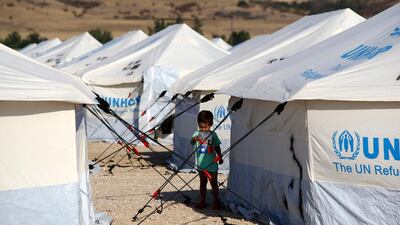
A migrant boy stands outside a tent at a refugee camp in Nea Kavala, northern Greece. About 1,500 asylum-seekers transported from Greece's eastern Aegean island of Lesbos to the mainland. Around 1,000 of those transferred and housed in Nea Kavala, where they will be staying in tents until the end of the month, after which they will be transferred to a new camp under construction. AP -

A migrant carries his belongings at a refugee camp in Nea Kavala, northern Greece. About 1,500 asylum-seekers transported from Greece's eastern Aegean island of Lesbos to the mainland. Around 1,000 of those transferred and housed in Nea Kavala, where they will be staying in tents until the end of the month, after which they will be transferred to a new camp under construction. AP -

A migrant passes by telephone booths in Nea Kavala camp, near the city of Kilkis, northern Greece. Some 1000 refugees and migrants were transferred from the Greek island of Lesbos to the Nea Kavala camp under a decision taken by the Greek government at an emergency meeting on August 31. AFP -
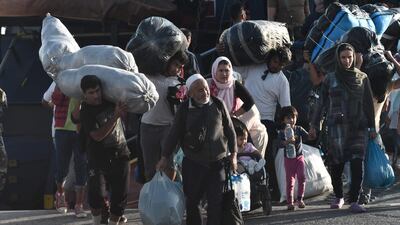
Hundreds of migrants arrive from the Greek island of Lesbos in the port of Thessaloniki. Another 700 migrants are due to be transferred later Monday, under a decision taken by the Greek government at an emergency meeting Saturday.The UN High Commissioner for Refugees said that the island of Lesbos was sheltering nearly 11,000 people at the end of August -- four times its capacity. In August alone, more than 3,000 people had arrived there, said the agency. AFP -

Hundreds of migrants arrive from the Greek island of Lesbos in the port of Thessaloniki. Another 700 migrants are due to be transferred later Monday, under a decision taken by the Greek government at an emergency meeting Saturday.The UN High Commissioner for Refugees said that the island of Lesbos was sheltering nearly 11,000 people at the end of August -- four times its capacity. In August alone, more than 3,000 people had arrived there, said the agency. AFP -

Children play after arriving at Nea Kavala refugee camp, near the city of Kilkis, northern Greece. Some 1000 refugees and migrants were transferred from the Greek island of Lesbos to the Nea Kavala camp under a decision taken by the Greek government at an emergency meeting on August 31. AFP -

A boy stands at Nea Kavala camp, near the city of Kilkis, northern Greece. Some 1000 refugees and migrants were transferred from the Greek island of Lesbos to the Nea Kavala camp under a decision taken by the Greek government at an emergency meeting on August 31. AFP -

Migrants are seen at Nea Kavala camp, near the city of Kilkis, northern Greece. Some 1000 refugees and migrants were transferred from the Greek island of Lesbos to the Nea Kavala camp under a decision taken by the Greek government at an emergency meeting on August 31. AFP -

A baby sleeps at a refugee camp in Nea Kavala, northern Greece. About 1,500 asylum-seekers transported from Greece's eastern Aegean island of Lesbos to the mainland. Around 1,000 of those transferred and housed in Nea Kavala, where they will be staying in tents until the end of the month, after which they will be transferred to a new camp under construction. AP -
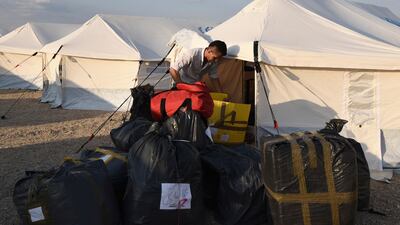
A migrant arrives at a refugee camp in Nea Kavala, northern Greece. About 1,500 asylum-seekers transported from Greece's eastern Aegean island of Lesbos to the mainland. Around 1,000 of those transferred and housed in Nea Kavala, where they will be staying in tents until the end of the month, after which they will be transferred to a new camp under construction. AP -

Children sleep inside a tent at a refugee camp in Nea Kavala, northern Greece. About 1,500 asylum-seekers transported from Greece's eastern Aegean island of Lesbos to the mainland. Around 1,000 of those transferred and housed in Nea Kavala, where they will be staying in tents until the end of the month, after which they will be transferred to a new camp under construction. AP