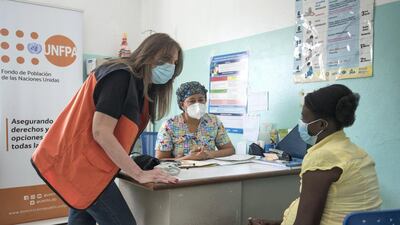
The UN said women in poorer nations were at risk as a result of the UK's decision to slash funding to a family planning programme. UNFPA

UN agency accuses UK of deserting poor nations with devastating aid cuts


  • English
  • Arabic

A UN agency launched a scathing attack on Britain over its foreign aid budget cuts, warning that women and girls around the world will suffer as a result.

The UN Population Fund said the UK planned to cut family planning aid from £154 million ($214m) to £23m this year – a drop of 85 per cent.

Details of the cut emerged came after other programmes were identified as being in the firing line for funding cuts after Britain slashed its foreign aid budget.

The agency, UNFPA, supplies contraceptives and maternal health medicine for millions of women in some of the world’s poorest countries, trains maternal health workers, and promotes efforts to stop female genital mutilation and child marriage.

Natalia Kanem, UNFPA executive director, accused Britain of “stepping away from its commitments at a time when inequalities are deepening and international solidarity is needed more than ever”.

“These cuts will be devastating for women and girls and their families across the world,” she said.

"With the now-withdrawn £130m, the UNFPA Supplies Partnership would have helped prevent around 250,000 maternal and child deaths, 14.6 million unintended pregnancies and 4.3 million unsafe abortions.”

An additional £12m will be cut from UNFPA's core operating funds.

The agency acknowledged "the challenging situation facing many donor governments", but said it "deeply regrets the decision of our longstanding partner".
"The truth is that when funding stops, women and girls suffer, especially the poor, those living in remote, underserved communities and those living through humanitarian crises," it said.

The UK this year announced it would slash its overall foreign aid budget from 0.7 per cent to 0.5 per cent of its national income, a reduction of about £4 billion.

The programmes affected by the decision are now becoming apparent.

On Wednesday, it was reported the UK planned to slash funding for international clean water and sanitation projects by 80 per cent.

On Tuesday, Liz Sugg – a former Foreign Office minister who resigned in protest over the cuts – challenged the government to confirm which programmes would be cut.

She said the government planned to cut the overseas budget for girls' education by more than 40 per cent.

Natalia Kanem, executive director of the UN Population Fund, visits the Kutupalong refugee camp in Bangladesh. Reuters

The former minister also claimed that Britain planned to close its Women’s Integrated Sexual Health programme and cut funding to the Reproductive Health Supplies Coalition by up to 80 per cent.

Foreign Secretary Dominic Raab said he did not recognise the figures, but admitted no area was immune to cuts.

Responding to the UN statement on Thursday, Ms Sugg said Britain’s withdrawn financial support to the women’s health organisation was a “double hit on the world's poorest”.

"The cuts which we're seeing to the aid budget are huge," she told the BBC Radio 4 Today programme on Thursday.

“This is money the UK committed to in the UN chamber, signed an agreement and now we’re walking away from it – it’s pretty unheard of.”

She said the UK was traditionally a strong advocate for women and girls around the world.

"(The cut) means millions of women will not have access to contraception and sadly that will mean many unwanted pregnancies and unsafe abortions," she said.

Former UK prime minister Tony Blair called on the leaders of the wealthy G7 collective of wealthy nations to redirect aid budgets to help poorer nations purchase Covid-19 vaccines.

Vaccines Minister Nadhim Zahawi emphasised the UK’s commitment to the World Health Organisation’s Covax initiative that helps inoculate the world’s poorest populations, with the UK donating £548m to the scheme.

“We are doing a hell of a lot to make sure we help the rest of the world,” he told Sky News.

The Foreign Office said the aid cuts were only temporary and put in place because of the "seismic effect” of Covid-19 on the UK economy.

"We are working through what this means for individual programmes. Decisions will be announced in due course,” it said.

"We will still spend more than £10bn this year to fight poverty, tackle climate change and improve global health."

Official data shows emergency pandemic support measures have sent Britain's annual borrowing rocketing to the highest level since the Second World War.

More on foreign aid

UK vows to reverse cut in international aid when economy recovers from pandemic

World’s poorest countries braced for funding cuts ahead of UK aid budget announcement

UK’s foreign aid cuts likely to hinder vaccination and climate change efforts

The Sand Castle

Director: Matty Brown

Stars: Nadine Labaki, Ziad Bakri, Zain Al Rafeea, Riman Al Rafeea

Rating: 2.5/5

A cryptocurrency primer for beginners

Cryptocurrency Investing  for Dummies – by Kiana Danial 

There are several primers for investing in cryptocurrencies available online, including e-books written by people whose credentials fall apart on the second page of your preferred search engine. 

Ms Danial is a finance coach and former currency analyst who writes for Nasdaq. Her broad-strokes primer (2019) breaks down investing in cryptocurrency into baby steps, while explaining the terms and technologies involved.

Although cryptocurrencies are a fast evolving world, this  book offers a good insight into the game as well as providing some basic tips, strategies and warning signs.

Begin your cryptocurrency journey here. 

Available at Magrudy’s , Dh104 

Specs

Engine: Dual-motor all-wheel-drive electric

Range: Up to 610km

Power: 905hp

Torque: 985Nm

Price: From Dh439,000

Available: Now

Water waste

In the UAE’s arid climate, small shrubs, bushes and flower beds usually require about six litres of water per square metre, daily. That increases to 12 litres per square metre a day for small trees, and 300 litres for palm trees.

Horticulturists suggest the best time for watering is before 8am or after 6pm, when water won't be dried up by the sun.

A global report published by the Water Resources Institute in August, ranked the UAE 10th out of 164 nations where water supplies are most stretched.

The Emirates is the world’s third largest per capita water consumer after the US and Canada.

Pox that threatens the Middle East's native species

Camelpox

Caused by a virus related to the one that causes human smallpox, camelpox typically causes fever, swelling of lymph nodes and skin lesions in camels aged over three, but the animal usually recovers after a month or so. Younger animals may develop a more acute form that causes internal lesions and diarrhoea, and is often fatal, especially when secondary infections result. It is found across the Middle East as well as in parts of Asia, Africa, Russia and India.

Falconpox

Falconpox can cause a variety of types of lesions, which can affect, for example, the eyelids, feet and the areas above and below the beak. It is a problem among captive falcons and is one of many types of avian pox or avipox diseases that together affect dozens of bird species across the world. Among the other forms are pigeonpox, turkeypox, starlingpox and canarypox. Avipox viruses are spread by mosquitoes and direct bird-to-bird contact.

Houbarapox

Houbarapox is, like falconpox, one of the many forms of avipox diseases. It exists in various forms, with a type that causes skin lesions being least likely to result in death. Other forms cause more severe lesions, including internal lesions, and are more likely to kill the bird, often because secondary infections develop. This summer the CVRL reported an outbreak of pox in houbaras after rains in spring led to an increase in mosquito numbers.

Our family matters legal consultant

Name: Hassan Mohsen Elhais

Position: legal consultant with Al Rowaad Advocates and Legal Consultants.

Who has lived at The Bishops Avenue?
  • George Sainsbury of the supermarket dynasty, sugar magnate William Park Lyle and actress Dame Gracie Fields were residents in the 1930s when the street was only known as ‘Millionaires’ Row’.
  • Then came the international super rich, including the last king of Greece, Constantine II, the Sultan of Brunei and Indian steel magnate Lakshmi Mittal who was at one point ranked the third richest person in the world.
  • Turkish tycoon Halis Torprak sold his mansion for £50m in 2008 after spending just two days there. The House of Saud sold 10 properties on the road in 2013 for almost £80m.
  • Other residents have included Iraqi businessman Nemir Kirdar, singer Ariana Grande, holiday camp impresario Sir Billy Butlin, businessman Asil Nadir, Paul McCartney’s former wife Heather Mills. 
Hunting park to luxury living
  • Land was originally the Bishop of London's hunting park, hence the name
  • The road was laid out in the mid 19th Century, meandering through woodland and farmland
  • Its earliest houses at the turn of the 20th Century were substantial detached properties with extensive grounds


Other key dates
  • Finals draw: December 2
  • Finals (including semi-finals and third-placed game): June 5–9, 2019
  • Euro 2020 play-off draw: November 22, 2019
  • Euro 2020 play-offs: March 26–31, 2020
