UK wins race to approve Pfizer vaccine with immunisations to start next week


  • English
  • Arabic

The UK approved the Pfizer-BioNTech vaccine for use and the shot will be available from next week.

Britain is the first country in the West to approve a coronavirus vaccine for general use in an attempt to end the pandemic that began in Wuhan in China late last year and has so far killed more than 1.4 million people.

The approval came on the same day England emerged from its second lockdown.

The vaccine was approved by the Medicines and Healthcare products Regulatory Agency (MHRA).

Immunisations could start within days, with the shot made available across the UK from next week, the government said.

Prime Minister Boris Johnson tweeted that the rollout of vaccines would "ultimately allow us to reclaim our lives and get the economy moving again".

Health Secretary Matt Hancock said "help is on its way" and confirmed hospitals would begin a mass vaccination programme for priority groups from "early next week".

"The NHS (National Health Service) stands ready to make that happen," he told Sky News.

"From early next week, we will start the programme for vaccinating people against Covid-19 in this country."

Pfizer and BioNTech on Tuesday sought regulatory clearance for their vaccine in the European Union, putting the shot on track for potential approval on the continent before the end of the year.

In the US, a Food and Drug Administration panel is to meet on December 10 to discuss the vaccine.

Britain was able to approve the vaccine ahead of Europe under special regulations put in place  before Brexit on January 1, when the UK becomes fully responsible for medicines authorisation.

Trials showed Pfizer's vaccine was 95 per cent effective in protecting people from coronavirus.

The UK has ordered 40 million doses of the vaccine – enough to vaccinate 20 million people because it is a two-shot regimen.

The government said the health service had made "extensive preparations" for a mass immunisation programme that will begin with care home residents, health workers, the elderly and the extremely clinically vulnerable as first in line to be inoculated.

But it said coronavirus restrictions must still be adhered to until most of the population is inoculated.

About 10 million doses should be available soon, with the first 800,000 arriving in the UK from Belgium in the coming days.

The shot will be administered by GPs, pharmacists and at vaccination centres which are being set up around the country.

While care home residents are first in line to get the shot, this depends on whether it is practically possible.

Adding to the distribution challenges, the Pfizer vaccine must be stored at ultra-cold temperatures. Two doses three weeks apart are required for protection.

The vast majority of vaccinations are expected next year.

Mr Hancock predicted the UK would begin to return to normality in the first half of 2021.

"From the spring onwards, things will start to get better," he told BBC's Radio 4 Today programme.

Experts hailed Britain's emergency use authorisation as a historic moment in the global fight against coronavirus and a triumph for science.

It is the fastest vaccine to go from concept to reality, taking only 10 months to follow the same steps that normally span a decade.

Danny Altmann, professor of immunology at Imperial College London, said news of the approval was momentous.

He said: "Less than 11 months from the first characterisation of the virus sequence, we have the first emergency approval for use of a really effective vaccine. Truly heroic.

"I don't think we should get too hung up on ‘the race’ and this as the first approval. Over the next several weeks we’ll probably see a number of licences granted – and we do need them all to get speedily out of this mess."

Liam Smeeth, professor of clinical epidemiology at the London School of Hygiene and Tropical Medicine, said the UK was charting a course towards a "much better situation".

"A further circuit breaker in January or possibly February is likely to be needed. But it is realistic to hope that by March or April the vast majority of older people, care home residents, and those with severe conditions will have been immunised," he said.

"Life won’t ever be the same as it was before Covid-19, but it will feel a whole lot better than now."

How does Pfizer's vaccine work?

Pfizer's 95 per cent effective shot is an mRNA vaccine.

Traditional vaccines inject people with a dead or weakened part of a virus so the body produces antibodies to fight it, as it would in a natural infection.

But mRNA vaccines differ in that they encourage the body to become its own miniature vaccine factory.

The vaccine, an abbreviation of "messenger RNA", delivers genetic instructions that prompt the body to produce virus proteins – without exposing the body to any threat.

Once this happens, the immune system begins to build up protective antibodies to guard against infection.

What are the key differences between the vaccines?

The Pfizer vaccine needs to be kept at minus 70°C while in storage, which may present headaches for health officials who have to source ultra-cold freezers.

The Moderna vaccine can to be stored for up to six months at minus 20°C.

While the AstraZeneca/Oxford vaccine has lower efficacy than the Pfizer and Moderna shots, it is cheaper, easier to store and and therefore more practical to distribute to the world than the two rivals.

The Oxford dose has an average 70 per cent effectiveness rate.

The trials showed a regimen of two full doses one month apart was 62 per cent effective, but a half dose followed by another full shot showed 90 per cent.

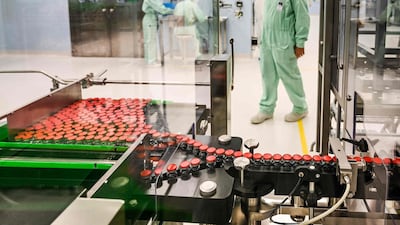
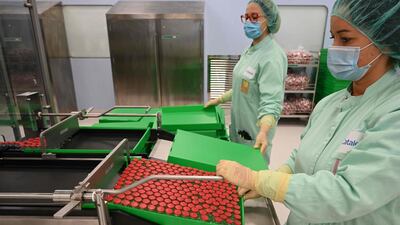
  • A lab technician oversees the filling and package of vials for the large-scale production of the Oxford-AstraZeneca Covid-19 vaccine candidate at the Italian manufacturing facility of Catalent in Anagni, southeast of Rome, September 11, 2020. AFP
    A lab technician oversees the filling and package of vials for the large-scale production of the Oxford-AstraZeneca Covid-19 vaccine candidate at the Italian manufacturing facility of Catalent in Anagni, southeast of Rome, September 11, 2020. AFP
  • The Oxford vaccine could be among the first to hit the market. Vincenzo Pinzo / AFP
    The Oxford vaccine could be among the first to hit the market. Vincenzo Pinzo / AFP
  • A boy looks at Sinovac Biotech's vaccine candidate at the China International Fair for Trade in Services in Beijing. AFP
    A boy looks at Sinovac Biotech's vaccine candidate at the China International Fair for Trade in Services in Beijing. AFP
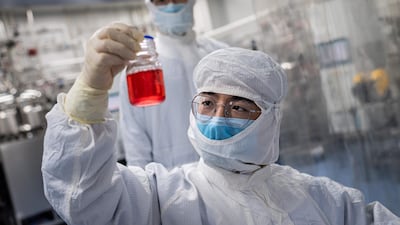
  • A technician looks at monkey kidney cells as he makes a test on an experimental vaccine for Covid-19 at Sinovac Biotech facilities in Beijing. AFP
    A technician looks at monkey kidney cells as he makes a test on an experimental vaccine for Covid-19 at Sinovac Biotech facilities in Beijing. AFP
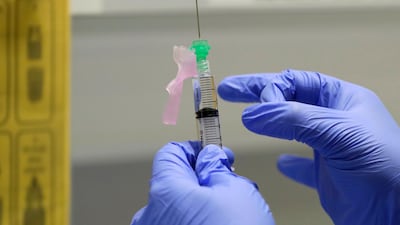
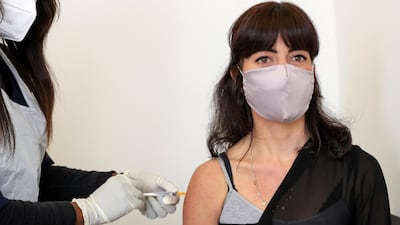
  • A clinical research nurse prepares a Covid-19 vaccine to administer to a volunteer, at a clinic in London. AP
    A clinical research nurse prepares a Covid-19 vaccine to administer to a volunteer, at a clinic in London. AP
  • Peru's President Martin Vizcarra speaks to the press during a visit to the bio-medical department of the Cayetano Heredia National University in Lima, where studies for vaccines against coronavirus are being developed. AFP
    Peru's President Martin Vizcarra speaks to the press during a visit to the bio-medical department of the Cayetano Heredia National University in Lima, where studies for vaccines against coronavirus are being developed. AFP
  • Robyn Porteous, a vaccine trial volunteer, is injected as part of South Africa's human clinical trial at the Wits RHI Shandukani Research Centre in Johannesburg, South Africa. Reuters
    Robyn Porteous, a vaccine trial volunteer, is injected as part of South Africa's human clinical trial at the Wits RHI Shandukani Research Centre in Johannesburg, South Africa. Reuters
  • A nurse inoculates volunteer Ilya Dubrovin, 36, with Russia's new coronavirus vaccine at a clinic in Moscow. AFP
    A nurse inoculates volunteer Ilya Dubrovin, 36, with Russia's new coronavirus vaccine at a clinic in Moscow. AFP
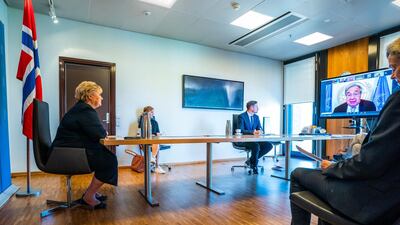
  • Norwegian Prime Minister Erna Solberg (L) and Minister for Development Aid Dag Inge Ulstein (R) participate in a digital meeting with international leaders about a fair global distribution of Covid-19 vaccines at the the Prime Minister's office in Oslo on 10 September 2020. EPA
    Norwegian Prime Minister Erna Solberg (L) and Minister for Development Aid Dag Inge Ulstein (R) participate in a digital meeting with international leaders about a fair global distribution of Covid-19 vaccines at the the Prime Minister's office in Oslo on 10 September 2020. EPA
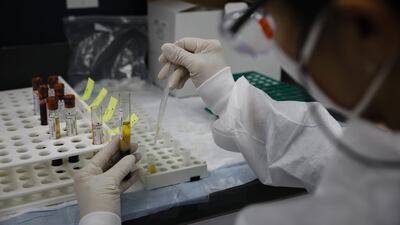
  • A medic works in a lab during clinical trials for a Covid-19 vaccine at Research Centres of America in Hollywood, Florida. Bloomberg
    A medic works in a lab during clinical trials for a Covid-19 vaccine at Research Centres of America in Hollywood, Florida. Bloomberg
Call of Duty: Black Ops 6

Developer: Treyarch, Raven Software
Publisher:  Activision
Console: PlayStation 4 & 5, Windows, Xbox One & Series X/S
Rating: 3.5/5

Top 10 in the F1 drivers' standings

1. Sebastian Vettel, Ferrari 202 points

2. Lewis Hamilton, Mercedes-GP 188

3. Valtteri Bottas, Mercedes-GP 169

4. Daniel Ricciardo, Red Bull Racing 117

5. Kimi Raikkonen, Ferrari 116

6. Max Verstappen, Red Bull Racing 67

7. Sergio Perez, Force India 56

8. Esteban Ocon, Force India 45

9. Carlos Sainz Jr, Toro Rosso 35

10. Nico Hulkenberg, Renault 26

UK%20record%20temperature
%3Cp%3E38.7C%20(101.7F)%20set%20in%20Cambridge%20in%202019%3C%2Fp%3E%0A

Sleep Well Beast
The National
4AD

The candidates

Dr Ayham Ammora, scientist and business executive

Ali Azeem, business leader

Tony Booth, professor of education

Lord Browne, former BP chief executive

Dr Mohamed El-Erian, economist

Professor Wyn Evans, astrophysicist

Dr Mark Mann, scientist

Gina MIller, anti-Brexit campaigner

Lord Smith, former Cabinet minister

Sandi Toksvig, broadcaster


What is the FNC?

The Federal National Council is one of five federal authorities established by the UAE constitution. It held its first session on December 2, 1972, a year to the day after Federation.
It has 40 members, eight of whom are women. The members represent the UAE population through each of the emirates. Abu Dhabi and Dubai have eight members each, Sharjah and Ras al Khaimah six, and Ajman, Fujairah and Umm Al Quwain have four.
They bring Emirati issues to the council for debate and put those concerns to ministers summoned for questioning. 
The FNC’s main functions include passing, amending or rejecting federal draft laws, discussing international treaties and agreements, and offering recommendations on general subjects raised during sessions.
Federal draft laws must first pass through the FNC for recommendations when members can amend the laws to suit the needs of citizens. The draft laws are then forwarded to the Cabinet for consideration and approval. 
Since 2006, half of the members have been elected by UAE citizens to serve four-year terms and the other half are appointed by the Ruler’s Courts of the seven emirates.
In the 2015 elections, 78 of the 252 candidates were women. Women also represented 48 per cent of all voters and 67 per cent of the voters were under the age of 40.
 

Mercer, the investment consulting arm of US services company Marsh & McLennan, expects its wealth division to at least double its assets under management (AUM) in the Middle East as wealth in the region continues to grow despite economic headwinds, a company official said.

Mercer Wealth, which globally has $160 billion in AUM, plans to boost its AUM in the region to $2-$3bn in the next 2-3 years from the present $1bn, said Yasir AbuShaban, a Dubai-based principal with Mercer Wealth.

Within the next two to three years, we are looking at reaching $2 to $3 billion as a conservative estimate and we do see an opportunity to do so,” said Mr AbuShaban.

Mercer does not directly make investments, but allocates clients’ money they have discretion to, to professional asset managers. They also provide advice to clients.

“We have buying power. We can negotiate on their (client’s) behalf with asset managers to provide them lower fees than they otherwise would have to get on their own,” he added.

Mercer Wealth’s clients include sovereign wealth funds, family offices, and insurance companies among others.

From its office in Dubai, Mercer also looks after Africa, India and Turkey, where they also see opportunity for growth.

Wealth creation in Middle East and Africa (MEA) grew 8.5 per cent to $8.1 trillion last year from $7.5tn in 2015, higher than last year’s global average of 6 per cent and the second-highest growth in a region after Asia-Pacific which grew 9.9 per cent, according to consultancy Boston Consulting Group (BCG). In the region, where wealth grew just 1.9 per cent in 2015 compared with 2014, a pickup in oil prices has helped in wealth generation.

BCG is forecasting MEA wealth will rise to $12tn by 2021, growing at an annual average of 8 per cent.

Drivers of wealth generation in the region will be split evenly between new wealth creation and growth of performance of existing assets, according to BCG.

Another general trend in the region is clients’ looking for a comprehensive approach to investing, according to Mr AbuShaban.

“Institutional investors or some of the families are seeing a slowdown in the available capital they have to invest and in that sense they are looking at optimizing the way they manage their portfolios and making sure they are not investing haphazardly and different parts of their investment are working together,” said Mr AbuShaban.

Some clients also have a higher appetite for risk, given the low interest-rate environment that does not provide enough yield for some institutional investors. These clients are keen to invest in illiquid assets, such as private equity and infrastructure.

“What we have seen is a desire for higher returns in what has been a low-return environment specifically in various fixed income or bonds,” he said.

“In this environment, we have seen a de facto increase in the risk that clients are taking in things like illiquid investments, private equity investments, infrastructure and private debt, those kind of investments were higher illiquidity results in incrementally higher returns.”

The Abu Dhabi Investment Authority, one of the largest sovereign wealth funds, said in its 2016 report that has gradually increased its exposure in direct private equity and private credit transactions, mainly in Asian markets and especially in China and India. The authority’s private equity department focused on structured equities owing to “their defensive characteristics.”