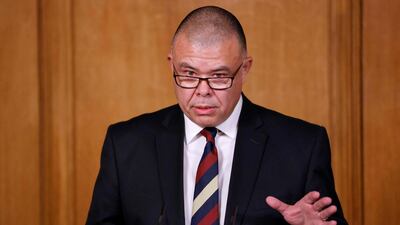
People vaccinated against coronavirus are still likely to pass the disease on, one of Britain’s leading scientists said on Sunday.
England’s deputy chief medical officer, Prof Jonathan Van-Tam, said that even after having two doses “you may still give Covid to someone else”.
Prof Van-Tam warned the 5.8 million people in Britain who have been vaccinated to continue to observe strict lockdown rules as the country was likely to pass 100,000 deaths this week.
So far, 3.6 million people in the UK have been infected and 97,939 have died from the virus.
"We do not yet know the impact of the vaccine on transmission of the virus," Prof Van-Tam wrote in The Sunday Telegraph.
“So even after you have had both doses of the vaccine, you may still give Covid to someone else and the chains of transmission will then continue.
“If you change your behaviour you could still be spreading the virus, keeping the number of cases high and putting others at risk who also need their vaccine but are further down the queue.”
He said hospitals still had a large number of Covid-19 admissions, with a quarter of people receiving treatment for the virus under the age of 55.
“Despite the speed of the roll-out, these are people who will not have the vaccine for a while yet,” Prof Van-Tam said.
It is also possible to contract the virus in the two or three weeks after inoculation, he said.
“Regardless of whether someone has had their vaccination or not, it is vital that everyone follows the national restrictions and public health advice, as protection takes up to three weeks to kick in and we don’t yet know the impact of vaccines on transmission,” Prof Van-Tam said.
With immunity taking time to build up, particularly in the elderly, he stressed the need for people to stay safe.
“If you are older it’s better to allow at least three weeks. You can still get Covid in this time.”
Prof Van-Tam said that while Covid-19 vaccines offered hope, “no vaccine has ever been 100 per cent effective, so no one will have 100 per cent protection from the virus”.
“The vaccine has brought considerable hope and we are in the final furlong of the pandemic," he wrote.
"But for now, vaccinated or not, we still have to follow the guidance for a bit longer.”
He defended the British government’s decision to keep the gap between the two doses at 12 weeks, despite the British Medical Association urging it be halved.
“Who on the at-risk list should suffer slower access to their first dose so that someone else who's already had one dose can get a second?” Prof Van-Tam asked.
But a doctor called the 12-week gap between doses of vaccines an “unregulated and unlicensed trial”.
“What really concerns us is we don’t know what happens if you don't give that second dose of vaccination after three weeks,” Dr Rosie Shire said.
Studies show that two doses given three weeks apart provided 90 per cent immunity, Dr Shire said.

Despacito's dominance in numbers
Released: 2017
Peak chart position: No.1 in more than 47 countries, including the United States, the United Kingdom, Australia and Lebanon
Views: 5.3 billion on YouTube
Sales: With 10 million downloads in the US, Despacito became the first Latin single to receive Diamond sales certification
Streams: 1.3 billion combined audio and video by the end of 2017, making it the biggest digital hit of the year.
Awards: 17, including Record of the Year at last year’s prestigious Latin Grammy Awards, as well as five Billboard Music Awards
MATCH INFO
Champions League quarter-final, first leg
Tottenham Hotspur v Manchester City, Tuesday, 11pm (UAE)
Matches can be watched on BeIN Sports
UAE v Gibraltar
What: International friendly
When: 7pm kick off
Where: Rugby Park, Dubai Sports City
Admission: Free
Online: The match will be broadcast live on Dubai Exiles’ Facebook page
UAE squad: Lucas Waddington (Dubai Exiles), Gio Fourie (Exiles), Craig Nutt (Abu Dhabi Harlequins), Phil Brady (Harlequins), Daniel Perry (Dubai Hurricanes), Esekaia Dranibota (Harlequins), Matt Mills (Exiles), Jaen Botes (Exiles), Kristian Stinson (Exiles), Murray Reason (Abu Dhabi Saracens), Dave Knight (Hurricanes), Ross Samson (Jebel Ali Dragons), DuRandt Gerber (Exiles), Saki Naisau (Dragons), Andrew Powell (Hurricanes), Emosi Vacanau (Harlequins), Niko Volavola (Dragons), Matt Richards (Dragons), Luke Stevenson (Harlequins), Josh Ives (Dubai Sports City Eagles), Sean Stevens (Saracens), Thinus Steyn (Exiles)
The five pillars of Islam
Coffee: black death or elixir of life?
It is among the greatest health debates of our time; splashed across newspapers with contradicting headlines - is coffee good for you or not?
Depending on what you read, it is either a cancer-causing, sleep-depriving, stomach ulcer-inducing black death or the secret to long life, cutting the chance of stroke, diabetes and cancer.
The latest research - a study of 8,412 people across the UK who each underwent an MRI heart scan - is intended to put to bed (caffeine allowing) conflicting reports of the pros and cons of consumption.
The study, funded by the British Heart Foundation, contradicted previous findings that it stiffens arteries, putting pressure on the heart and increasing the likelihood of a heart attack or stroke, leading to warnings to cut down.
Numerous studies have recognised the benefits of coffee in cutting oral and esophageal cancer, the risk of a stroke and cirrhosis of the liver.
The benefits are often linked to biologically active compounds including caffeine, flavonoids, lignans, and other polyphenols, which benefit the body. These and othetr coffee compounds regulate genes involved in DNA repair, have anti-inflammatory properties and are associated with lower risk of insulin resistance, which is linked to type-2 diabetes.
But as doctors warn, too much of anything is inadvisable. The British Heart Foundation found the heaviest coffee drinkers in the study were most likely to be men who smoked and drank alcohol regularly.
Excessive amounts of coffee also unsettle the stomach causing or contributing to stomach ulcers. It also stains the teeth over time, hampers absorption of minerals and vitamins like zinc and iron.
It also raises blood pressure, which is largely problematic for people with existing conditions.
So the heaviest drinkers of the black stuff - some in the study had up to 25 cups per day - may want to rein it in.
Rory Reynolds
'Cheb%20Khaled'
%3Cp%3E%3Cstrong%3EArtist%3A%20%3C%2Fstrong%3EKhaled%3Cbr%3E%3Cstrong%3ELabel%3A%20%3C%2Fstrong%3EBelieve%3Cbr%3E%3Cstrong%3ERating%3A%3C%2Fstrong%3E%204%2F5%3C%2Fp%3E%0A
