


The men, far from home, signed up for money but under the barrage of strikes they only think of their families in Syria.
Turkey sent thousands of Syrian men to fight for Azerbaijan soon after clashes broke out with the breakaway region of Nagorno-Karabakh.
After two weeks of heavy fighting, a Russian-mediated ceasefire was agreed to late on Friday.
"I'm talking to you now from an underground bunker where we had to run away," Ibrahim, 24, said in a rushed phone call with The National earlier in the week. He sounded petrified.
“The military jets strike us hard. We lost so many guys, I couldn’t count how many.
“I don't know what we are doing here. Even money is not a reason to be in this horror movie.
"The Turks put us in such a position that we can't any more escape from here."

On September 27, fighting broke out between Azerbaijan and Armenian separatists who hold Nagorno-Karabakh.
The ethnically Armenian enclave backed by Yerevan broke off from Azerbaijan in 1994 and has been the flashpoint of several rounds of fighting.
Ibrahim, a father of three, said Azerbaijani troops, who his militia group were supposed to be fighting alongside, “are kilometres behind us”.
That left his group with support only from Turkish drones.
“I hope we will be able to come back with our legs and arms,” Ibrahim said.
His location, shared over WhatsApp, showed he was right on the front line, east of Karabakh separatist region, near the Azerbaijani village of Akhmedalylar and close to the border with Iran.
It is 1,300 kilometres from the refugee camp in which his family lives, near the town of Sarmada at the Syrian-Turkish border.
Ibrahim is a member of the Sultan Murad Brigade, a mostly Turkmen pro-Turkey Syrian armed group.
He said that three weeks ago, one of the militia officers asked for volunteers for Turkish operations in Azerbaijan.
“Many of us refused after they saw what happened in [Turkey’s intervention in] Libya," Ibrahim said.
"But I thought that I could make money in order to take my family out of this situation before the winter."
As in Azerbaijan, Turkey paid for thousands of Syrian mercenaries to back Tripoli militias in Libya against the eastern-based Libyan National Army.
Ibrahim was offered a three-month contract and 8,000 Turkish lira ($1,300) a month on September 24, three days before the conflict began in earnest.
After signing up, he was taken through the Kilis military border crossing to Gaziantep in Turkey, then by a commercial flight to Baku through Ankara, he said.
-
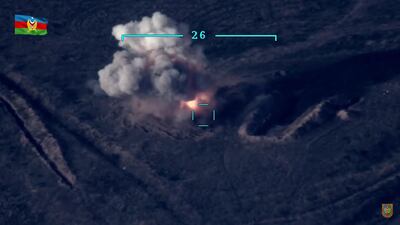
A frame grab from handout video provided by the Ministry of Defence of the Republic of Azerbaijan allegedly shows an Armenian tank being destroyed by Azerbaijan's military at Nagorno-Karabakh Republic, on the border of Armenia and Azerbaijan. EPA -

In this handout photo taken from a footage released by Azerbaijan's Defense Ministry, Azerbaijan's forces destroy Armenian anti-aircraft system at the contact line of the self-proclaimed Republic of Nagorno-Karabakh, Azerbaijan. AP -
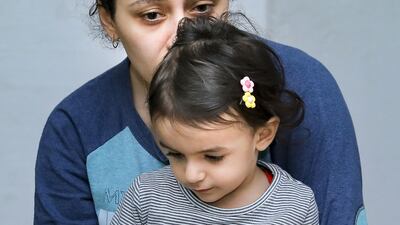
In this photo released by the Armenian Foreign Ministry, a woman with her child sit in a bombshelter to protect against shelling, in Stepanakert, the self-proclaimed Republic of Nagorno-Karabakh, Azerbaijan. AP -
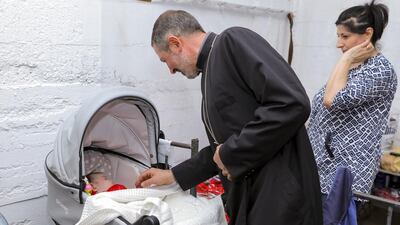
In this handout photo released by Armenian Foreign Ministry, an Armenian church priest looks a a baby in a bombshelter to protect against shelling in Stepanakert, the self-proclaimed Republic of Nagorno-Karabakh, Azerbaijan. AP -
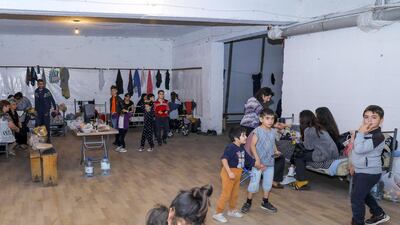
In this photo released by the Armenian Foreign Ministry, people gather in a bombshelter to protect against shelling in Stepanakert, the self-proclaimed Republic of Nagorno-Karabakh, Azerbaijan. AP -
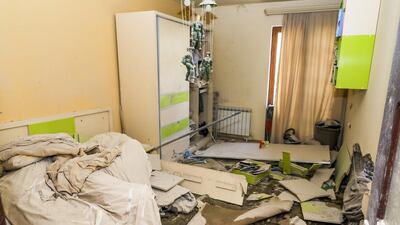
This handout photo released by Armenian Foreign Ministry, shows a damaged after shelling flat in Stepanakert, the self-proclaimed Republic of Nagorno-Karabakh, Azerbaijan. AP -
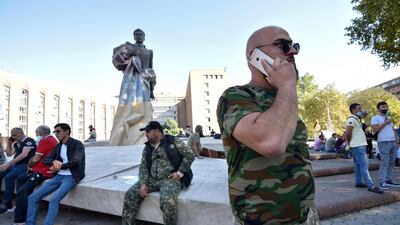
Volunteers and veterans, who are ready to go to the frontline in Nagorny Karabakh, gather in Yerevan. AFP -
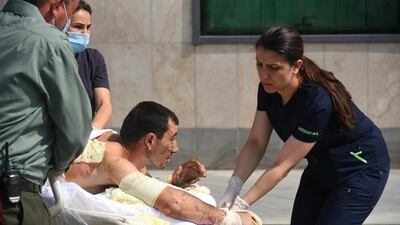
A handout photo released by the Armenian Foreign Ministry shows specialists delivering medical support to a man, who is said to be a civilian injured during clashes in the breakaway region of Nagorno-Karabakh. REUTERS -
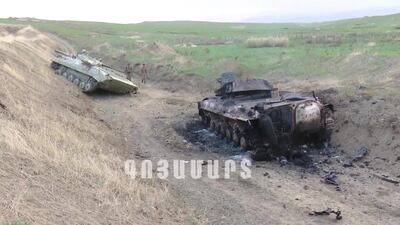
A grab taken from a handout video released by the so-called Nagorno-Karabakh (NKR) Defense Army, or Artsakh Defence Army, via Youtube claims to show tanks allegedly destroyed in shelling, artillery and air attacks along the front at Nagorno-Karabakh Republic, on a border of Armenia and Azerbaijan. EPA -
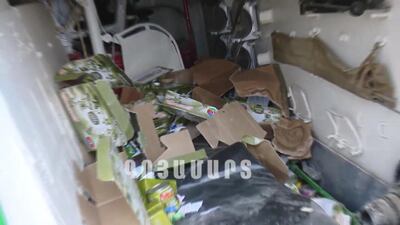
A grab taken from a handout video released by the so-called Nagorno-Karabakh (NKR) Defense Army, or Artsakh Defence Army, via Youtube claims to show Azerbaijani food rations in a tank allegedly destroyed in shelling, artillery and air attacks along the front at Nagorno-Karabakh Republic, on a border of Armenia and Azerbaijan. EPA -
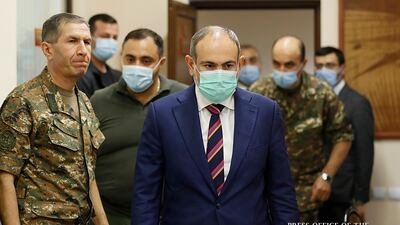
A handout photo made available by the Armenian Government Press Office shows Armenian Prime Minister Nikol Pashinyan meeting with the military leaders in Yerevan, Armenia. EPA -
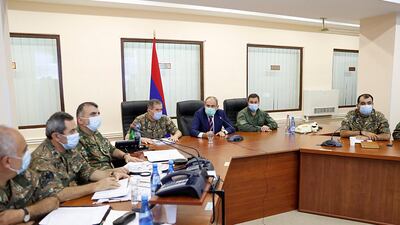
Armenian Prime Minister Nikol Pashinyan meets with top military officials in Yerevan. AFP -
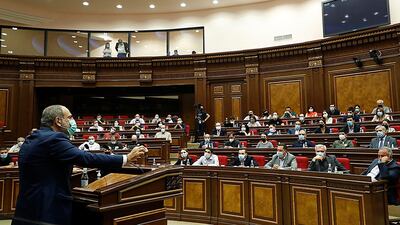
Armenian Prime Minister Nikol Pashinyan gives a speech at the parliament in Yerevan. AFP


Ibrahim estimated there were around 3,000 Syrian mercenaries fighting for Azerbaijan and Turkey in Karabakh.
“They gave us food, military uniforms and equipment like sniper rifles and anti-tank rockets, but we are under heavy bombardment," he said.
"On Friday alone we lost six men and 30 of us were injured and had to be transported to Baku.”
The two first Syrian casualties in the conflict were reported last weekend.
Both fighters, registered with Al Hamza division, affiliated with the Syrian National Army and originally from the region of Homs, were killed last Sunday by Armenian forces, said Hamid, a commander from the group.
Relatives organised condolence ceremonies in various refugee camps in northern Syria as the bodies began to return.
The Syrian Office of Human Rights estimates at least 107 Syrian mercenaries have been killed and at least 30 more wounded.
Last Saturday, Mohammed, a young fighter from Maaret Al Numan, was declared dead.
A picture of him in an olive grove in happier times was shared with The National by his close friends.
Hamid claims to have sent about 15 of his men to Nagorno-Karabakh since September 18.
“The recruits are gathered at the Hawar Kilis operations centre, on the border with Turkey," he said.
"They mainly come from two factions of Syrian opposition armed groups, Sultan Murad Brigade and Al Hamza Division, but more are joining. Every day, a new convoy leaves."
Hamid said there was no shortage of volunteers. Several thousand men registered with the Turkish authorities.
“They were told that they would keep military or strategic installations like oilfields and that they would serve as an interposition force,” he says.
Last Friday, 200 men of Jaish Al Islam abandoned the Syrian ground conflict in favour of the fight against "the Armenians", without gaining permission from their commanders, a senior leader of the militia told The National.
Some of the Turkey-allied Syrian factions did not want to support this new war effort, after the experiences in Libya.
Several thousand men were sent by Turkey to the country at the start of the year to fight on the side of the Libyan Government of National Accord, in a move widely condemned by the international community.
But they received only a part of the enticing bonuses promised and found themselves thrown into more dangerous missions than they agreed to.
Hamid said that of the 200 fighters with whom he went to Libya, only about half returned.
The others were killed or seriously injured. Families are still waiting for the compensation that Ankara promised.
Despite the dangers, recruiters have no difficulty in convincing new fighters, Hamid said.
The distress and poverty in Syrian refugee camps push many to try their luck.
“There are a lot of intermediaries who do their shopping, choose young people in good shape and good health," he said.
"They go to refugee camps and recruit civilians and young people, sometimes minors."
Fighting for money has become, for many men in the prime of life, a rare way out of Syria, where life opportunities are dwindling amid a nine-year war.
Mohammed, 29, a father of three, landed in Baku on October 2 along with dozens of other Syrian volunteers.
He had signed to go to Libya but was not called by his commanders. He did not want to miss this second opportunity.
“When we got off the plane, we were brought in military convoys to the front line," Mohammed said.
"There, we are on a Turkish base. It's cold, we don't understand the language and the officers only give us access to the internet so that we can notify our families.
“But I'm happy to be travelling abroad."
Azerbaijan has denied the use of foreign mercenaries, accusing Armenians of spreading fake news.
Turkish state media and pro-government sources have thrown similar accusations at Armenia, sharing unverified footage purporting to show fighters travelling from Syria to battle alongside Armenian forces.
They appeared to be patriot volunteers of Armenian heritage coming from Syria and Lebanon to defend their “motherland” and its territory.
“We are there to prevent a new genocide like the one Turks did 100 years ago against our ancestors," said Vartan, a Lebanese Armenian who was preparing to fly to Yerevan.
"We won't let them repeat that."

