
Parman Romonov and Kaim Abdijew were Soviet prisoners of war captured by the Nazis. Their dates of birth and death are recorded, but nothing else – they are among a small number of Muslims who met their end at the Auschwitz-Birkenau Nazi concentration camp, and little is known about them.
Seventy-five years ago on Monday, the huge Auschwitz camp in south-west Poland was liberated from the Germans by the Soviet Red Army. Among those starved, gassed and slaughtered in this and other Nazi camps were Muslims from North Africa and central Asia.
The deaths and the many others here were "crimes against humanity", secretary-general of the Muslim World League, Muhammad bin Abdul Karim Al-Issa, told world leaders on Friday as they gathered to mark the anniversary.
-
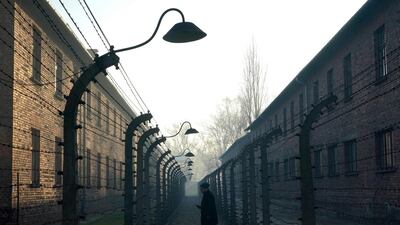
A man walks by the barbed wire fence of the Auschwitz German Nazi death camp in Oswiecim, Poland. AFP -
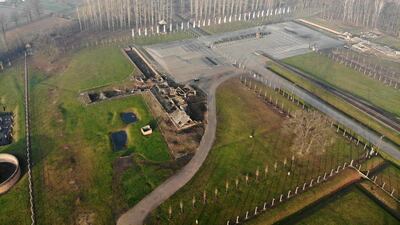
A view of the remains of gas chambers and crematoriums of Auschwitz I, which was part of former German Nazi death camp Auschwitz-Birkenau. AFP -
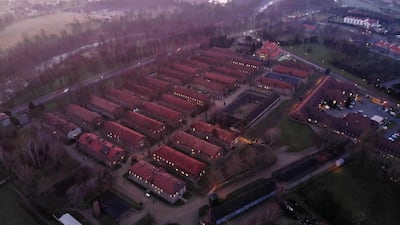
Buildings of Auschwitz I, which were part of former German Nazi death camp Auschwitz-Birkenau. AFP -
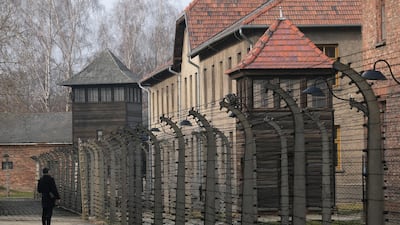
A visitor walks among barbed wire and prison barracks at the former Auschwitz I concentration camp in Oswiecim, Poland. Getty Images -
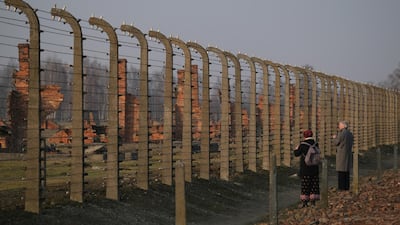
Visitors look through barbed wire towards the remains of prisoner barracks at the former Auschwitz-Birkenau German concentration camp near Oswiecim, Poland. Getty Images -
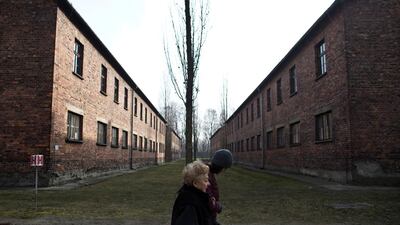
Jona Laks, survivor of Nazi Dr Josef Mengele's experiments and her granddaughter, Lee Aldar walk as they visit the Auschwitz death camp, in Oswiecim, Poland. Reuters -
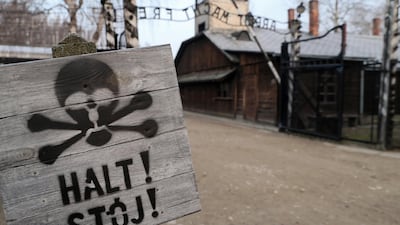
The Death Gate of the former Auschwitz II-Birkenau camp during ceremonies marking the 75th anniversary of the liberation of the former Nazi-German concentration and extermination camp KL Auschwitz-Birkenau, in Oswiecim, Poland. EPA -
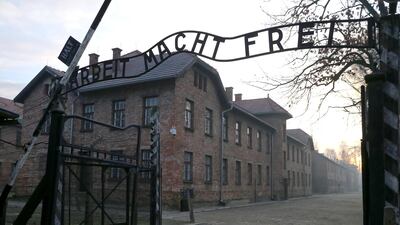
The Death Gate of the former Auschwitz II-Birkenau camp during ceremonies marking the 75th anniversary of the liberation of the former Nazi-German concentration and extermination camp KL Auschwitz-Birkenau, in Oswiecim, Poland. EPA -
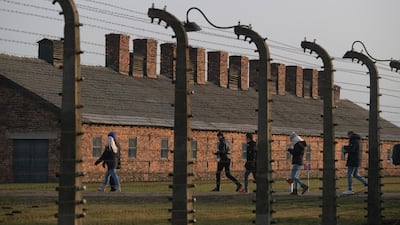
Visitors walks past barbed wire and prisoner barracks at the former Auschwitz-Birkenau German concentration camp near Oswiecim, Poland. Getty Images -

The blocks of Auschwitz I, which was part of former German Nazi death camp Auschwitz-Birkenau. AFP -
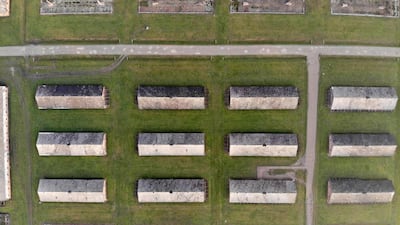
The remains of barracks for prisoners at the former German Nazi death camp Auschwitz II - Birkenau. AFP -
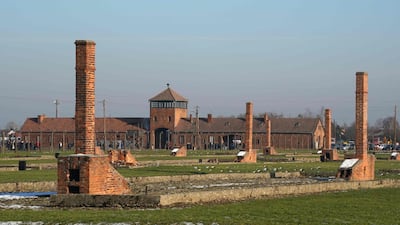
The remains of the barracks and the main building of the Auschwitz-Birkenau German Nazi death camp. AFP -
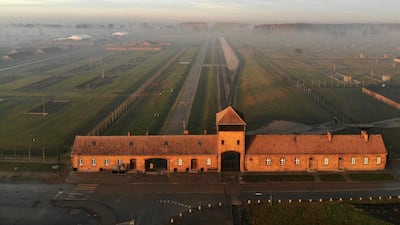
The railway entrance to former German Nazi death camp Auschwitz II - Birkenau with its SS guards tower. AFP -
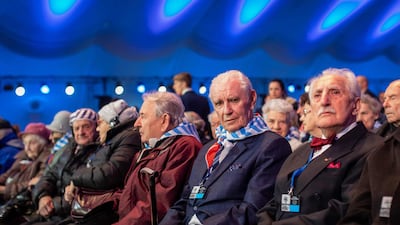
Survivers attend the offical ceremony at the former German Nazi death camp Auschwitz-Birkenau during events to commemorate the 75th anniversary of the camp's liberation in Oswiecim, Poland. AFP -

Mayor of London Sadiq Khan and Jozef Wanger, member of the Auschwitz-Birkenau Foundation, are pictured ahead of ceremonies marking the 75th anniversary of the liberation of the camp and International Holocaust Victims Remembrance Day on the site of the former Nazi German concentration and extermination camp Auschwitz II-Birkenau in Brzezinka near Oswiecim, Poland, January 27, 2020. Reuters -
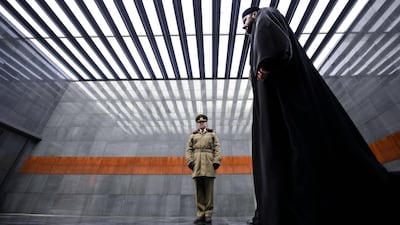
An orthodox priest walks after paying respects at the Holocaust memorial in Bucharest, Romania, Monday, Jan. 27, 2020. Romania marked the International Holocaust Remembrance Day on the 75th anniversary of the Soviet army's liberation of the Auschwitz-Birkenau death camp. AP Photo -

Mayor of London Sadiq Aman Khan (right) in front of the 'Gate of Death' at the former Auschwitz II-Birkenau camp before ceremonies marking the 75th anniversary of the liberation of the former Nazi-German concentration and extermination camp KL Auschwitz-Birkenau, in Oswiecim, Poland. EPA -

Governor of New York State Andrew M. Cuomo (second right) in front of the 'Gate of Death' at the former Auschwitz II-Birkenau camp. EPA -
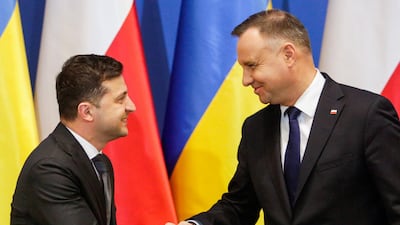
Poland's President Andrzej Duda meets with his Ukrainian counterpart Volodymyr Zelenskiy during the events dedicated to the 75th anniversary of the liberation of the former Nazi German concentration and extermination camp Auschwitz. Adrianna Bochenek / Agencja Gazeta via Reuters -
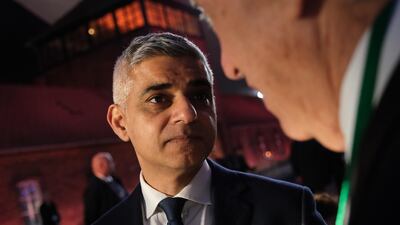
London Mayor Sadiq Khan attends the official ceremony to mark the 75th anniversary of the liberation of the Auschwitz concentration camp. Getty Images -
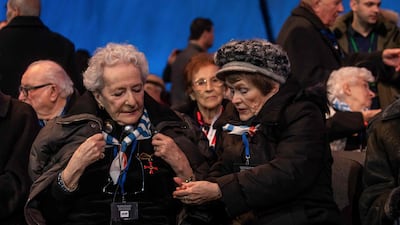
Survivers attend the offical ceremony at the former German Nazi death camp Auschwitz-Birkenau. AFP -
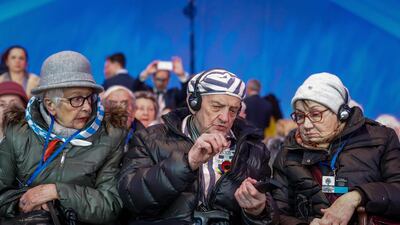
Survivers attend the offical ceremony at the former German Nazi death camp Auschwitz-Birkenau. AFP -
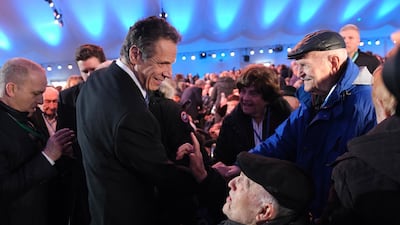
Andrew Cuomo (left), Governor of the state of New York, chats with Rabbi Meyer Kizelnik (seated), a childhood survivor of the Auschwitz concentration camp, prior to the official ceremony to mark the 75th anniversary of the liberation of the camp. Getty Images -

Roland Lauder, President of the World Jewish Congress, arrives for the offical ceremony at the former German Nazi death camp Auschwitz-Birkenau during events to commemorate the 75th anniversary of the camp's liberation in Oswiecim, Poland, on January 27, 2020. More than 200 survivors came from across the globe to the camp the Nazis built in Oswiecim in then-occupied Poland, to share their testimony as a stark warning amid a recent surge of anti-semitic attacks on both sides of the Atlantic. / AFP / Wojtek RADWANSKI -

Auschwitz concentration camp survivors and their families attend the official ceremony to mark the 75th anniversary of the liberation of the Auschwitz concentration camp. Getty Images -

Britain's Camilla, King Willem-Alexander and Queen Maxima of the Netherlands attend the ceremonies marking the 75th anniversary of the liberation of the camp. Reuters


"That is to say, a violation of us all, an affront to all of God’s children,” he said.
Of the 1.3 million people, mostly Jews, who were detained in the Auschwitz-Birkenau complex until 1945, 1.1 million never made it out alive. A dearth of records, however, has made it difficult to establish exactly how many of the detained were Muslims.
“We know very little because very little documentation survived,” says Pawel Sawicki of the Auschwitz-Birkenau State Museum. “But from the shred of information we have, we can find two groups of Muslims among the prisoners. The names look far more linked with the Arabic culture than Russian.”
Some seemed to be Soviet prisoners of war while others were arrested by the Nazis in France, and were from the North African colonies.
Some records recovered by the Soviets suggest that 53 of 400,000 registered Auschwitz prisoners were Muslims. The "Death Books" recorded by the Nazis at Auschwitz listed five prisoners as Muslims, but omit records from several months in between 1940 and 1941.

Much of the research on Muslim concentration camp prisoners was conducted by the now deceased German historian Gerhard Hopp, who wrote about it in his 2005 book Germany and the Middle East: 1871-1945. Mr Hopp's research estimates that at least 1,000 Muslims were detained by the Nazi regime. At least two men, described as Muslims, Said Bemab and Mendel Flajszer, were held and probably died at the Mauthausen-Gusen Nazi concentration camp in Austria.
“Arabs were never among the ‘privileged’ inmates, but they are today among the forgotten victims of the Nazis," Mr Hopp wrote in 2002.
The subjection of Muslims under the fascist wave of Second World War wasn’t limited to Nazi-occupied territory. In Croatia, a fascist regime established a camp to murder as many as 12,000 Bosnian Muslims, Croats and other suspected opponents.
“In North Africa we have a clearer picture of what happened to Jews and Muslims under the Vichy,” says Mehnaz Afridi, director of the Holocaust, Genocide and Interfaith Education Center at Manhattan College in New York City. “There were many small camps in North Africa like in Morocco, Tunisia and Algeria. Jews were interned and tortured in these camps by the Vichy party and local Muslims were hired to help.”
In Russia, hundreds of Tatar Muslim prisoners of war, believed to have been mistaken as being Jewish due to their physical appearance, were executed by the SS in 1941.
Experts say it’s important to highlight that, for the most part, Muslims were not targeted by the Nazis for religious or racial reasons. Relations between Muslim countries at a time when Jews were migrating to Palestine were often complicated or ill-defined. However, numerous examples of Arab and Muslim rescue efforts during the Holocaust have been recorded.
“Albania was the only European country to rescue all of its Jews and save more that came through the border,” says Ms Afridi. “Muslims played a small role but an important one in rescuing Jews.”
In Tunisia, Si Ali Sakkat, a former mayor of Tunis, sheltered dozens of Jews who had escaped a labour camp. In Albania, photographer Refik Veseli's sheltering of two Jewish families between 1943 and 1944 inspired efforts that ultimately saved thousands of Jews.
Some Jews converted to Islam in an attempt to be saved from the genocide.
At the same time, the Nazi leadership was attempting not to upset Muslim-majority countries in the Middle East, where they hoped to gain a foothold over the Allied forces. “The swift intervention to stop the shootings of Muslims [in Russia] stemmed from the concerns of leading Nazi officials about Germany’s relations with the Islamic world,” writes David Motadel of the London School of Economics.
As the Nazis turned their attention to occupying the Caucasus and Muslim-dominated regions, such as North Africa and parts of the Balkans, its propaganda machine went into overdrive, according to Mr Motadel. “Berlin began to promote Nazi Germany as a protector of Islam.”
Those efforts ultimately failed, however, as the Nazis collapsed on several fronts. Allied forces drove German and Italian troops out of North Africa by 1943 while Communist forces liberated Albania a year later.

