
Russian opposition leader Alexei Navalny has shown signs he was poisoned and remains in an induced coma, said the German hospital treating him.
The Charite hospital in Berlin said doctors found cholinesterase inhibitors in Mr Navalny’s system, suggesting he was poisoned, although the specific substance is unknown.
“His health is serious but there is currently no acute danger to his life,” the hospital said.
Mr Navalny, 44, was admitted to hospital on Saturday after an intervention by German Chancellor Angela Merkel.
German NGO Cinema For Peace organised a special flight for him to Berlin on Saturday.
Mr Navalny is being treated with the antidote atropine.
“The outcome of the disease remains uncertain and long-term consequences, especially in the area of the nervous system, cannot be ruled out at this point,” the hospital said.
Mr Navalny has been in an induced coma since Thursday after he became ill on a plane returning to Moscow from the Siberian city of Tomsk.
The German hospital said it had been in close contact with Mr Navalny’s wife, Yulia Navalnaya, who visited him in the Berlin hospital on Sunday and Monday.
Mrs Merkel said it was imperative to find out what happened to Mr Navalny.
"In view of Mr Navalny's prominent role in the political opposition in Russia, the authorities there are now urgently called on to investigate this act thoroughly, and to do so with full transparency," she said in a joint statement with German Foreign Minister Heiko Maas.
"Those responsible must be identified and held accountable," they said.
The EU's diplomatic chief, Josep Borrell, on Monday called on Russian authorities to launch an "independent and transparent investigation" into the apparent poisoning of Mr Navalny.
"The European Union strongly condemns what seems to be an attempt on Mr Navalny's life," Mr Borrell said.
"The Russian people, as well as the international community, are demanding the facts behind Mr Navalny's poisoning. Those responsible must be held to account."
Several Kremlin critics have fallen victim to poisoning in recent years, including former Ukrainian president Viktor Yushchenko in 2004 and Sergei Skripal, a former spy who was living in Britain, in 2018.
-

Russian opposition leader Alexei Navalny, with his wife Yulia, daughter Daria and son Zakhar. AP, file -
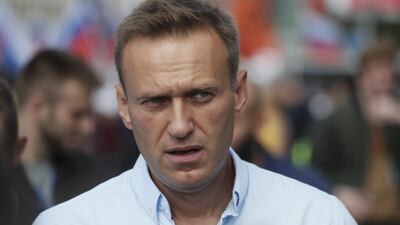
Russian Opposition activist Alexei Navalny attends a rally in support of opposition candidates in the Moscow City Duma elections in downtown of Moscow. EPA, file -
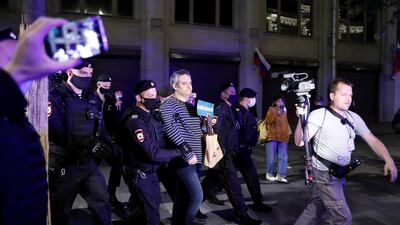
Police officers detain a man during a single-person demonstration in support of Russian opposition leader Alexei Navalny near the presidential administration headquarters in central Moscow. Reuters -
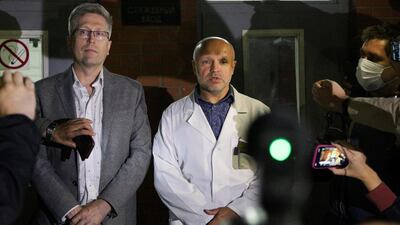
Anatoly Kalinichenko, deputy chief doctor of the Omsk Ambulance Hospital No. 1, right, and Boris Teplykh, head of the department of anaesthesiology and resuscitation of the Pirogov's medical centre, speak to the media at the intensive care unit where Alexei Navalny was hospitalised. AP -
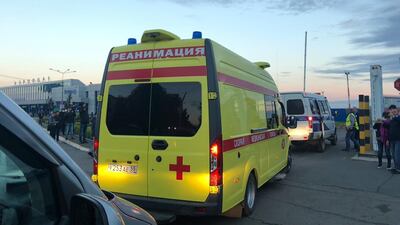
An ambulance carrying Alexei Navalny from the Omsk Ambulance Hospital No. 1, intensive care unit to the airport. Alexei Navalny's press team via AP -
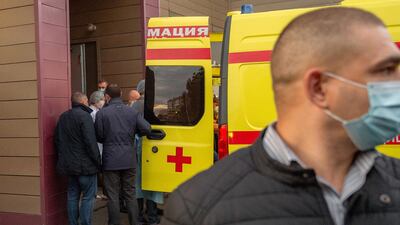
Russian medics put opposition politician Alexei Navalny into an ambulance to transport him from an emergency care hospital to an airport. EPA -

Medics upload Alexei Navalny into a German special medical plane at an airport in Omsk. Alexei Navalny's press team via AP -
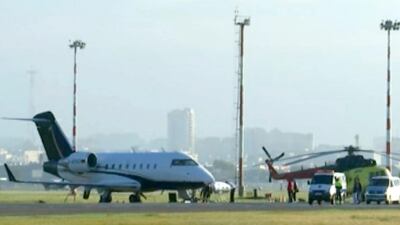
Russian opposition leader Alexei Navalny, centre on stretcher, is transported to a German special medical plane at an airport in Omsk. AP -
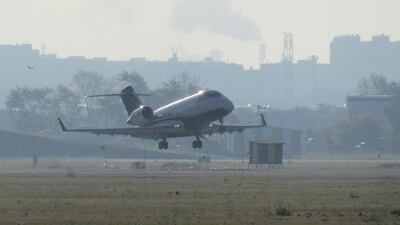
An ambulance aircraft evacuating Russian opposition leader Alexei Navalny for medical treatment in a German hospital takes off. Reuters



