
This is 2nd Lieutenant John James Donaldson. Known as Jack, he was my great, great-uncle. He signed up to the volunteer Tyneside Scottish brigade of the Northumberland Fusiliers in April 1915.
Jack was a Pal. Pals were so called because they were brigades recruited from friends in the same villages and towns, workplaces and even football teams. Local forces designed to be an instant band of brothers, bound by family ties and loyalty.
England's heavily industrialised north-east, with Newcastle at its centre, provided about 8,000 men from its factories, shipyards, coal mines, offices and farms for these battalions. The recruitment drive raised enough to form two brigades of Northumberland Fusiliers, the Tyneside Scottish and Tyneside Irish, each drawing recruits based on their lines of Celtic ancestry and religion, from the workers who flocked there during the Victorian and Edwardian industrial expansion.
But the concept of the Pals units had a fatal flaw. Those who fought together often died together. And so it proved for the Tyneside Pals on the morning of July 1, 1916 at the Battle of the Somme.

As a prelude to the battle proper, the British mounted a week-long bombardment of German positions in late June 1916. The assault was designed to obliterate the enemy and provide a “walk-through” for the British when the shells stopped. But German forces simply hunkered down in their deep defences and waited for the noise to stop. The shelling campaign didn’t work.
The British plan of attack was based on tunnels called Lochnagar and Y Sap, which were dug either side of the village of La Boisselle, underneath the German forces. Explosives were placed in the tunnels and detonated at 7.28am. The explosions were so huge it was said that earth and mud spewed to twice the height of the Eiffel Tower (the crater left by Lochnagar is still visible today). Two minutes later, Jack blew his whistle and the men of the 1st Battalion, Tyneside Scottish went over the top, walking steadily towards the German lines.

But the Y Sap blast had little effect. The Germans had intercepted a “good luck” call from a hapless senior officer and had already withdrawn their troops to safety when the explosives went off. They emerged when the dust and debris had settled.
Jack and his men were sitting ducks on the battlefield. They had 700 metres of no-man’s-land to cross. They marched north down a gentle slope, then up a hill towards their objective, always within full view of the Germans.
Machine guns mowed down the lines of Tynesiders in this death valley. It was here that Jack met his end.
It’s hard to imagine the awfulness of that morning. Even more impossible to put yourself in the boots of the Tyneside Irish, who watched this massacre unfold and then followed their fellow Geordies to their fate later that morning.
By day's end, 2,909 young men of Tyneside lay dead or injured. The vast majority of the bodies, including Jack's, were lost to mud and mortar.
Today we look back on this “war to end all wars’ with a mixture of pride and dismay. Jack was 28 when he died. His adult life halted before it had really begun.

What did the Battle of the Somme achieve? The grinding slaughter wore both sides to a standstill, perhaps shortening the war and certainly lessons were learnt in battle technique and common sense that reduced the death rate in the following 29 months. It should also be noted that Tyneside never suffered the blight of sectarianism that scarred other Northern industrial British towns. Perhaps their dying together forced the following generations to live together.

"Their Name Liveth For Evermore" is carved on thousands of war memorials around the world. But 100 years on the engraved names slowly turn from living history to history, becoming just numbers, statistics, maps and unremembered words on memorials. Now none of the survivors remain to tell their stories of flesh and blood and friendship, and for every Uncle Jack there are another 20 million Uncle Ottos, Uncle Faisels, Uncle Pierres and Uncle Mehmets. Twenty million mothers mourning, the cost of a world at war.
RIP Jack, Armistice Day belongs to you, your Pals and all those who gave their today so that we may have our tomorrow.
Nick Donaldson is Creative Director of The National
_____________
Read more on the First World War
Pictures: 20 photos from the world at war
-
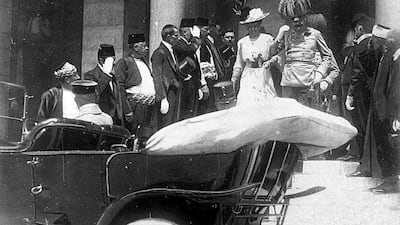
The Archduke of Austria Franz Ferdinand, center right, and his wife Sophie walk to their a car in Sarajevo minutes before their assassination, on June 28, 1914. All by AP Photos -
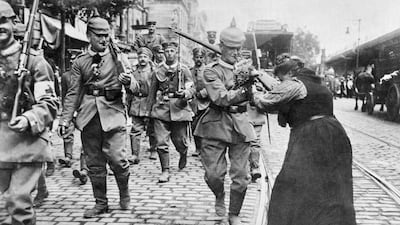
Prussian soldiers leaving Berlin for the front are given flowers by a woman. -
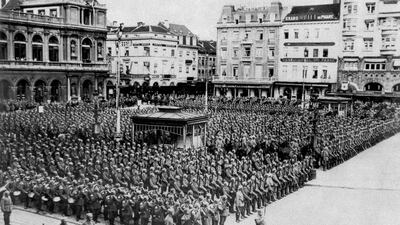
German troops stand in formation during the occupation of Brussels. -
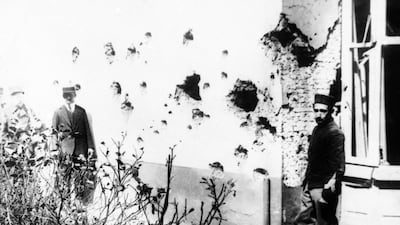
A man stands next to a building damaged by shrapnel from bombs dropped from a Zeppelin in Antwerp, Belgium. -
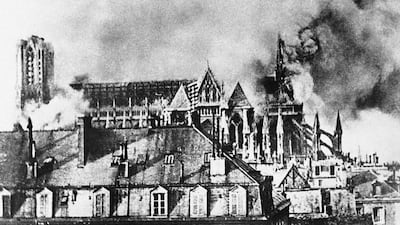
The Cathedral of Reims, France smokes after bombardment. -
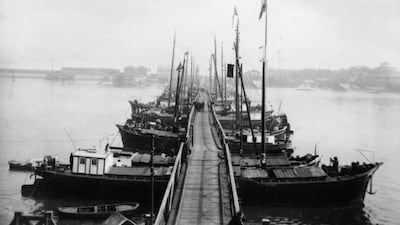
Small boats create a pontoon bridge over the Scheldt River in Antwerp, Belgium, for residents and troops escaping the German Army. -
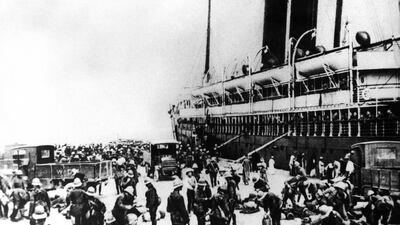
Australian troops arrive in Alexandria, Egypt, en route to the battlefield on the Gallipoli Peninsula. -
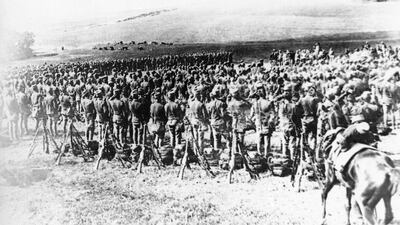
Troops are mobilized on the bank of the Danube River across from Belgrade. -
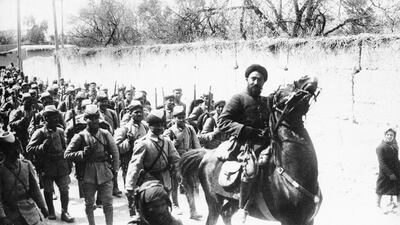
Turkish soldiers at a military review in Damascus, Syria. -
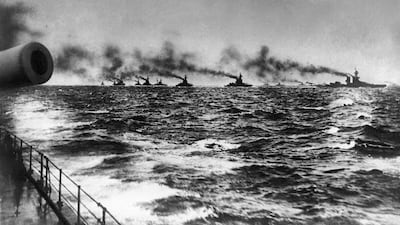
The British Grand Fleet under admiral John Jellicoe are on their way to meet the Imperial German Navy's fleet for the Battle of Jutland in the North Sea. -
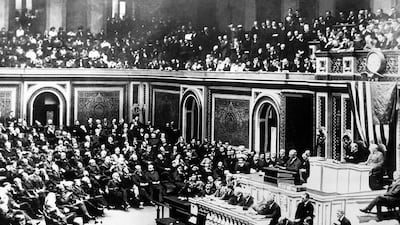
US President Woodrow Wilson delivers a speech to the joint session of Congress, in Washington, DC, United States, on April 2, 1917. -

The first 5,000 American soldiers to reach England march across historic Westminster Bridge in London, UK. -
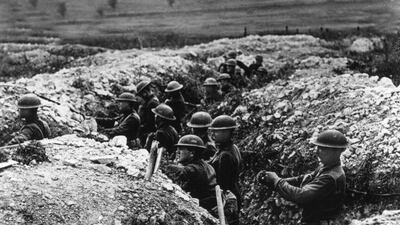
United States Army troops stand in the trenches in France. -
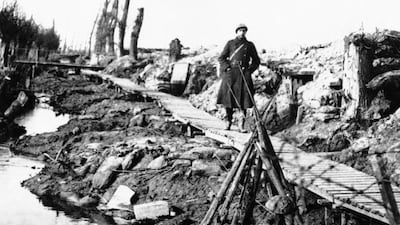
A soldier walks along wooden planks placed over the mud of Flanders' Fields near the Yperlee Canal near Ypres, Belgium. -
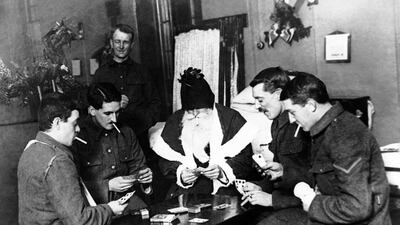
Wounded World War One soldiers play a game at a London hospital. -
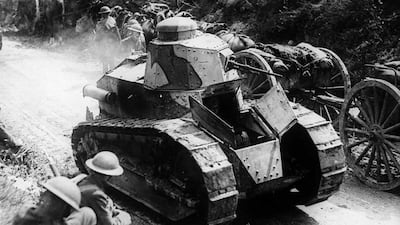
Two soldiers are passed by tanks on their way to support French troops in Juvigny, France. -
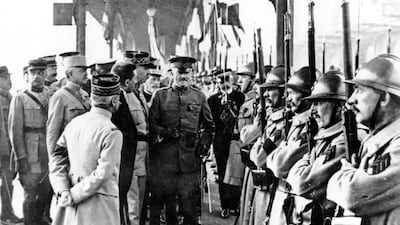
US Army General John J. Pershing, center, inspects French troops at Boulogne, France, on June 13, 1917. -
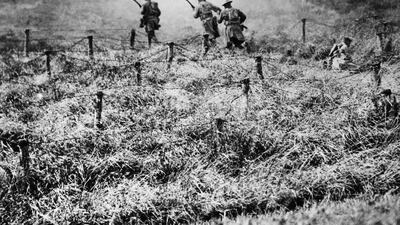
US troops advance on a path through a barbed wire entanglement near Beauqueanes, Somme, France. -
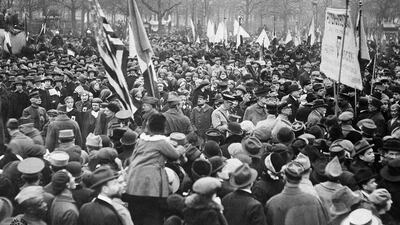
People in the streets of Paris, France, celebrate the signing of the Armistice. -
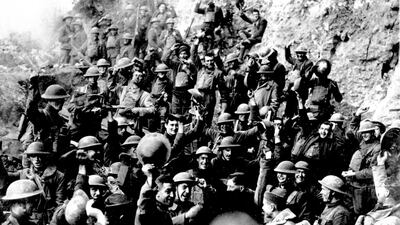
American troops, near St. Mihiel, France, cheer after hearing the news that the Armistice has been signed.


Forgotten Muslim heroes of Great War immortalised in London exhibition
Tower of London glows to mark centenary of the end of First World War - in pictures
How the First World War shaped the borders of the Middle East

