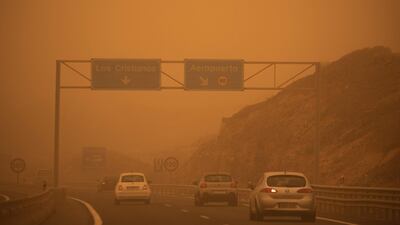
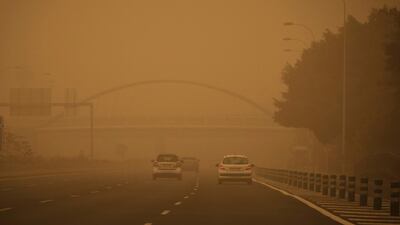
Motorists travel on the TF-1 highway on February 23 after the sandstorm hit Tenerife. Airports on the Canary Islands were closed after strong winds carrying sand from the Sahara shrouded the tourist hot spot. AFP
Motorists travel on the TF-1 highway on February 23 after the sandstorm hit Tenerife. Airports on the Canary Islands were closed after strong winds carrying sand from the Sahara shrouded the tourist h

'Like living on Mars': Canary Islands hit by massive sandstorm


Ian Oxborrow
  • English
  • Arabic

The Canary Islands are typically a tranquil haven for European holidaymakers seeking some warm sunshine and sand during the cold winter months.

But thousands of travellers got rather more sand than they bargained for this weekend as a huge sandstorm blew in from the Sahara.

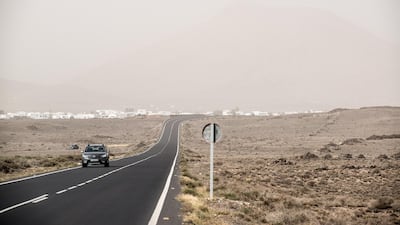
  • Cars drive on the TF-1 highway during a sandstorm in Santa Cruz de Tenerife. AFP
    Cars drive on the TF-1 highway during a sandstorm in Santa Cruz de Tenerife. AFP
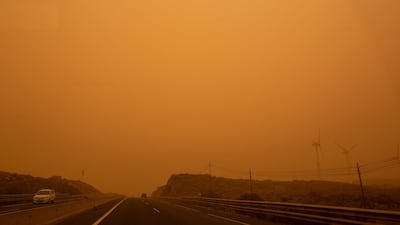
  • Cars drive on the TF-1 highway during a sandstorm in Santa Cruz de Tenerife, on the Canary Island of Tenerife. AFP
    Cars drive on the TF-1 highway during a sandstorm in Santa Cruz de Tenerife, on the Canary Island of Tenerife. AFP
  • Gran Canaria Airport as airplanes are not allowed to take-off in Las Palmas de Gran Canaria, Canary Islands, Spain. EPA
    Gran Canaria Airport as airplanes are not allowed to take-off in Las Palmas de Gran Canaria, Canary Islands, Spain. EPA
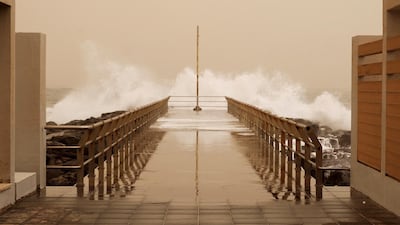
  • Big waves hit the sea promenade of El Burrero's beach during a windy afternoon in Las Palmas de Gran Canaria, Canary Islands on February 23, 2020. EPA
    Big waves hit the sea promenade of El Burrero's beach during a windy afternoon in Las Palmas de Gran Canaria, Canary Islands on February 23, 2020. EPA
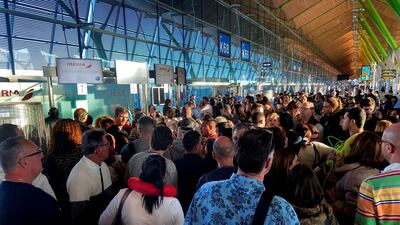
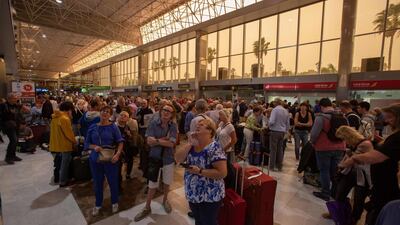
  • Hundreds of people await at Madrid-Barajas Adolfo Suarez Airport as flights to the Canary islands have been either canceled or delayed, in Madrid, Spain. EPA
    Hundreds of people await at Madrid-Barajas Adolfo Suarez Airport as flights to the Canary islands have been either canceled or delayed, in Madrid, Spain. EPA
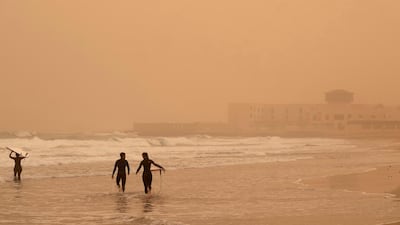
  • Surfers go for a swim at Playa Blanca in Puerto del Rosario, Fuerteventura, Canary Islands. EPA
    Surfers go for a swim at Playa Blanca in Puerto del Rosario, Fuerteventura, Canary Islands. EPA
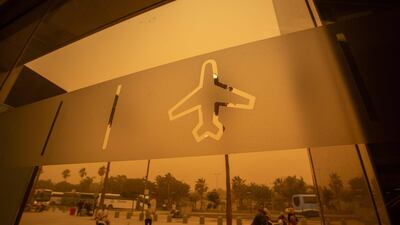
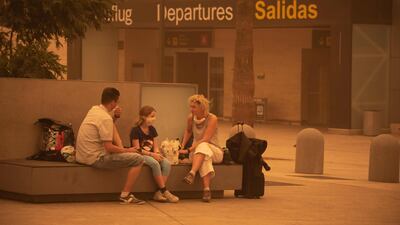
  • Passengers walk outside Tenerife South–Reina Sofia Airport during a sandstorm on February 23, 2020 on the Canary Island of Tenerife. AFP
    Passengers walk outside Tenerife South–Reina Sofia Airport during a sandstorm on February 23, 2020 on the Canary Island of Tenerife. AFP
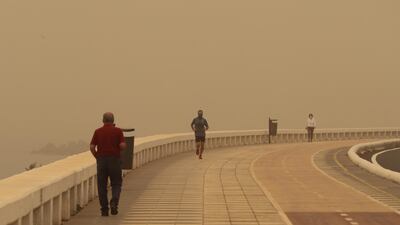
  • People take a stroll by the sea promenade in Las Palmas de Gran Canaria, Canary Islands, Spain. EPA
    People take a stroll by the sea promenade in Las Palmas de Gran Canaria, Canary Islands, Spain. EPA
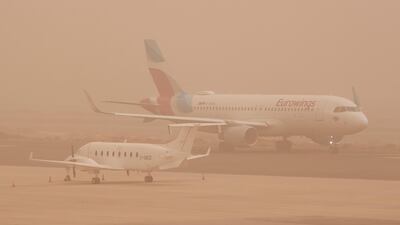
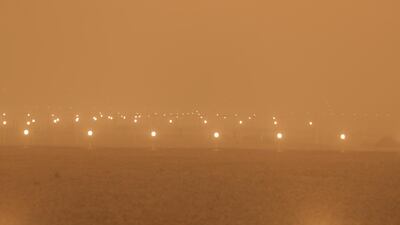
  • A view of the runway during a sandstorm blown over from North Africa known as "calima" at Las Palmas Airport, Canary Islands, Gran Canaria. Reuters
    A view of the runway during a sandstorm blown over from North Africa known as "calima" at Las Palmas Airport, Canary Islands, Gran Canaria. Reuters
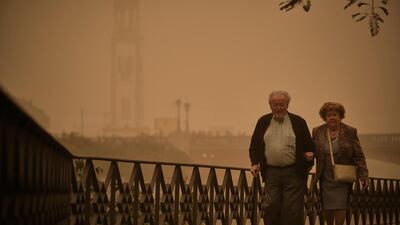
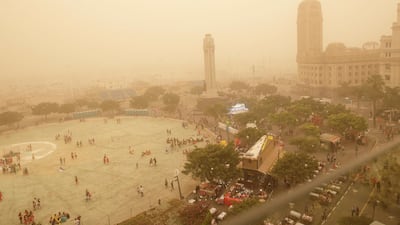
  • A couple walk across a bridge in a cloud of red dust in Santa Cruz de Tenerife, Spain. AP Photo
    A couple walk across a bridge in a cloud of red dust in Santa Cruz de Tenerife, Spain. AP Photo
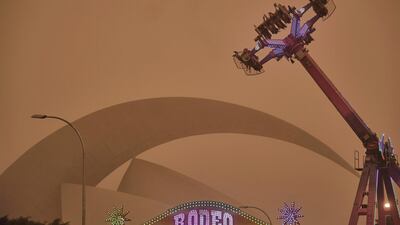
  • People ride on a fairground attraction in a cloud of red dust in Santa Cruz de Tenerife, Spain. AP Photo
    People ride on a fairground attraction in a cloud of red dust in Santa Cruz de Tenerife, Spain. AP Photo
  • Cars drive in a cloud of red dust in Santa Cruz de Tenerife, Spain. AP Photo
    Cars drive in a cloud of red dust in Santa Cruz de Tenerife, Spain. AP Photo
  • Santa Cruz de Tenerife in the Canary Islands on February 23, 2020. EPA
    Santa Cruz de Tenerife in the Canary Islands on February 23, 2020. EPA
  • A car drives along Arrecife, in Lanzarote, Canary Islands, Spain, on February 23, 2020. EPA
    A car drives along Arrecife, in Lanzarote, Canary Islands, Spain, on February 23, 2020. EPA
  • Passengers wait at Tenerife South–Reina Sofia Airport after flights were cancelled due to a sandstorm on February 23, 2020 on the Canary Island of Tenerife. AFP
    Passengers wait at Tenerife South–Reina Sofia Airport after flights were cancelled due to a sandstorm on February 23, 2020 on the Canary Island of Tenerife. AFP
  • Passengers wait outside Tenerife South–Reina Sofia Airport after flights were cancelled due to a sandstorm on February 23, 2020 on the Canary Island of Tenerife. AFP
    Passengers wait outside Tenerife South–Reina Sofia Airport after flights were cancelled due to a sandstorm on February 23, 2020 on the Canary Island of Tenerife. AFP

Tenerife and Gran Canaria were shrouded in orange dust, causing travel disruption that left holidaymakers stranded on the islands off the coast of north-west Africa.

A Nasa satellite image showed the sand being carried east from the Sahara across the Atlantic Ocean to the popular holiday resorts.

Airport operator Aena confirmed on Sunday that it diverted all incoming flights amid the poor visibility, but some outbound flights from Fuerteventura and Lanzarote were operating.

Many tourists took to social media to say they were stranded and pictures showed huge queues forming at airports as people waited for flights to resume. Some called the weather phenomenon "apocalyptic", while others said it was "like living on Mars".

The regional government declared a state of alert on Saturday and advised people to keep doors and windows closed, avoid non-essential car travel and stay away from coastal areas.

Spain's national weather service warned winds of up to 120 kilometres per hour would continue to affect the islands until Monday.


Mercer, the investment consulting arm of US services company Marsh & McLennan, expects its wealth division to at least double its assets under management (AUM) in the Middle East as wealth in the region continues to grow despite economic headwinds, a company official said.

Mercer Wealth, which globally has $160 billion in AUM, plans to boost its AUM in the region to $2-$3bn in the next 2-3 years from the present $1bn, said Yasir AbuShaban, a Dubai-based principal with Mercer Wealth.

Within the next two to three years, we are looking at reaching $2 to $3 billion as a conservative estimate and we do see an opportunity to do so,” said Mr AbuShaban.

Mercer does not directly make investments, but allocates clients’ money they have discretion to, to professional asset managers. They also provide advice to clients.

“We have buying power. We can negotiate on their (client’s) behalf with asset managers to provide them lower fees than they otherwise would have to get on their own,” he added.

Mercer Wealth’s clients include sovereign wealth funds, family offices, and insurance companies among others.

From its office in Dubai, Mercer also looks after Africa, India and Turkey, where they also see opportunity for growth.

Wealth creation in Middle East and Africa (MEA) grew 8.5 per cent to $8.1 trillion last year from $7.5tn in 2015, higher than last year’s global average of 6 per cent and the second-highest growth in a region after Asia-Pacific which grew 9.9 per cent, according to consultancy Boston Consulting Group (BCG). In the region, where wealth grew just 1.9 per cent in 2015 compared with 2014, a pickup in oil prices has helped in wealth generation.

BCG is forecasting MEA wealth will rise to $12tn by 2021, growing at an annual average of 8 per cent.

Drivers of wealth generation in the region will be split evenly between new wealth creation and growth of performance of existing assets, according to BCG.

Another general trend in the region is clients’ looking for a comprehensive approach to investing, according to Mr AbuShaban.

“Institutional investors or some of the families are seeing a slowdown in the available capital they have to invest and in that sense they are looking at optimizing the way they manage their portfolios and making sure they are not investing haphazardly and different parts of their investment are working together,” said Mr AbuShaban.

Some clients also have a higher appetite for risk, given the low interest-rate environment that does not provide enough yield for some institutional investors. These clients are keen to invest in illiquid assets, such as private equity and infrastructure.

“What we have seen is a desire for higher returns in what has been a low-return environment specifically in various fixed income or bonds,” he said.

“In this environment, we have seen a de facto increase in the risk that clients are taking in things like illiquid investments, private equity investments, infrastructure and private debt, those kind of investments were higher illiquidity results in incrementally higher returns.”

The Abu Dhabi Investment Authority, one of the largest sovereign wealth funds, said in its 2016 report that has gradually increased its exposure in direct private equity and private credit transactions, mainly in Asian markets and especially in China and India. The authority’s private equity department focused on structured equities owing to “their defensive characteristics.”