• A man walks past graffiti on a wall in Manchester. Reuters
    A man walks past graffiti on a wall in Manchester. Reuters
  • Traffic passes the Arndale Centre shopping mall in Manchester. Bloomberg
    Traffic passes the Arndale Centre shopping mall in Manchester. Bloomberg
  • Pedestrians pass an advertising sign displaying that the Local Covid Alert Level is High in Manchester. Bloomberg
    Pedestrians pass an advertising sign displaying that the Local Covid Alert Level is High in Manchester. Bloomberg
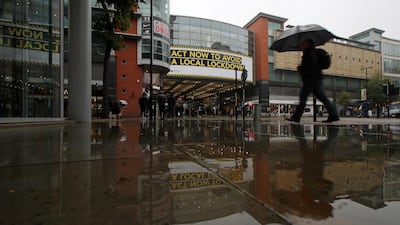
  • Pedestrians pass a large advertisement on the Arndale Centre shopping mall reading "Act now to avoid a local lockdown" in Manchester. Bloomberg
    Pedestrians pass a large advertisement on the Arndale Centre shopping mall reading "Act now to avoid a local lockdown" in Manchester. Bloomberg
  • Parasols and gazebos cover outdoor seating areas along Dale Street in Manchester. Bloomberg
    Parasols and gazebos cover outdoor seating areas along Dale Street in Manchester. Bloomberg
  • Pedestrians wearing protective face coverings walk past a Covid-19 testing sign in Manchester. AFP
    Pedestrians wearing protective face coverings walk past a Covid-19 testing sign in Manchester. AFP
  • A couple wear face-masks as they chat in the Ancoats district of Manchester. AFP
    A couple wear face-masks as they chat in the Ancoats district of Manchester. AFP
  • A member of ground staff sanitises a goal post during the Premier League match between Manchester City and Arsenal at Etihad Stadium in Manchester. Getty Images
    A member of ground staff sanitises a goal post during the Premier League match between Manchester City and Arsenal at Etihad Stadium in Manchester. Getty Images
  • An artist works on a mural in Manchester. Reuters
    An artist works on a mural in Manchester. Reuters

ICU beds crisis: Manchester just weeks from meltdown


Jamie Prentis
  • English
  • Arabic

Greater Manchester will run out of intensive care beds by November 12, the UK government has warned, with Prime Minister Boris Johnson ready to offer the region £100 million ($129.4m) to offset the economic effects of a stricter lockdown.

Mr Johnson's spokesman said the estimate was based on modelling by experts advising the government.

He said coronavirus cases in the over-60 age group had tripled in the past 15 days.

Projections suggest Covid-19 patients would take up the entire intensive care capacity by November 8, and the entire surge capacity by November 12, meaning hospitals would be overwhelmed.

Manchester’s current rate is 432.5 cases for each 100,000 people.

Greater Manchester had only 46 critical care beds left last Friday – 18 per cent of its total supply – and some of its 12 hospitals were already full, National Health Service figures obtained by The Guardian  showed.

The NHS said it was monitoring hospital admission rates, critical care beds and intensive care units.

"It's not unusual for 80-85 per cent of ICU beds to be in use at this time of year," it said.

"And our hospitals work together if there are particular pressures in any one area, to ensure the best care for patients who need the high level of support ICU provides, for Covid and for other reasons."

Mr Johnson hopes to reach an agreement with leaders in the region to convince it to go into a Tier 3 lockdown, meaning the area has a “very high level" of coronavirus infections.

Greater Manchester Mayor Andy Burnham has so far resisted pressure to enact tougher measures in the region and received support from backbench MPs in Mr Johnson’s Conservative Party.

Mr Burnham wants the government to give more support to workers who would lose their jobs if their place of work closes if a Tier 3 lockdown were enforced.

On Monday morning, a senior minister said the government offered leaders in Greater Manchester more money to impose a stricter lockdown.

“There is now a need to be honest for the local leaders, including the mayor, to show flexibility, to come to us and to reach an agreement today or tomorrow so we can bring this to a conclusion,” Robert Jenrick, Secretary for Local Government, told Sky News.

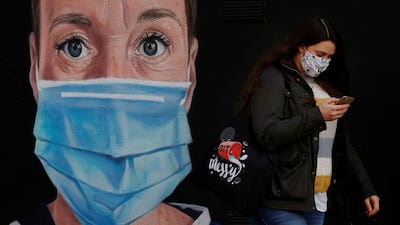
  • A woman wears a face mask as she walks past a mural of a nurse in Manchester. Reuters
    A woman wears a face mask as she walks past a mural of a nurse in Manchester. Reuters
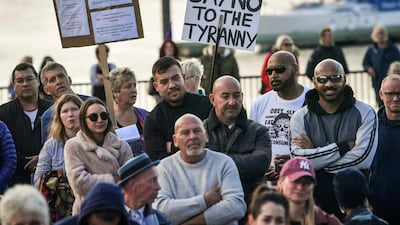
  • People attend an anti-lockdown protest outside the Senedd Cymru in Cardiff Bay, Wales. AP Photo
    People attend an anti-lockdown protest outside the Senedd Cymru in Cardiff Bay, Wales. AP Photo
  • A sign appealing to the public to follow guidelines in Manchester. Reuters
    A sign appealing to the public to follow guidelines in Manchester. Reuters
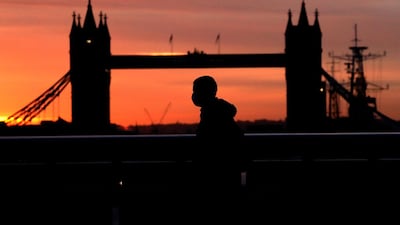
  • A person wearing a face mask walks across London Bridge, with Tower Bridge in the background, at sunrise in London. AP Photo
    A person wearing a face mask walks across London Bridge, with Tower Bridge in the background, at sunrise in London. AP Photo
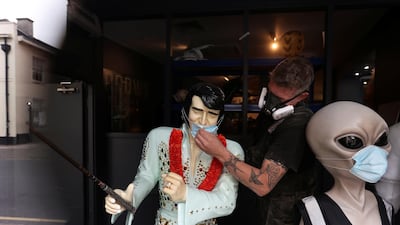
  • A worker adjusts a face mask on a mannequin at a shop in Nottingham. Reuters
    A worker adjusts a face mask on a mannequin at a shop in Nottingham. Reuters
  • A man wearing a face mask walks along the River Mersey in Liverpool. Reuters
    A man wearing a face mask walks along the River Mersey in Liverpool. Reuters
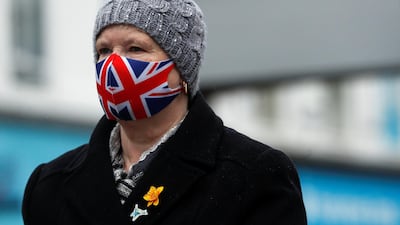
  • A person wears a Union Jack face mask in Newcastle Upon Tyne. Reuters
    A person wears a Union Jack face mask in Newcastle Upon Tyne. Reuters
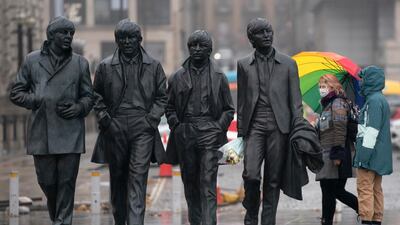
  • Members of the public wearing face masks stand near a statue of The Beatles in Liverpool. AP Photo
    Members of the public wearing face masks stand near a statue of The Beatles in Liverpool. AP Photo

“We’ve offered further resources and you can see very clearly from the resources that we’ve given to Merseyside and Lancashire, with whom we’ve worked well, in recent weeks, the sort of package that we’re willing to offer to Greater Manchester."

The highest level of restrictions would force pubs to close and ban people from mixing indoors with others from different households.

Meanwhile, Wales announced it would impose a two-week "firebreak" lockdown from Friday, in which everybody apart from essential workers must stay at home to combat an accelerating second wave of Covid-19.

There were 4,127 new confirmed cases of coronavirus recorded by Public Health Wales between October 9 and 15, although the real level of infections is believed to be much higher.

The “sharp and deep” lockdown will begin at 6pm on October 23 and last until November 9, First Minister Mark Drakeford said.

“The only exceptions will be critical workers and jobs where working from home is not possible,” Mr Drakeford said.

The UK recorded 18,804 new daily cases of Covid-19 in 24 hours, Worldometer said on Monday.

Ten tax points to be aware of in 2026

1. Domestic VAT refund amendments: request your refund within five years

If a business does not apply for the refund on time, they lose their credit.

2. E-invoicing in the UAE

Businesses should continue preparing for the implementation of e-invoicing in the UAE, with 2026 a preparation and transition period ahead of phased mandatory adoption. 

3. More tax audits

Tax authorities are increasingly using data already available across multiple filings to identify audit risks. 

4. More beneficial VAT and excise tax penalty regime

Tax disputes are expected to become more frequent and more structured, with clearer administrative objection and appeal processes. The UAE has adopted a new penalty regime for VAT and excise disputes, which now mirrors the penalty regime for corporate tax.

5. Greater emphasis on statutory audit

There is a greater need for the accuracy of financial statements. The International Financial Reporting Standards standards need to be strictly adhered to and, as a result, the quality of the audits will need to increase.

6. Further transfer pricing enforcement

Transfer pricing enforcement, which refers to the practice of establishing prices for internal transactions between related entities, is expected to broaden in scope. The UAE will shortly open the possibility to negotiate advance pricing agreements, or essentially rulings for transfer pricing purposes. 

7. Limited time periods for audits

Recent amendments also introduce a default five-year limitation period for tax audits and assessments, subject to specific statutory exceptions. While the standard audit and assessment period is five years, this may be extended to up to 15 years in cases involving fraud or tax evasion. 

8. Pillar 2 implementation 

Many multinational groups will begin to feel the practical effect of the Domestic Minimum Top-Up Tax (DMTT), the UAE's implementation of the OECD’s global minimum tax under Pillar 2. While the rules apply for financial years starting on or after January 1, 2025, it is 2026 that marks the transition to an operational phase.

9. Reduced compliance obligations for imported goods and services

Businesses that apply the reverse-charge mechanism for VAT purposes in the UAE may benefit from reduced compliance obligations. 

10. Substance and CbC reporting focus

Tax authorities are expected to continue strengthening the enforcement of economic substance and Country-by-Country (CbC) reporting frameworks. In the UAE, these regimes are increasingly being used as risk-assessment tools, providing tax authorities with a comprehensive view of multinational groups’ global footprints and enabling them to assess whether profits are aligned with real economic activity. 

Contributed by Thomas Vanhee and Hend Rashwan, Aurifer