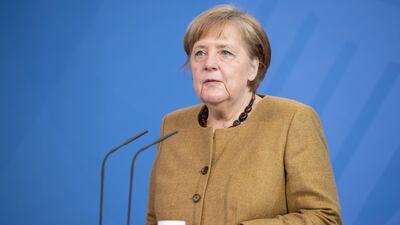
German Chancellor Angela Merkel. EPA

How Angela Merkel's would-be successors compare on Middle East and refugee policy


Tim Stickings
  • English
  • Arabic

Angela Merkel's decision to open Germany's doors to Syrian refugees was one of the defining moments of her 16 years in power and has been a flashpoint in German politics ever since.

But Ms Merkel is bowing out this year and the candidates to succeed her at September’s election are largely unknown quantities in foreign policy – although they have struck different tones on the refugee issue.

Dr Muriel Asseburg, an expert on migration and the Middle East at the German Institute for International and Security Affairs, told The National that the parties' room for manoeuvre on migration was limited, as crisis-hit Germans say it is "time to focus on the domestic population's demands".

But she said the parties vying for the chancellorship would come under pressure from the far-right Alternative for Germany, which has sought to make out that "everything's fine in Syria" and that refugees can return.

Two men are fighting to lead Ms Merkel's conservative bloc into the election, while the Greens are poised to choose a nominee and the Social Democrats (SPD) have already picked their candidate.

The National examines the positions on Middle East and refugee policy of the main contenders.

CDU leader Armin Laschet. Reuters

Armin Laschet, Christian Democratic Union

Mr Laschet, above, is a centrist ally of Ms Merkel who defended the chancellor's decision to open Germany's borders during the 2015 refugee crisis.

As premier of the state of North Rhine-Westphalia, he described the region as an "open-minded land of integration with a culture of welcoming persecuted people and their families".

But he also said in 2019, when his government deported the leader of an alleged Al Qaeda cell to Morocco, that “criminals and people who pose a danger will be systematically deported, more than in any other state”.

Dr Asseburg said Mr Laschet had “not been at the forefront of allowing more refugees in or taking a special role towards assuming more responsibility towards refugees”.

“I find it difficult to foresee how he would handle that as a chancellor. That is more linked to his personality, which I would see as not very easy to predict,” she said.

Mr Laschet’s foreign policy views have been under scrutiny since he was elected CDU leader in January, partly because of his statements on Syria.

He was a critic of western intervention against Syrian President Bashar Al Assad, which he said had facilitated the rise of ISIS. He also defended Mr Al Assad by claiming that Syrians enjoyed religious freedom before the outbreak of war.

Mr Laschet's views on the Middle East include public warmth towards Jordan, which he described last month as a "cornerstone of stability for the whole region".

He also praised the nuclear deal with Iran, which he said had "made the world safer".

CSU leader Markus Soeder. EPA

Markus Soeder, Christian Social Union

Mr Soeder, above, the minister-president of Bavaria who is vying with Mr Laschet to lead the joint CDU-CSU ticket into the election, used tougher language on the refugee issue.

At the height of the 2015 migration crisis, he said that Germany could “not take in all the world’s refugees” and urged a debate on putting up border fences in Europe.

In a 2018 interview he said that Bavaria did “not want to bring in any Islamic holidays”.

But Dr Asseburg said Mr Soeder’s tough language was partly a question of image.

“Soeder likes to project the image that he’s taking a tough line. I’m not sure that he is actually taking a tougher line than others do. The toughness is mainly about trying to get the process done in an orderly fashion,” she said.

“In the end, I don’t see him as necessarily much tougher than his SPD colleagues or colleagues from the CDU.”

Having spent his career in regional politics, Mr Soeder’s foreign policy record is limited.

Dr Asseburg said that Mr Laschet and Mr Soeder, who lead the two most populous states in Germany, were both “very much domestic politicians”.

Mr Soeder’s stance on refugees brought him into conflict with Turkish President Recep Tayyip Erdogan, who he criticised for threatening to tear up the EU-Ankara agreement on protecting Europe’s borders.

He also ventured into foreign policy in 2019 to criticise Nato member Turkey over its offensive in northern Syria.

Green leaders Robert Habeck and Annalena Baerbock. Reuters

Robert Habeck and Annalena Baerbock, The Greens

The Greens have yet to decide which of their two co-leaders, Robert Habeck, above left, and Annalena Baerbock, right, will run for the chancellorship in September’s election.

Mr Habeck’s career has focused on domestic politics, while Ms Baerbock held a foreign policy brief in the party but is also the youngest and least experienced of the candidates, Dr Asseburg said.

On migration, Dr Asseburg said the Greens would be more open to “family reunification” policies seeking to reunite solo refugees with their relatives.

The party would also seek a “more principled immigration law that looks towards the medium and long term and allows for immigration of qualified workers and qualified professionals”, she said.

A Green election manifesto calls for streamlining the asylum process so that applicants will know more quickly whether they can stay in Germany.

But Dr Asseburg said that the Greens would not come out with a “major initiative of changing everything” on refugee policy.

In foreign policy, she said there would be a greater emphasis on human rights and accountability if the Greens joined the government for the first time since 2005.

“We would see a different approach towards refugees and migration. And maybe also a different approach with regard to arms sales in general,” she said.

The Greens’ manifesto says they “stand on the side of all of those fighting for democracy, human rights and the rule of law” in Mr Erdogan’s Turkey.

SPD nominee Olaf Scholz. EPA

Olaf Scholz, Social Democratic Party

Mr Scholz, above, is the nominee of the Social Democrats (SPD), who have governed in coalition with Ms Merkel for most of her 16 years in power.

At the time of the 2015 refugee crisis, Mr Scholz was the mayor of Hamburg, a city praised by the Brookings Institution for its "remarkable ability to innovate" in response to the migrant arrivals.

Mr Scholz defended the EU pact with Turkey but hit out at Mr Erdogan for making “absurd accusations” against German MPs of Turkish descent whom the Turkish president described as having “impure blood”.

Since joining Ms Merkel’s Cabinet in 2018, Mr Scholz pleaded successfully for Germany to take in migrants from a Greek refugee camp that was destroyed by fire.

But he also faced criticism, in his role as finance minister, for proposing cuts to funding for refugees and asylum seekers.

Dr Asseburg said Mr Scholz was generally in favour of “allowing regulated migration into Germany in order to cover for the need for qualified workers and professionals”.

As a government minister, Mr Scholz voiced support for upholding the nuclear deal with Iran since the US pulled out of the pact in 2018.

And amid tensions in the Arabian Gulf in 2019, Mr Scholz said that Berlin would not join any US military action to protect shipping in the Strait of Hormuz.

More on Germany

'Half' of Covid-19 ICU patients in Germany are Muslim

Germany's Muslims urged to avoid large Ramadan gatherings

'We can do this' on refugees, Merkel said - and Germans have

COMPANY%20PROFILE
%3Cp%3E%3Cstrong%3ECompany%20name%3C%2Fstrong%3E%3A%20ASI%20(formerly%20DigestAI)%3C%2Fp%3E%0A%3Cp%3E%3Cstrong%3EStarted%3A%3C%2Fstrong%3E%202017%3C%2Fp%3E%0A%3Cp%3E%3Cstrong%3EFounders%3A%3C%2Fstrong%3E%20Quddus%20Pativada%3C%2Fp%3E%0A%3Cp%3E%3Cstrong%3EBased%3A%3C%2Fstrong%3E%20Dubai%2C%20UAE%3C%2Fp%3E%0A%3Cp%3E%3Cstrong%3EIndustry%3A%3C%2Fstrong%3E%20Artificial%20intelligence%2C%20education%20technology%3C%2Fp%3E%0A%3Cp%3E%3Cstrong%3EFunding%3A%3C%2Fstrong%3E%20%243%20million-plus%3C%2Fp%3E%0A%3Cp%3E%3Cstrong%3EInvestors%3A%3C%2Fstrong%3E%20GSV%20Ventures%2C%20Character%2C%20Mark%20Cuban%3C%2Fp%3E%0A
MATCH INFO

Uefa Champions League, Group C
Liverpool v Red Star Belgrade
Anfield, Liverpool
Wednesday, 11pm (UAE)

Why it pays to compare

A comparison of sending Dh20,000 from the UAE using two different routes at the same time - the first direct from a UAE bank to a bank in Germany, and the second from the same UAE bank via an online platform to Germany - found key differences in cost and speed. The transfers were both initiated on January 30.

Route 1: bank transfer

The UAE bank charged Dh152.25 for the Dh20,000 transfer. On top of that, their exchange rate margin added a difference of around Dh415, compared with the mid-market rate.

Total cost: Dh567.25 - around 2.9 per cent of the total amount

Total received: €4,670.30 

Route 2: online platform

The UAE bank’s charge for sending Dh20,000 to a UK dirham-denominated account was Dh2.10. The exchange rate margin cost was Dh60, plus a Dh12 fee.

Total cost: Dh74.10, around 0.4 per cent of the transaction

Total received: €4,756

The UAE bank transfer was far quicker – around two to three working days, while the online platform took around four to five days, but was considerably cheaper. In the online platform transfer, the funds were also exposed to currency risk during the period it took for them to arrive.

The National Archives, Abu Dhabi

Founded over 50 years ago, the National Archives collects valuable historical material relating to the UAE, and is the oldest and richest archive relating to the Arabian Gulf.

Much of the material can be viewed on line at the Arabian Gulf Digital Archive - https://www.agda.ae/en

Directed by Sam Mendes

Starring Dean-Charles Chapman, George MacKay, Daniel Mays

4.5/5

Islamophobia definition

A widely accepted definition was made by the All Party Parliamentary Group on British Muslims in 2019: “Islamophobia is rooted in racism and is a type of racism that targets expressions of Muslimness or perceived Muslimness.” It further defines it as “inciting hatred or violence against Muslims”.

The%20Genius%20of%20Their%20Age
%3Cp%3EAuthor%3A%20S%20Frederick%20Starr%3Cbr%3EPublisher%3A%20Oxford%20University%20Press%3Cbr%3EPages%3A%20290%3Cbr%3EAvailable%3A%20January%2024%3C%2Fp%3E%0A
'Nightmare Alley'

Director:Guillermo del Toro

Stars:Bradley Cooper, Cate Blanchett, Rooney Mara

Rating: 3/5

Ten tax points to be aware of in 2026

1. Domestic VAT refund amendments: request your refund within five years

If a business does not apply for the refund on time, they lose their credit.

2. E-invoicing in the UAE

Businesses should continue preparing for the implementation of e-invoicing in the UAE, with 2026 a preparation and transition period ahead of phased mandatory adoption. 

3. More tax audits

Tax authorities are increasingly using data already available across multiple filings to identify audit risks. 

4. More beneficial VAT and excise tax penalty regime

Tax disputes are expected to become more frequent and more structured, with clearer administrative objection and appeal processes. The UAE has adopted a new penalty regime for VAT and excise disputes, which now mirrors the penalty regime for corporate tax.

5. Greater emphasis on statutory audit

There is a greater need for the accuracy of financial statements. The International Financial Reporting Standards standards need to be strictly adhered to and, as a result, the quality of the audits will need to increase.

6. Further transfer pricing enforcement

Transfer pricing enforcement, which refers to the practice of establishing prices for internal transactions between related entities, is expected to broaden in scope. The UAE will shortly open the possibility to negotiate advance pricing agreements, or essentially rulings for transfer pricing purposes. 

7. Limited time periods for audits

Recent amendments also introduce a default five-year limitation period for tax audits and assessments, subject to specific statutory exceptions. While the standard audit and assessment period is five years, this may be extended to up to 15 years in cases involving fraud or tax evasion. 

8. Pillar 2 implementation 

Many multinational groups will begin to feel the practical effect of the Domestic Minimum Top-Up Tax (DMTT), the UAE's implementation of the OECD’s global minimum tax under Pillar 2. While the rules apply for financial years starting on or after January 1, 2025, it is 2026 that marks the transition to an operational phase.

9. Reduced compliance obligations for imported goods and services

Businesses that apply the reverse-charge mechanism for VAT purposes in the UAE may benefit from reduced compliance obligations. 

10. Substance and CbC reporting focus

Tax authorities are expected to continue strengthening the enforcement of economic substance and Country-by-Country (CbC) reporting frameworks. In the UAE, these regimes are increasingly being used as risk-assessment tools, providing tax authorities with a comprehensive view of multinational groups’ global footprints and enabling them to assess whether profits are aligned with real economic activity. 

Contributed by Thomas Vanhee and Hend Rashwan, Aurifer

Benefits of first-time home buyers' scheme
  • Priority access to new homes from participating developers
  • Discounts on sales price of off-plan units
  • Flexible payment plans from developers
  • Mortgages with better interest rates, faster approval times and reduced fees
  • DLD registration fee can be paid through banks or credit cards at zero interest rates
The specs: 2018 Nissan 370Z Nismo

The specs: 2018 Nissan 370Z Nismo
Price, base / as tested: Dh182,178
Engine: 3.7-litre V6
Power: 350hp @ 7,400rpm
Torque: 374Nm @ 5,200rpm
Transmission: Seven-speed automatic
​​​​​​​Fuel consumption, combined: 10.5L / 100km

Mercer, the investment consulting arm of US services company Marsh & McLennan, expects its wealth division to at least double its assets under management (AUM) in the Middle East as wealth in the region continues to grow despite economic headwinds, a company official said.

Mercer Wealth, which globally has $160 billion in AUM, plans to boost its AUM in the region to $2-$3bn in the next 2-3 years from the present $1bn, said Yasir AbuShaban, a Dubai-based principal with Mercer Wealth.

Within the next two to three years, we are looking at reaching $2 to $3 billion as a conservative estimate and we do see an opportunity to do so,” said Mr AbuShaban.

Mercer does not directly make investments, but allocates clients’ money they have discretion to, to professional asset managers. They also provide advice to clients.

“We have buying power. We can negotiate on their (client’s) behalf with asset managers to provide them lower fees than they otherwise would have to get on their own,” he added.

Mercer Wealth’s clients include sovereign wealth funds, family offices, and insurance companies among others.

From its office in Dubai, Mercer also looks after Africa, India and Turkey, where they also see opportunity for growth.

Wealth creation in Middle East and Africa (MEA) grew 8.5 per cent to $8.1 trillion last year from $7.5tn in 2015, higher than last year’s global average of 6 per cent and the second-highest growth in a region after Asia-Pacific which grew 9.9 per cent, according to consultancy Boston Consulting Group (BCG). In the region, where wealth grew just 1.9 per cent in 2015 compared with 2014, a pickup in oil prices has helped in wealth generation.

BCG is forecasting MEA wealth will rise to $12tn by 2021, growing at an annual average of 8 per cent.

Drivers of wealth generation in the region will be split evenly between new wealth creation and growth of performance of existing assets, according to BCG.

Another general trend in the region is clients’ looking for a comprehensive approach to investing, according to Mr AbuShaban.

“Institutional investors or some of the families are seeing a slowdown in the available capital they have to invest and in that sense they are looking at optimizing the way they manage their portfolios and making sure they are not investing haphazardly and different parts of their investment are working together,” said Mr AbuShaban.

Some clients also have a higher appetite for risk, given the low interest-rate environment that does not provide enough yield for some institutional investors. These clients are keen to invest in illiquid assets, such as private equity and infrastructure.

“What we have seen is a desire for higher returns in what has been a low-return environment specifically in various fixed income or bonds,” he said.

“In this environment, we have seen a de facto increase in the risk that clients are taking in things like illiquid investments, private equity investments, infrastructure and private debt, those kind of investments were higher illiquidity results in incrementally higher returns.”

The Abu Dhabi Investment Authority, one of the largest sovereign wealth funds, said in its 2016 report that has gradually increased its exposure in direct private equity and private credit transactions, mainly in Asian markets and especially in China and India. The authority’s private equity department focused on structured equities owing to “their defensive characteristics.”

Classification of skills

A worker is categorised as skilled by the MOHRE based on nine levels given in the International Standard Classification of Occupations (ISCO) issued by the International Labour Organisation. 

A skilled worker would be someone at a professional level (levels 1 – 5) which includes managers, professionals, technicians and associate professionals, clerical support workers, and service and sales workers.

The worker must also have an attested educational certificate higher than secondary or an equivalent certification, and earn a monthly salary of at least Dh4,000. 

Skewed figures

In the village of Mevagissey in southwest England the housing stock has doubled in the last century while the number of residents is half the historic high. The village's Neighbourhood Development Plan states that 26% of homes are holiday retreats. Prices are high, averaging around £300,000, £50,000 more than the Cornish average of £250,000. The local average wage is £15,458. 

The Pope's itinerary

Sunday, February 3, 2019 - Rome to Abu Dhabi
1pm: departure by plane from Rome / Fiumicino to Abu Dhabi
10pm: arrival at Abu Dhabi Presidential Airport


Monday, February 4
12pm: welcome ceremony at the main entrance of the Presidential Palace
12.20pm: visit Abu Dhabi Crown Prince at Presidential Palace
5pm: private meeting with Muslim Council of Elders at Sheikh Zayed Grand Mosque
6.10pm: Inter-religious in the Founder's Memorial


Tuesday, February 5 - Abu Dhabi to Rome
9.15am: private visit to undisclosed cathedral
10.30am: public mass at Zayed Sports City – with a homily by Pope Francis
12.40pm: farewell at Abu Dhabi Presidential Airport
1pm: departure by plane to Rome
5pm: arrival at the Rome / Ciampino International Airport

Jumanji: The Next Level

Director: Jake Kasdan

Stars: Dwayne Johnson, Kevin Hart, Karen Gillan, Jack Black, Nick Jonas 

Two out of five stars 

House-hunting

Top 10 locations for inquiries from US house hunters, according to Rightmove

  1. Edinburgh, Scotland 
  2. Westminster, London 
  3. Camden, London 
  4. Glasgow, Scotland 
  5. Islington, London 
  6. Kensington and Chelsea, London 
  7. Highlands, Scotland 
  8. Argyll and Bute, Scotland 
  9. Fife, Scotland 
  10. Tower Hamlets, London
