British Prime Minister Boris Johnson has said travel to the UK will not return to normal this year despite a new proposal for vaccinated passengers.
Mr Johnson said on Monday that “hassle and delays” would be a feature of foreign travel for the foreseeable future to prevent imported cases of Covid-19.
He confirmed ministers were considering dropping the 10-day quarantine requirement for fully vaccinated passengers from “amber list” countries, but said no decision had yet been made.
“We’ll certainly be looking at that, but I want to stress that this is going to be, whatever happens, a difficult year for travel,” Mr Johnson said.
“There will be hassle. There will be delays, I’m afraid, because the priority has got to be to keep the country safe and to stop the virus coming back in.”
Mr Johnson’s gloomy outlook comes as new data released showed about one in 200 people returning from amber countries tested positive for Covid.
Eighty-nine of 23,465 passengers who travelled to the UK from these destinations between May 20 and June 9 were found to have the virus.
The National Health Service’s Test and Trace figures showed that no “variants of concern” were detected.
Mr Johnson said “things are looking good” for the removal of social distancing restrictions on July 19 but he would not rule out future lockdowns in case “some new horror” presented itself.
He said the Delta variant was spreading rapidly, despite the vaccination drive.
Cases of the variant are “sadly going up still. It’s going up by about 30 per cent a week in cases, hospitalisations up by roughly the same amount and so, sadly, are ICU admissions into intensive care,” he said.
“So we’ve got to be cautious, but we will be following the data the whole time.”
Meanwhile, Health Secretary Matt Hancock said he hoped to scrap isolation for fully vaccinated people who come into contact with a Covid case.
He said a trial was under way offering daily rapid testing as an alternative to isolation.
“We’re always looking at how we can replace the restrictions we have had to have as a country with the protection you get from the vaccine. That’s the whole point of the vaccine,” he said.
Of adults living in the UK, 81.9 per cent have had at least one dose of a Covid-19 vaccine, and 59.7 per cent have had two, government figures showed.
Coronavirus in the UK - in pictures
-
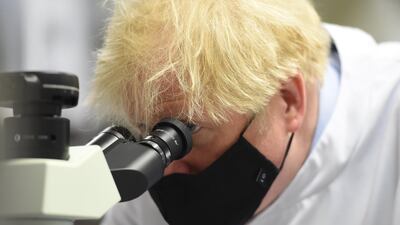
British Prime Minister Boris Johnson looks through a microscope during a visit to a lab at The National Institute for Biological Standards in South Mimms. Getty Images -
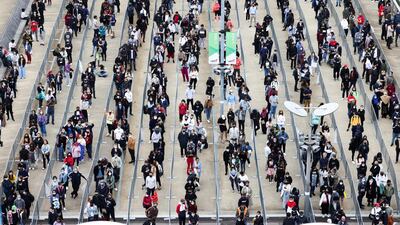
People queue outside a mass vaccination centre for those aged 18 and over at the London Stadium. Reuters -

People inside the stone circle during Summer Solstice at Stonehenge. The prehistoric monument of ancient stones have been officially closed for the celebrations due to the coronavirus lockdown, but groups of people ignored the lockdown. AP Photo -

Members of the public walk past shops in Kendal in Cumbria, where surge testing has been deployed following an outbreak of a coronavirus variant of concern. AFP -
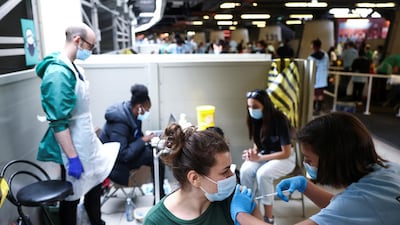
A person receives a dose of the Pfizer/BioNTech vaccine at a mass vaccination centre at the London Stadium. Reuters -
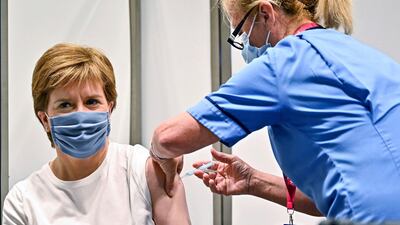
First Minister of Scotland Nicola Sturgeon receives her second dose of the AstraZeneca vaccine at the NHS Louisa Jordan vaccine centre in Glasgow. AP Photo -
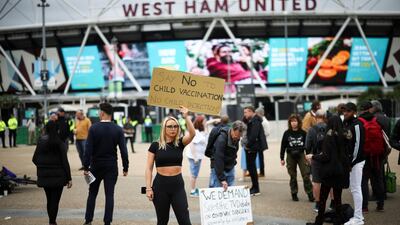
Anti-vaccine protestors gather outside a mass vaccination centre at the London Stadium. Reuters -

Members of the public queue to enter a temporary Covid-19 testing centre set up a car park in Kendal in Cumbria. AFP -

Medical staff work inside the mass vaccination centre at the London Stadium. Reuters -
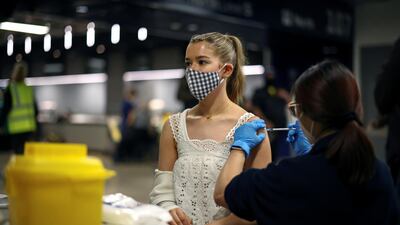
A person receives a dose of the Pfizer/BioNTech vaccine at the Tottenham Hotspur Stadium, in London. Reuters -

People enter a Covid-19 vaccination centre in London. EPA


Margaret Keenan, 91, who received the world’s first Covid-19 vaccine dose outside trial conditions, on Monday urged other people to be immunised.
“Whatever you thought before, please do have the jab,” she said on BBC Breakfast.
“There is nothing to it. Don’t be afraid of a needle. It is just to save your life and to save other lives.”
About one million vaccine appointments were booked in England at the weekend after the programme opened up to include over-18s on Friday.
By July 19, it is hoped that all adults will have had their first dose and everyone aged over 50 – as well as the clinically extremely vulnerable – will have been offered their second.

