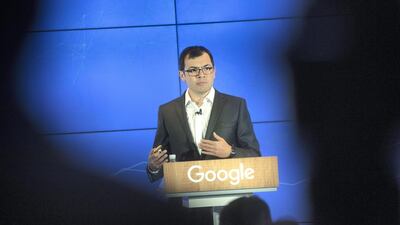
DeepMind chief executive Demis Hassabi. Getty Images

Google AI researchers crack 50-year-old biological question


  • English
  • Arabic

Scientists could pinpoint how diseases such as cancer invade cells after AI researchers at Google cracked a 50-year-old biological challenge.

Researchers have long tried to predict the shape of proteins in the body in a challenge known as the “protein folding problem”.

Proteins start off in a long chain but then fold on themselves to form a three-dimensional shape to perform their biological function.

But sometimes this process fails, which scientists say can cause diseases.

DeepMind, the London-based subsidiary of Google, has now reached the threshold for solving the problem.

Using algorithms, they were able to predict the structure of proteins.

Understanding how a protein will form has implications for discovering how new diseases, such as cancer, invade our cells, potentially leading to better drug development to fight the disease.

It can also help in designing enzymes to break down pollutants and improve crop yields.

“These algorithms are now becoming strong enough and powerful enough to be applicable to scientific problems,” DeepMind chief executive Demis Hassabis said.

“We have a system that’s accurate enough to actually have biological significance and relevance for biological researchers.”

DeepMind is now looking into ways of offering scientists access to its AlphaFold system in a “scalable way”.

The group completed the challenge at the latest Critical Assessment of Structure Prediction (Casp) competition.

The event started in 1994 and is held every two years to accelerate research on the topic.

Casp scientists analysed the shape of amino acid sequences for a set of about 100 proteins.

Competitors were given the sequences, and challenged to predict their shape.

AlphaFold’s assessment lined up almost perfectly with the Casp analysis for two thirds of the proteins, compared with about 10 per cent from the other teams, and better than DeepMind’s tool achieved in the same competition two years ago.

Mr Hassabis said his inspiration for AlphaFold came from “citizen science” attempts to find unknown protein structures, like Foldit, which presented amateur volunteers with the problem in the form of a puzzle.

In its first two years, the human gamers proved surprisingly good at solving the riddles, discovering a structure that had baffled scientists and designing a new enzyme that was later confirmed in the lab.

“Determining a single protein structure often required years of experimental effort,” said Janet Thornton, director emeritus of the European Bioinformatics Institute and one of the pioneers of using computational approaches to understanding protein structure.

“A better understanding of protein structures and the ability to predict them using a computer means a better understanding of life, evolution and, of course, human health and disease.”


COMPANY PROFILE
Name: Kumulus Water
 
Started: 2021
 
Founders: Iheb Triki and Mohamed Ali Abid
 
Based: Tunisia 
 
Sector: Water technology 
 
Number of staff: 22 
 
Investment raised: $4 million 
Building boom turning to bust as Turkey's economy slows

Deep in a provincial region of northwestern Turkey, it looks like a mirage - hundreds of luxury houses built in neat rows, their pointed towers somewhere between French chateau and Disney castle.

Meant to provide luxurious accommodations for foreign buyers, the houses are however standing empty in what is anything but a fairytale for their investors.

The ambitious development has been hit by regional turmoil as well as the slump in the Turkish construction industry - a key sector - as the country's economy heads towards what could be a hard landing in an intensifying downturn.

After a long period of solid growth, Turkey's economy contracted 1.1 per cent in the third quarter, and many economists expect it will enter into recession this year.

The country has been hit by high inflation and a currency crisis in August. The lira lost 28 per cent of its value against the dollar in 2018 and markets are still unconvinced by the readiness of the government under President Recep Tayyip Erdogan to tackle underlying economic issues.

The villas close to the town centre of Mudurnu in the Bolu region are intended to resemble European architecture and are part of the Sarot Group's Burj Al Babas project.

But the development of 732 villas and a shopping centre - which began in 2014 - is now in limbo as Sarot Group has sought bankruptcy protection.

It is one of hundreds of Turkish companies that have done so as they seek cover from creditors and to restructure their debts.

Milestones on the road to union

1970

October 26: Bahrain withdraws from a proposal to create a federation of nine with the seven Trucial States and Qatar. 

December: Ahmed Al Suwaidi visits New York to discuss potential UN membership.

1971

March 1:  Alex Douglas Hume, Conservative foreign secretary confirms that Britain will leave the Gulf and “strongly supports” the creation of a Union of Arab Emirates.

July 12: Historic meeting at which Sheikh Zayed and Sheikh Rashid make a binding agreement to create what will become the UAE.

July 18: It is announced that the UAE will be formed from six emirates, with a proposed constitution signed. RAK is not yet part of the agreement.

August 6:  The fifth anniversary of Sheikh Zayed becoming Ruler of Abu Dhabi, with official celebrations deferred until later in the year.

August 15: Bahrain becomes independent.

September 3: Qatar becomes independent.

November 23-25: Meeting with Sheikh Zayed and Sheikh Rashid and senior British officials to fix December 2 as date of creation of the UAE.

November 29:  At 5.30pm Iranian forces seize the Greater and Lesser Tunbs by force.

November 30: Despite  a power sharing agreement, Tehran takes full control of Abu Musa. 

November 31: UK officials visit all six participating Emirates to formally end the Trucial States treaties

December 2: 11am, Dubai. New Supreme Council formally elects Sheikh Zayed as President. Treaty of Friendship signed with the UK. 11.30am. Flag raising ceremony at Union House and Al Manhal Palace in Abu Dhabi witnessed by Sheikh Khalifa, then Crown Prince of Abu Dhabi.

December 6: Arab League formally admits the UAE. The first British Ambassador presents his credentials to Sheikh Zayed.

December 9: UAE joins the United Nations.

Gender pay parity on track in the UAE

The UAE has a good record on gender pay parity, according to Mercer's Total Remuneration Study.

"In some of the lower levels of jobs women tend to be paid more than men, primarily because men are employed in blue collar jobs and women tend to be employed in white collar jobs which pay better," said Ted Raffoul, career products leader, Mena at Mercer. "I am yet to see a company in the UAE – particularly when you are looking at a blue chip multinationals or some of the bigger local companies – that actively discriminates when it comes to gender on pay."

Mr Raffoul said most gender issues are actually due to the cultural class, as the population is dominated by Asian and Arab cultures where men are generally expected to work and earn whereas women are meant to start a family.

"For that reason, we see a different gender gap. There are less women in senior roles because women tend to focus less on this but that’s not due to any companies having a policy penalising women for any reasons – it’s a cultural thing," he said.

As a result, Mr Raffoul said many companies in the UAE are coming up with benefit package programmes to help working mothers and the career development of women in general. 

The%20specs%3A%202024%20Mercedes%20E200
%3Cp%3E%3Cstrong%3EEngine%3A%20%3C%2Fstrong%3E2.0-litre%20four-cyl%20turbo%20%2B%20mild%20hybrid%0D%3Cbr%3E%3Cstrong%3EPower%3A%20%3C%2Fstrong%3E204hp%20at%205%2C800rpm%20%2B23hp%20hybrid%20boost%0D%3Cbr%3E%3Cstrong%3ETorque%3A%20%3C%2Fstrong%3E320Nm%20at%201%2C800rpm%20%2B205Nm%20hybrid%20boost%0D%3Cbr%3E%3Cstrong%3ETransmission%3A%20%3C%2Fstrong%3E9-speed%20auto%0D%3Cbr%3E%3Cstrong%3EFuel%20consumption%3A%20%3C%2Fstrong%3E7.3L%2F100km%0D%3Cbr%3E%3Cstrong%3EOn%20sale%3A%20%3C%2Fstrong%3ENovember%2FDecember%0D%3Cbr%3E%3Cstrong%3EPrice%3A%20%3C%2Fstrong%3EFrom%20Dh205%2C000%20(estimate)%3C%2Fp%3E%0A
MISSION: IMPOSSIBLE – FINAL RECKONING

Director: Christopher McQuarrie

Starring: Tom Cruise, Hayley Atwell, Simon Pegg

Rating: 4/5

GAC GS8 Specs

Engine: 2.0-litre 4cyl turbo

Power: 248hp at 5,200rpm

Torque: 400Nm at 1,750-4,000rpm

Transmission: 8-speed auto

Fuel consumption: 9.1L/100km

On sale: Now

Price: From Dh149,900

ATP RANKINGS (NOVEMBER 4)

1. Rafael Nadal (ESP) 9,585 pts ( 1)
2. Novak Djokovic (SRB) 8,945 (-1)
3. Roger Federer (SUI) 6,190
4. Daniil Medvedev (RUS) 5,705
5. Dominic Thiem (AUT) 5,025
6. Stefanos Tsitsipas (GRE) 4,000 ( 1)
7. Alexander Zverev (GER) 2,945 (-1)
8. Matteo Berrettini (ITA) 2,670 ( 1)
9. Roberto Bautista (ESP) 2,540 ( 1)
10. Gaël Monfils (FRA) 2,530 ( 3)
11. David Goffin (BEL) 2,335 ( 3)
12. Fabio Fognini (ITA) 2,290
13. Kei Nishikori (JPN) 2,180 (-2)
14. Diego Schwartzman (ARG) 2,125 ( 1)
15. Denis Shapovalov (CAN) 2,050 ( 13)
16. Stan Wawrinka (SUI) 2,000
17. Karen Khachanov (RUS) 1,840 (-9)
18. Alex De Minaur (AUS) 1,775
19. John Isner (USA) 1,770 (-2)
20. Grigor Dimitrov (BUL) 1,747 ( 7)

HOW DO SIM CARD SCAMS WORK?

Sim swap frauds are a form of identity theft.

They involve criminals conning mobile phone operators into issuing them with replacement Sim cards, often by claiming their phone has been lost or stolen 

They use the victim's personal details - obtained through criminal methods - to convince such companies of their identity.

The criminal can then access any online service that requires security codes to be sent to a user's mobile phone, such as banking services.

Jetour T1 specs

Engine: 2-litre turbocharged

Power: 254hp

Torque: 390Nm

Price: From Dh126,000

Available: Now

Innotech Profile

Date started: 2013

Founder/CEO: Othman Al Mandhari

Based: Muscat, Oman

Sector: Additive manufacturing, 3D printing technologies

Size: 15 full-time employees

Stage: Seed stage and seeking Series A round of financing 

Investors: Oman Technology Fund from 2017 to 2019, exited through an agreement with a new investor to secure new funding that it under negotiation right now. 

The National Archives, Abu Dhabi

Founded over 50 years ago, the National Archives collects valuable historical material relating to the UAE, and is the oldest and richest archive relating to the Arabian Gulf.

Much of the material can be viewed on line at the Arabian Gulf Digital Archive - https://www.agda.ae/en

The burning issue

The internal combustion engine is facing a watershed moment – major manufacturer Volvo is to stop producing petroleum-powered vehicles by 2021 and countries in Europe, including the UK, have vowed to ban their sale before 2040. The National takes a look at the story of one of the most successful technologies of the last 100 years and how it has impacted life in the UAE. 

Read part four: an affection for classic cars lives on

Read part three: the age of the electric vehicle begins

Read part two: how climate change drove the race for an alternative 

Key findings of Jenkins report
  • Founder of the Muslim Brotherhood, Hassan al Banna, "accepted the political utility of violence"
  • Views of key Muslim Brotherhood ideologue, Sayyid Qutb, have “consistently been understood” as permitting “the use of extreme violence in the pursuit of the perfect Islamic society” and “never been institutionally disowned” by the movement.
  • Muslim Brotherhood at all levels has repeatedly defended Hamas attacks against Israel, including the use of suicide bombers and the killing of civilians.
  • Laying out the report in the House of Commons, David Cameron told MPs: "The main findings of the review support the conclusion that membership of, association with, or influence by the Muslim Brotherhood should be considered as a possible indicator of extremism."
Ten tax points to be aware of in 2026

1. Domestic VAT refund amendments: request your refund within five years

If a business does not apply for the refund on time, they lose their credit.

2. E-invoicing in the UAE

Businesses should continue preparing for the implementation of e-invoicing in the UAE, with 2026 a preparation and transition period ahead of phased mandatory adoption. 

3. More tax audits

Tax authorities are increasingly using data already available across multiple filings to identify audit risks. 

4. More beneficial VAT and excise tax penalty regime

Tax disputes are expected to become more frequent and more structured, with clearer administrative objection and appeal processes. The UAE has adopted a new penalty regime for VAT and excise disputes, which now mirrors the penalty regime for corporate tax.

5. Greater emphasis on statutory audit

There is a greater need for the accuracy of financial statements. The International Financial Reporting Standards standards need to be strictly adhered to and, as a result, the quality of the audits will need to increase.

6. Further transfer pricing enforcement

Transfer pricing enforcement, which refers to the practice of establishing prices for internal transactions between related entities, is expected to broaden in scope. The UAE will shortly open the possibility to negotiate advance pricing agreements, or essentially rulings for transfer pricing purposes. 

7. Limited time periods for audits

Recent amendments also introduce a default five-year limitation period for tax audits and assessments, subject to specific statutory exceptions. While the standard audit and assessment period is five years, this may be extended to up to 15 years in cases involving fraud or tax evasion. 

8. Pillar 2 implementation 

Many multinational groups will begin to feel the practical effect of the Domestic Minimum Top-Up Tax (DMTT), the UAE's implementation of the OECD’s global minimum tax under Pillar 2. While the rules apply for financial years starting on or after January 1, 2025, it is 2026 that marks the transition to an operational phase.

9. Reduced compliance obligations for imported goods and services

Businesses that apply the reverse-charge mechanism for VAT purposes in the UAE may benefit from reduced compliance obligations. 

10. Substance and CbC reporting focus

Tax authorities are expected to continue strengthening the enforcement of economic substance and Country-by-Country (CbC) reporting frameworks. In the UAE, these regimes are increasingly being used as risk-assessment tools, providing tax authorities with a comprehensive view of multinational groups’ global footprints and enabling them to assess whether profits are aligned with real economic activity. 

Contributed by Thomas Vanhee and Hend Rashwan, Aurifer

Mercer, the investment consulting arm of US services company Marsh & McLennan, expects its wealth division to at least double its assets under management (AUM) in the Middle East as wealth in the region continues to grow despite economic headwinds, a company official said.

Mercer Wealth, which globally has $160 billion in AUM, plans to boost its AUM in the region to $2-$3bn in the next 2-3 years from the present $1bn, said Yasir AbuShaban, a Dubai-based principal with Mercer Wealth.

Within the next two to three years, we are looking at reaching $2 to $3 billion as a conservative estimate and we do see an opportunity to do so,” said Mr AbuShaban.

Mercer does not directly make investments, but allocates clients’ money they have discretion to, to professional asset managers. They also provide advice to clients.

“We have buying power. We can negotiate on their (client’s) behalf with asset managers to provide them lower fees than they otherwise would have to get on their own,” he added.

Mercer Wealth’s clients include sovereign wealth funds, family offices, and insurance companies among others.

From its office in Dubai, Mercer also looks after Africa, India and Turkey, where they also see opportunity for growth.

Wealth creation in Middle East and Africa (MEA) grew 8.5 per cent to $8.1 trillion last year from $7.5tn in 2015, higher than last year’s global average of 6 per cent and the second-highest growth in a region after Asia-Pacific which grew 9.9 per cent, according to consultancy Boston Consulting Group (BCG). In the region, where wealth grew just 1.9 per cent in 2015 compared with 2014, a pickup in oil prices has helped in wealth generation.

BCG is forecasting MEA wealth will rise to $12tn by 2021, growing at an annual average of 8 per cent.

Drivers of wealth generation in the region will be split evenly between new wealth creation and growth of performance of existing assets, according to BCG.

Another general trend in the region is clients’ looking for a comprehensive approach to investing, according to Mr AbuShaban.

“Institutional investors or some of the families are seeing a slowdown in the available capital they have to invest and in that sense they are looking at optimizing the way they manage their portfolios and making sure they are not investing haphazardly and different parts of their investment are working together,” said Mr AbuShaban.

Some clients also have a higher appetite for risk, given the low interest-rate environment that does not provide enough yield for some institutional investors. These clients are keen to invest in illiquid assets, such as private equity and infrastructure.

“What we have seen is a desire for higher returns in what has been a low-return environment specifically in various fixed income or bonds,” he said.

“In this environment, we have seen a de facto increase in the risk that clients are taking in things like illiquid investments, private equity investments, infrastructure and private debt, those kind of investments were higher illiquidity results in incrementally higher returns.”

The Abu Dhabi Investment Authority, one of the largest sovereign wealth funds, said in its 2016 report that has gradually increased its exposure in direct private equity and private credit transactions, mainly in Asian markets and especially in China and India. The authority’s private equity department focused on structured equities owing to “their defensive characteristics.”

SPECS
%3Cp%3EEngine%3A%20Supercharged%203.5-litre%20V6%0D%3Cbr%3EPower%3A%20400hp%0D%3Cbr%3ETorque%3A%20430Nm%0D%3Cbr%3EOn%20sale%3A%20Now%0D%3Cbr%3EPrice%3A%20From%20Dh450%2C000%0D%3Cbr%3E%3C%2Fp%3E%0A
Our family matters legal consultant

Name: Hassan Mohsen Elhais

Position: legal consultant with Al Rowaad Advocates and Legal Consultants.

The Great Derangement: Climate Change and the Unthinkable
Amitav Ghosh, University of Chicago Press

Global institutions: BlackRock and KKR

US-based BlackRock is the world's largest asset manager, with $5.98 trillion of assets under management as of the end of last year. The New York firm run by Larry Fink provides investment management services to institutional clients and retail investors including governments, sovereign wealth funds, corporations, banks and charitable foundations around the world, through a variety of investment vehicles.

KKR & Co, or Kohlberg Kravis Roberts, is a global private equity and investment firm with around $195 billion of assets as of the end of last year. The New York-based firm, founded by Henry Kravis and George Roberts, invests in multiple alternative asset classes through direct or fund-to-fund investments with a particular focus on infrastructure, technology, healthcare, real estate and energy.


RIDE%20ON
%3Cp%3EDirector%3A%20Larry%20Yang%3C%2Fp%3E%0A%3Cp%3EStars%3A%20Jackie%20Chan%2C%20Liu%20Haocun%2C%20Kevin%20Guo%3C%2Fp%3E%0A%3Cp%3ERating%3A%202%2F5%3C%2Fp%3E%0A
Our family matters legal consultant

Name: Hassan Mohsen Elhais

Position: legal consultant with Al Rowaad Advocates and Legal Consultants.

Leap of Faith

Michael J Mazarr

Public Affairs

Dh67