• Forensic police survey the scene of terrorist shootings in central Vienna, Austria, on Monday. AFP
    Forensic police survey the scene of terrorist shootings in central Vienna, Austria, on Monday. AFP
  • Austria's Interior Minister Karl Nehammer, centre,, the head of the Austrian Federal Police Franz Ruf, left, and Vienna police chief Gerhard Puerstl address a press conference in Vienna. AFP
    Austria's Interior Minister Karl Nehammer, centre,, the head of the Austrian Federal Police Franz Ruf, left, and Vienna police chief Gerhard Puerstl address a press conference in Vienna. AFP
  • A broken plate lies on the ground next to chairs and tables of a cafe near Stephansplatz in Vienna after a shooting at several locations across central Vienna. AFP
    A broken plate lies on the ground next to chairs and tables of a cafe near Stephansplatz in Vienna after a shooting at several locations across central Vienna. AFP
  • An unfinished piece of cake is seen on a table of a cafe near Stephansplatz in Vienna after terrorist shootings at several locations across central Vienna. AFP
    An unfinished piece of cake is seen on a table of a cafe near Stephansplatz in Vienna after terrorist shootings at several locations across central Vienna. AFP
  • Forensic investigators at work after terrorist shootings in the first district of Vienna. EPA
    Forensic investigators at work after terrorist shootings in the first district of Vienna. EPA
  • Armed police arrive at the first district near the state opera in central Vienna, following a shooting near a synagogue. AFP
    Armed police arrive at the first district near the state opera in central Vienna, following a shooting near a synagogue. AFP
  • Austrian police gather after terrorist shootings in the first district of Vienna. EPA
    Austrian police gather after terrorist shootings in the first district of Vienna. EPA
  • Police control a person at Mariahilferstrasse in central Vienna on November 2, 2020, following a shooting near a synagogue. AFP
    Police control a person at Mariahilferstrasse in central Vienna on November 2, 2020, following a shooting near a synagogue. AFP
  • Armed police control a passage near the opera in central Vienna following a terrorist attack. AFP
    Armed police control a passage near the opera in central Vienna following a terrorist attack. AFP
  • Armed police control a passage near the opera in central Vienna following a terrorist attack. AFP
    Armed police control a passage near the opera in central Vienna following a terrorist attack. AFP
  • Armed policemen stand guard in a shopping street in the centre of Vienna following a terrorist attack. AFP
    Armed policemen stand guard in a shopping street in the centre of Vienna following a terrorist attack. AFP
  • Austrian police search two civilians in front of The Wiener Staatsoper following a terrorist attack. EPA
    Austrian police search two civilians in front of The Wiener Staatsoper following a terrorist attack. EPA
  • Danish police secure the area near a synagogue in Copenhagen following a terrorist attack in the Austrian capital. AFP
    Danish police secure the area near a synagogue in Copenhagen following a terrorist attack in the Austrian capital. AFP
  • Armed policemen stand out of their car near the State Opera in the centre of Vienna following a terrorist attack. AFP
    Armed policemen stand out of their car near the State Opera in the centre of Vienna following a terrorist attack. AFP
  • Police block a street in Vienna city centre following terrorist shootings. Getty Images
    Police block a street in Vienna city centre following terrorist shootings. Getty Images
  • Heavily armed police speak to a passerby near the Vienna State Opera following a terrorist gun attack. Getty Images
    Heavily armed police speak to a passerby near the Vienna State Opera following a terrorist gun attack. Getty Images
  • A man holds his hands up as police officers check him on a street after exchanges of gunfire in Vienna. Reuters
    A man holds his hands up as police officers check him on a street after exchanges of gunfire in Vienna. Reuters
  • Police officers check a person after gunshots were heard, in Vienna. Ronald Zak
    Police officers check a person after gunshots were heard, in Vienna. Ronald Zak
  • Austrian police guard visitor of The Wiener Staatsoper (Vienna State Opera) while they leave a metro station following gun attacks in the capital. EPA
    Austrian police guard visitor of The Wiener Staatsoper (Vienna State Opera) while they leave a metro station following gun attacks in the capital. EPA
  • Austrian police guard a visitor while they leave The Wiener Staatsoper (Vienna State Opera) after a shooting near the Stadttempel synagogue in Vienna. EPA
    Austrian police guard a visitor while they leave The Wiener Staatsoper (Vienna State Opera) after a shooting near the Stadttempel synagogue in Vienna. EPA
  • Heavily armed police stand near Schwedenplatz square in the city centre following reports of shots fired nearby. Getty Images
    Heavily armed police stand near Schwedenplatz square in the city centre following reports of shots fired nearby. Getty Images
  • An armed policeman outside the Interior Ministry in the centre of Vienna. AFP
    An armed policeman outside the Interior Ministry in the centre of Vienna. AFP
  • General Director for public safety Franz Ruf, Interior Minister Karl Nehammer and police chief of Vienna Gerhard Puerstl speak at a press conference. Getty Images
    General Director for public safety Franz Ruf, Interior Minister Karl Nehammer and police chief of Vienna Gerhard Puerstl speak at a press conference. Getty Images
  • Police special forces patrol after a shooting near the Stadttempel synagogue in Vienna, Austria. EPA
    Police special forces patrol after a shooting near the Stadttempel synagogue in Vienna, Austria. EPA
  • Police cars patrol near Schwedenplatz square in Vienna following terrorist attacks in Austria's capital. Getty Images
    Police cars patrol near Schwedenplatz square in Vienna following terrorist attacks in Austria's capital. Getty Images
  • Heavily armed police stand near Schwedenplatz square in Vienna city centre following gun attacks across the Austrian capital on Monday. Getty Images
    Heavily armed police stand near Schwedenplatz square in Vienna city centre following gun attacks across the Austrian capital on Monday. Getty Images

Fear of a fresh ISIS attack strategy grips Europe


Nicky Harley
  • English
  • Arabic

A string of ISIS terrorist attacks across Europe, which have left at least seven dead, is thought to be part of a carefully-planned pre-lockdown strategy by the group.

At least four people were killed on Monday and many more seriously injured in a series of shootings across Vienna, which came only days after three people were killed in Nice and a further three plots were thwarted in France.

Terrorism experts have told The National that an ISIS plot to target Europe cannot be ruled out and say the group is taking advantage of the pre-lockdown focus in many parts of the continent.

On Tuesday, the UK raised its terror threat level to severe meaning an attack is highly likely as England prepares to go into lockdown on Thursday.

Austria’s Interior Minister Karl Nehammer has said one of the attackers, who was shot dead by police in Vienna, was “an Islamist sympathiser”.

He has been named as Kujtim Fejzulai, a 20-year-old of Albanian origin, who had grown up in Vienna and was known to security services. He was wearing a fake suicide vest and was killed by police.

In Nice, the attacker Brahim Aioussaoi is believed to be an ISIS soldier and had recently arrived in France from Tunisia.

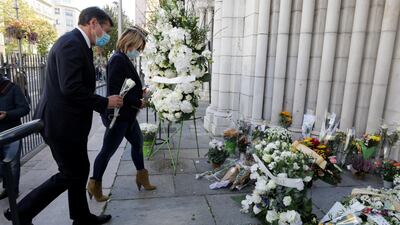
  • Mayor of Nice Christian Estrosi and his wife Laura pay tribute to the victims of a deadly knife attack at the Notre Dame church in Nice. Reuters
    Mayor of Nice Christian Estrosi and his wife Laura pay tribute to the victims of a deadly knife attack at the Notre Dame church in Nice. Reuters
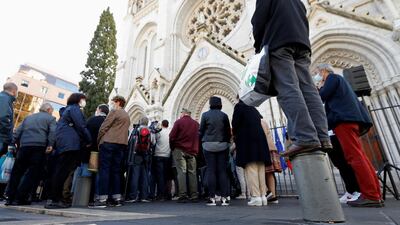
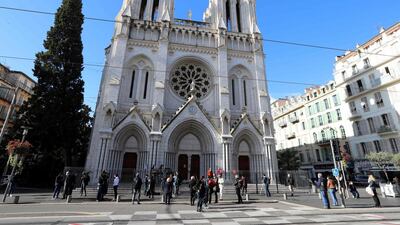
  • People gather in front of the Notre Dame church. Reuters
    People gather in front of the Notre Dame church. Reuters
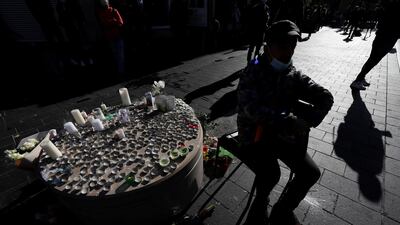
  • A man sits near candles and flowers placed in tribute to the victims. Reuters
    A man sits near candles and flowers placed in tribute to the victims. Reuters
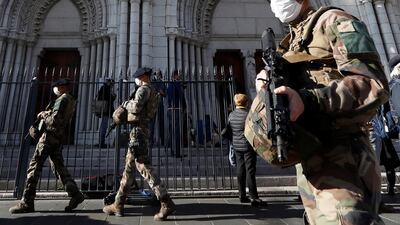
  • French soldiers patrol near the Notre Dame church. Reuters
    French soldiers patrol near the Notre Dame church. Reuters
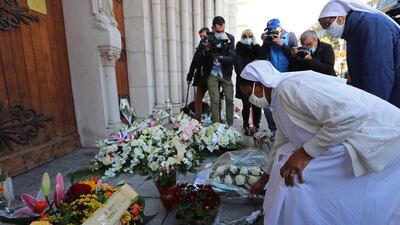
  • Two nuns lay flowers in front of the church in Nice. AFP
    Two nuns lay flowers in front of the church in Nice. AFP
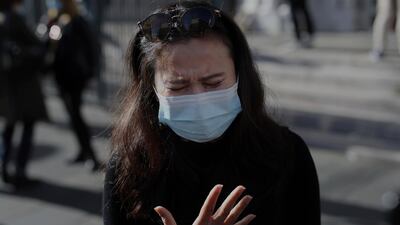
  • A woman cries as she speaks to reporters. AP Photo
    A woman cries as she speaks to reporters. AP Photo
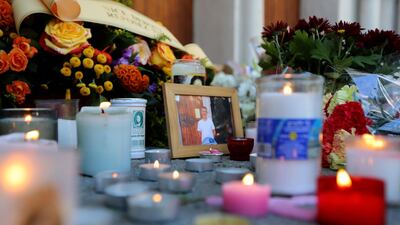
  • Tributes to one of the victims outside the church. AFP
    Tributes to one of the victims outside the church. AFP
  • The scene outside the Notre Dame church on Friday morning. AFP
    The scene outside the Notre Dame church on Friday morning. AFP
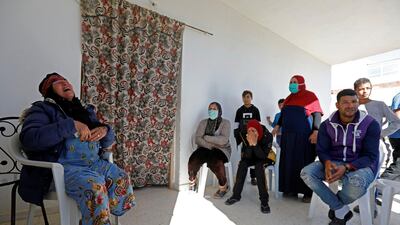
  • Gamra, the mother of Brahim Aouissaoui, who is suspected of carrying out Thursday's attack in Nice, reacts at her home in Tunisia. Reuters
    Gamra, the mother of Brahim Aouissaoui, who is suspected of carrying out Thursday's attack in Nice, reacts at her home in Tunisia. Reuters
  • The Family home of Brahim Aouissaoui in Thina, a suburb of Sfax, Tunisia. Reuters
    The Family home of Brahim Aouissaoui in Thina, a suburb of Sfax, Tunisia. Reuters

A clergyman and two parishioners were killed after they were partially beheaded by their assailant last Thursday.

It came weeks after the decapitation of a school teacher in the Paris suburbs by another extremist.

Hans Josef Schindler, director of think tank the Counter Extremism Project, told The National the Vienna attacks were well-planned. The intention of the terrorists, he said, was to exploit the pre-lockdown period to target people gathering on their last night of freedom.

“The attack in Vienna seems to have been fairly well co-ordinated,” he said.

“It took advantage of the large amount of civilians being in bars and restaurants during the last evening before a new national lockdown was taking effect.”

Mr Schindler said the latest incident had all the hallmarks of meticulous preparation, more so than the recent attacks in France.

“The attacker used a firearm and seemed to have had a certain level of competency in using it,” he said. “This requires training, in particular when using such a weapon in a highly stressful situation. Therefore, it seems very likely that the attacker had some – at least – paramilitary training.

“The problem is that after such a string of ‘successful’ terrorist operations in France, it is hard to distinguish whether other attacks are part of a wider plan or whether they are happening because radicalised individuals feel additionally motivated to do something in their area as well.

“However, what is clear is that the Vienna attacker and his potential accomplices have chosen the timing and the location for the attacks very smartly. The preparations, the procurement of weapons and ammunition and possible training, must have been planned for quite a while and last night presented a window of opportunity before the target environment would have become very depleted again due to the national lockdown.”

Security expert Matteo Pugliese, from the University of Barcelona, said ISIS had issued a rallying call on social media to its followers to launch attacks in Europe.

But he said it was too early to say what had motivated the Vienna attacker.

"He was very young and it's more likely he radicalised online or with some peers. He probably was fascinated by ISIS digital propaganda. For sure, he didn't do this completely alone, he had some logistics support for weapons," he told The National.

“ISIS recently asked its followers to carry out attacks in Europe, but it seems this terrorist decided to take action autonomously and to pledge allegiance to ISIS just before the attack.

“The attacker was among at least 90 individuals stopped by the authorities from travelling to Syria.”

In the past two years Austria has cracked down on radicalisation and shut down several mosques.

It followed the case of Mirsad Omerovic, who ran an ISIS terrorist cell in Vienna and in 2016 was jailed for 20 years.

He is believed to have been responsible for recruiting more than 160 youngsters in Vienna.

Omerovic was allegedly responsible for radicalising Austrian teenagers Samra Kesinovic, then 17, and Sabina Selimovic, then 15, who joined ISIS in April 2014, becoming worldwide poster girls for the group.

Austrian prosecutors claim he “brainwashed” dozens of young people into joining ISIS in Syria.

Mr Pugliese believes the Omerovic cell and Monday’s attacks may be connected.

“Some underground networks could still be operating,” he said. “There could be some link between Omerovic’s network.”

Veronika Hofinger, who works in counter-terrorism in Vienna, told The National that the latest attacks came without warning.

“I don’t know of any actual warnings,” she said. “We were all so focused on the lockdown, starting today.”

In March, academics in Austria published research into the ISIS threat following two government reports into the issue.

It is estimated up to 300 Austrians have joined ISIS, making it one of the European countries with the highest per-capita share of foreign fighters.

“Although the situation in Austria cannot be compared to the challenges in other European countries, such as France, our study identifies existing problems,” said Ms Hofinger in a report.

“Respondents who have served a prison sentence all came into contact with extremist ideas or inmates there, but most of them were not radicalised in jail.”

Monday’s attack was the first ISIS attack on Austrian soil, with previous plots in the country having been thwarted.


Wednesday's results

Finland 3-0 Armenia
Faroes Islands 1-0 Malta
Sweden 1-1 Spain
Gibraltar 2-3 Georgia
Romania 1-1 Norway
Greece 2-1 Bosnia and Herzegovina
Liechtenstein 0-5 Italy
Switzerland 2-0 Rep of Ireland
Israel 3-1 Latvia

Real estate tokenisation project

Dubai launched the pilot phase of its real estate tokenisation project last month.

The initiative focuses on converting real estate assets into digital tokens recorded on blockchain technology and helps in streamlining the process of buying, selling and investing, the Dubai Land Department said.

Dubai’s real estate tokenisation market is projected to reach Dh60 billion ($16.33 billion) by 2033, representing 7 per cent of the emirate’s total property transactions, according to the DLD.

UAE v Gibraltar

What: International friendly

When: 7pm kick off

Where: Rugby Park, Dubai Sports City

Admission: Free

Online: The match will be broadcast live on Dubai Exiles’ Facebook page

UAE squad: Lucas Waddington (Dubai Exiles), Gio Fourie (Exiles), Craig Nutt (Abu Dhabi Harlequins), Phil Brady (Harlequins), Daniel Perry (Dubai Hurricanes), Esekaia Dranibota (Harlequins), Matt Mills (Exiles), Jaen Botes (Exiles), Kristian Stinson (Exiles), Murray Reason (Abu Dhabi Saracens), Dave Knight (Hurricanes), Ross Samson (Jebel Ali Dragons), DuRandt Gerber (Exiles), Saki Naisau (Dragons), Andrew Powell (Hurricanes), Emosi Vacanau (Harlequins), Niko Volavola (Dragons), Matt Richards (Dragons), Luke Stevenson (Harlequins), Josh Ives (Dubai Sports City Eagles), Sean Stevens (Saracens), Thinus Steyn (Exiles)