"Stands Scotland where it did?" is the question that was first asked by Macduff in Shakespeare's Macbeth.
Yet this week, centuries after the Bard wrote "the Scottish play", the same question will be on the lips of politicians and commentators as soon as the result of Thursday's election in Scotland is known.
This week, Scottish voters are going to the polls for the sixth parliament election since the establishment of devolved government in 1999.
The anaesthesia of the pandemic has dampened political debate. Without the traditional rallies, meetings and street campaigning, the mood of the electorate has proved difficult to judge.
According to opinion polls, the ruling Scottish National Party seems likely to win – the question is by how much – but in a political environment in which political opinion is congealed rather than vigorous and fluid.
Voters will choose 129 representatives (MSPs) to hold the Scottish government to account on the wide range of policy areas that are devolved, such as transport, health and education.
Yet this week’s election may appear to have significance beyond Scotland because of the salience of the “national question” – whether Scotland should leave the United Kingdom to establish itself as a separate sovereign state.
The issue is back on the agenda because, if the opinion polls are to be believed, the SNP are within touching distance of securing a majority, and are campaigning on a manifesto commitment to hold a referendum on independence.
It would not be the first time that Scotland has considered whether it wants to break away from the UK.
Only seven years ago, after the SNP victory in a previous Scottish Parliament election, the referendum was held.
On a record turnout of 84.6 per cent, the 2014 vote resulted in a clear 10-point victory (45/55) for the remain side, with Scotland voting to stay part of the UK.
Since that referendum, the nation has remained divided broadly 50/50 on the question of independence, but with the pro-UK vote split between three parties – Labour, Conservative and Liberal Democrat. The SNP have dominated parliamentary representation.
Now, the SNP argue that the 2016 Brexit vote – in which the UK opted narrowly (52/48) to leave the EU but Scots were 62/38 in favour of the UK remaining in the EU – provides the basis for another referendum.
The deep unpopularity of scandal-ridden Prime Minister Boris Johnson and his government’s erratic handling of the Covid crisis – with a tragically high death toll followed by widespread vaccination – also provide the backdrop to this week’s vote.
So, what is likely to happen this week and beyond?
It is already clear that the domestic policy failures of the incumbent SNP government – on schools, hospitals, care homes and ferries – have struggled to get a hearing amid the Covid-19 crisis.
The divides and, indeed, wounds of 2014 are still evident in Scottish politics, and accountability for policy failure seems a casualty of a nation so deeply polarised by a politics of flags. For the time being, Scottish politics is about identity more than policy, never mind policy delivery.
Over their 14 years in power, the SNP have proved far better at campaigning than governing.
-

Scotland's First Minister and leader of the Scottish National Party, Nicola Sturgeon passes the SNP campaign bus as she campaigns in Midsteeple Quarter in Dumfrieshire. AFP -
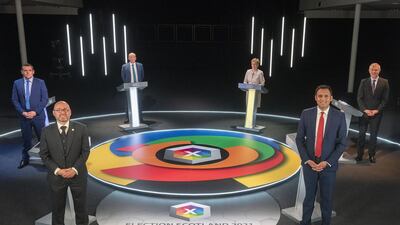
Nicola Sturgeon, Willie Rennie of Scottish Liberal Democrats, Anas Sarwar of Scottish Labour, Patrick Harvie of Scottish Green Party and Douglas Ross of Scottish Conservatives take part in a face off in the final TV debate in Edinburgh. Getty Images -
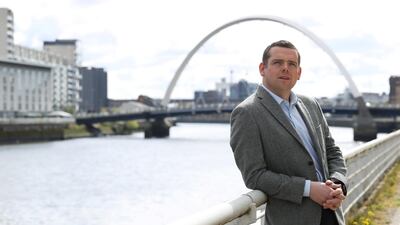
Douglas Ross, leader of the Scottish Conservatives, poses for a portrait, while campaigning in Glasgow. Reuters -
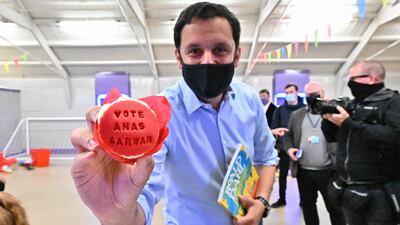
Scottish Labour leader Anas Sarwar campaigns with a visit to a mother and toddler group at a community centre in Glasgow. Getty Images -
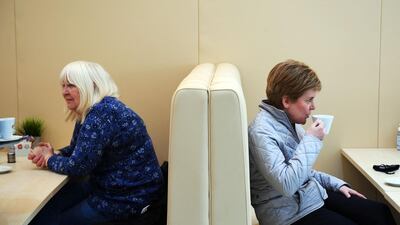
Nicola Sturgeon has a cup of tea as she campaigns in Glasgow. AFP -
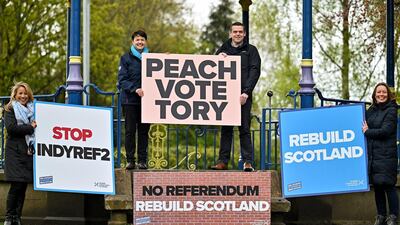
Scottish Conservative party leader Douglas Ross and Former Leader Ruth Davidson campaign with candidates Marie Claire Munro and Rebecca Fraser at Lewisvale Park in Musselburgh. Getty Images -
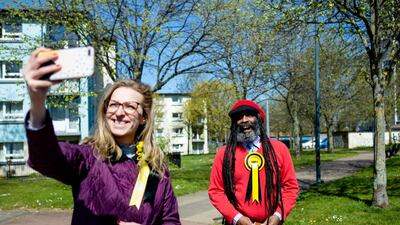
Sarah Masson, candidate for the Scottish National Party in the Edinburgh Western constituency, left, and Graham Campbell, councillor for the Scottish National Party , right, campaign in Muirhouse. Bloomberg -
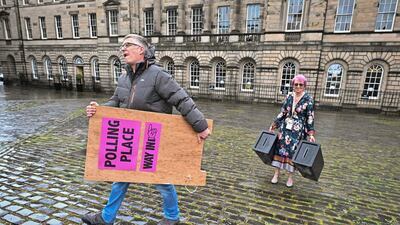
Staff at Edinburgh City Council move ballot boxes as they're taken for distribution to polling stations in Edinburgh. Getty Images -

Nicola Sturgeon poses with three-year-old Christopher Mutch in a tractor during a campaign visit to LOVE Gorgie Farm in Edinburgh. AFP -
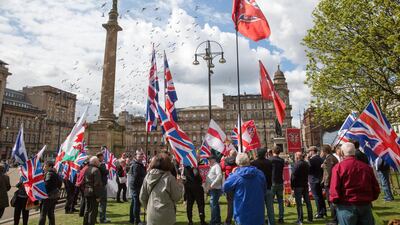
Unionist counter-protesters protest against a pro-independence rally held by independence pressure group All Under One Banner in George Square, Glasgow. EPA


Yet the break-out star of this campaign is Anas Sarwar, elected as leader of the Scottish Labour Party only seven weeks ago, who appears to be enjoying himself.
In contrast, First Minister and SNP Leader Nicola Sturgeon, who is troubled by the re-emergence of her long-time mentor Alex Salmond at the head of the new Alba Party, looks like she'd rather be anywhere else than on the campaign trail.
Yet it’s already clear that, important though it is, this campaign has struggled to catch fire amid continuing pandemic restrictions and voters’ understandable worries about the toll taken by Covid.
It could yet be a result in which everyone loses – with the SNP falling short of a majority, pro-UK parties struggling and only the pro-independence Greens shoring up the SNP vote.
Turnout will shape the result and its impact. The last time Scots voted for MSPs, turnout was only 56 per cent, so it’s possible during the pandemic that it will fall below 50 per cent.
If there is a pro-independence majority, the Scottish government will undoubtedly seek the authority to hold another referendum.
The legal authority to hold such a referendum rests with the UK Parliament, so the focus would move to Mr Johnson.
He has indicated that he does not support the holding of a further referendum only seven years since the last one, so the stage would be set for legal challenges and more political arguments.
What is clear is that this week’s Scottish election seems likely to pose more questions than it answers.
The most important politics may come not before polling day, but afterwards.
Rt Hon Douglas Alexander is a Senior Fellow at Harvard University’s Kennedy School and a former Secretary of State for Scotland

