

Researchers in Germany say they are surprised at the high number of people willing to serve as guinea pigs to help test a vaccine for the coronavirus after they were inundated with thousands of volunteers for the trial of an experimental drug.
Around 4,000 people have so far signed up to test the effectiveness of a potential Covid-19 vaccine being developed by the biopharmaceutical company CureVac.
The large volume of volunteers took the research team, which usually struggles to find willing participants for its studies, by surprise.
Peter Kremsner, one of the study’s directors, told the DPA news agency: “It’s a real luxury situation, unlike usual clinical trials.
“Normally we have trouble coming up with enough test subjects,” he added.
The clinical study began last month at University Hospital in Tuebingen, near the southern German city of Stuttgart.

Mr Kremsner said around 50 people had already been given the experimental drug and none had shown surprising side effects.
The trial intends to test 168 people, meaning many of the would-be volunteers will not take part.
Similar tests, however, are due to take place in the German cities of Munich and Hanover, as well as in Ghent, Belgium. The first results are expected in August.
CureVac, which is headquartered in Tuebingen, specialises in developing a type of vaccine that uses molecules known as mRNA to encourage cells in the body to produce the same proteins found in the novel coronavirus. The vaccinated patient’s body then recognises the protein as foreign and will respond with antibodies, resulting in immunity to the virus.
The German government has given strong backing to the CureVac vaccine, announcing last month that it would acquire a stake in the company worth €300 million (Dh1.2 billion).
The government, like many others around the world, is counting on a vaccine to help it beat the virus and begin to undo the economic damage wrought by the pandemic.
Willingness to try new vaccine declining in Europe
Despite the stronger than expected response to the clinical trial, a growing number of Europeans are undecided about whether they would get vaccinated against the virus when an effective drug is available.
Some 7,000 people in Germany, Britain, the Netherlands, Italy, France and Portugal were surveyed on their attitudes to a potential vaccine in April and June, Germany's Suddeutsche Zeitung newspaper reported on Sunday.
Nearly three quarters (74 per cent) of those who responded in April indicated they would be willing to be vaccinated. Researchers found that proportion had dropped to 68 per cent in June.
The waning enthusiasm among respondents was particularly clear in Germany, where willingness to take a new vaccine dropped from 70 per cent to 61 per cent.
-

A cadet candidate stands behind a plastic screen as he gets instructions on his arrival at the U.S. Military Academy, in West Point, N.Y. The Army is welcoming more than 1,200 candidates from every state. Candidates will be COVID-19 tested immediately upon arrival, wear masks, and practice social distancing. AP Photo -

EMT’s cleanse their materials outside Memorial West Hospital where coronavirus disease (COVID-19) patients are treated, in Pembroke Pines, Florida, U.S. REUTERS -
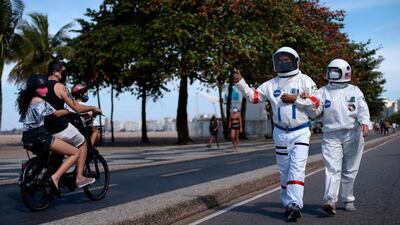
Brazilian accountant Tercio Galdino, 66, gives the thumb up to people riding a motorcycle as he and his wife Alicea Galdino walk along Leme beach in protective suits, in Rio de Janeiro, Brazil. Tercio, who has a chronic lung disease, made the protective suits (looking like astronauts gear) at home using suits used by health professionals. He says that, in addition to giving him protection against the new coronavirus, they also wear them for fun, as he has huge interest in astronomy. AFP -
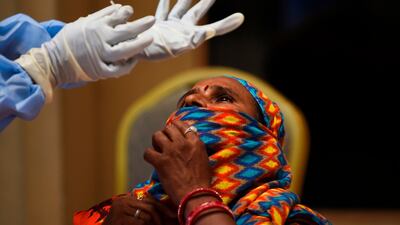
A health worker prepares to take a swab sample from a passenger for a rapid antigen tests (RAT) for the COVID-19 coronavirus at Ranip Bust Terminus in Ahmedabad. AFP -
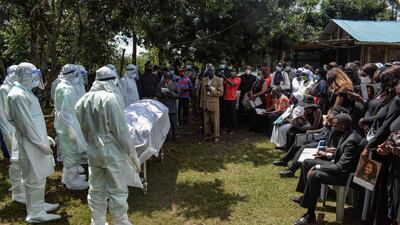
Members of Bungoma County Isolation Team in personal protection equipment (PPE) stand by the coffin of Dr. Doreen Lugaliki, 39, the first Kenyan doctor who died of the COVID-19 coronavirus in Nairobi, during her funeral in Ndalu, western Kenya. AFP -
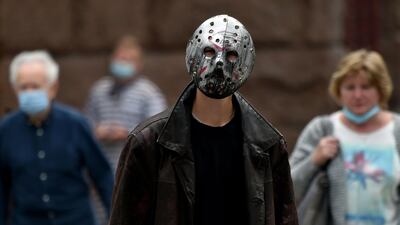
A man wearing an iron mask walks among people wearing surgical masks in the center of the Ukrainian capital of Kiev. AFP -
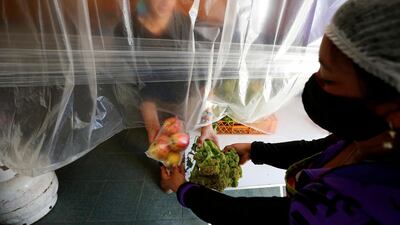
A volunteer delivers food rations at a so-called 'Olla comun', a communal kitchen set up to provide hot food for those with dwindling incomes or nothing, on a hill named "Mariposas" (butterflies), during the spread of the coronavirus disease (COVID-19), in Valparaiso, Chile. REUTERS -

A man fills a bottle with oil perfume along a wholesale market as the spread of the coronavirus disease (COVID-19) continues, in Karachi, Pakistan. REUTERS -

A man reads as he lies in a field where circles were painted to help visitors maintain social distancing at Ibirapuera Park after it was reopened as the city eases the restrictions imposed to control the spread of the coronavirus disease (COVID-19), in Sao Paulo, Brazil. REUTERS -

A man rests in an almost empty area in the City of London financial district, following the outbreak of the coronavirus disease (COVID-19) in London, Britain. REUTERS -

Children wearing masks to curb the spread of the coronavirus sit on a bench in Beijing, China. China reported only a handful of new cases of the virus, all of them brought from outside the country, as domestic community infections fall to near zero. AP Photo -

Elderly women wearing masks to curb the spread of the coronavirus chat as they sit on the sideway with their dogs in Beijing, China. China reported only a handful of new virus cases, all of them brought from outside the country, as domestic community infections fall to near zero. AP Photo


Jonas Schreyogg of the University of Hamburg, which worked with several other European institutions to carry out the survey, said however that only a small number of respondents were outright opposed to vaccination.
"These people are not the problem," he told Suddeutsche Zeitung.
But the increasing number of people who are on the fence about taking a new vaccine for Covid-19 poses a challenge to European governments and scientists alike, who have all identified effective immunisation as central to allowing a return to pre-pandemic norms.
Mr Schreyogg was optimistic that scientists and researchers could work to convince those who were unsure of the safety or potential side effects of the new vaccine.
“On the positive side, this means that the willingness to get vaccinated could be significantly increased if we succeed in giving these people more security,” he said.
Transparency in the testing and approval process as well as public education campaigns would both be vital to persuading Europeans to come down from the fence in favour of vaccination, he added.

