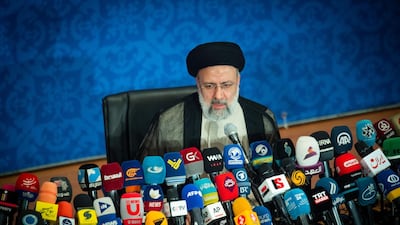

Ebrahim Raisi will be a stay-at-home President of Iran because of the threat of arrest and prosecution owing to his central role in the 1988 Iranian prison massacres, a prominent human rights barrister has said.
Geoffrey Robertson identified Mr Raisi as a central figure in the 'death committees' that sentenced thousands of regime critics to death at the end of the Iran-Iraq war for their political and religious views. Mr Raisi was elected with a low turnout as Iran's new president last week from a small field of predominantly conservative politicians.
“We now have an international criminal as president of the state of Iran,” said Mr Robertson, who wrote a groundbreaking 2011 report into the massacres.
“If he ever ventures out of Iran, any democratic country would be entitled under universal jurisdiction to arrest him and put him on trial.
“Crimes against humanity trumps state immunity. I suspect he will not venture out of Iran.”
An alleged minor figure in the massacres, Iranian lawyer Hamid Nouri was arrested in Sweden in 2019 under the principle of universal jurisdiction.
It allows prosecutors to put anyone on trial for crimes against humanity wherever they were committed. He is expected to stand trial this summer.
Days after the end of the Iran-Iraq war in 1988, former Iranian supreme leader Ayatollah Ruhollah Khomeini signed a death warrant for thousands of prisoners linked to the opposition.
Mr Raisi was a member of three-man committees that identified dissidents in prisons across the country and ordered the deaths of those who failed tests of loyalty to the regime.
Within weeks, up to 5,000 were killed. Those selected were blindfolded and “ordered to join a conga-line that led straight to the gallows”, Mr Robertson said in his report.
Their bodies were doused with disinfectant and buried at night in clandestine mass graves. Their families learned of their fate months later when they were handed a plastic bag of their possessions.
The executions focused on supporters of the Mujahideen-e-Khalq, who backed the overthrow of the shah but then became the enemy of the regime after hundreds of its members were killed at a 1981 opposition rally.
Mr Robertson interviewed 50 survivors of the massacre for his 2011 report commissioned by the US-based Abdorrahman Boroumand Centre and said it was clear Mr Raisi was a central figure in the operation.
Mr Raisi has never denied his role in the death committees and his notoriety means he will damage the reputation of any international organisation for which he speaks during his presidency, the Australian lawyer said.
Geoffrey Robertson
He called on the UN to investigate Mr Raisi’s role in the killings after turning a “blind eye” in the immediate aftermath of massacres.
“The UN has a duty to set up a proper inquiry into these barbaric doings of 1988,” he said. The organisation would have to “grapple with the fact that one of its members is led by an international criminal".
“Diplomats will have to be careful they will never shake the bloodstained hand of this criminal … bump his shoulder or take anything that he says seriously,” Mr Robertson said.
He said that Mr Nouri’s trial could shed further light on the massacres. “It may be that his testimony, certainly the testimonies of other witnesses, will identify the role played by the president of Iran in this international crime.”
Mr Robertson was speaking at an event organised by exiled opposition group the National Council of Resistance of Iran.

