
Boris Johnson said on Monday a new rapid testing regime will be Britain's way out of the coronavirus crisis as he outlined details of England's second national lockdown.
Addressing the House of Commons, the Prime Minister said rapid testing would be the government's lockdown "exit strategy".
He said: "The way out is to get the R down now to beat this autumn surge and to use this moment to exploit the medical and technical advances we are making to keep it low.
"We have the immediate prospect of many millions of cheap, reliable and rapid turnaround tests with a result within minutes.
"These tests identify people who are infectious but do not have symptoms, allowing them to immediately self-isolate and stop the spread of the disease, and allowing those who are not infectious to continue as normal."
Mr Johnson said the government was planning a "steady but massive" expansion of rapid testing that will begin "within days". He said the army had been drafted in to help.
"Over the next few days and weeks we plan a steady but massive expansion in the deployment of these quick turnaround tests, applying them in an ever-growing number of situations, from helping women having their partners with them in labour wards to testing whole towns and even cities," he said.
"The army has been brought in to work on the logistics and the programme will begin in a matter of days."
Mr Johnson first raised the prospect of a mass testing regime in early September under a plan known as "Operation Moonshot".
Leaked documents at the time suggested the government wanted as many as 10 million tests to be carried out per day so uninfected people could move "freely" in their daily lives.
The plan was reported to cost an estimated £100 billion ($129bn).
Last month, trials of a rapid testing programme were quietly scaled back in the northern England city of Salford after authorities struggled to sign up participants.
As Mr Johnson was speaking in the Commons, the UK recorded another 18,950 coronavirus cases and a further 136 deaths.
The figure was slightly down on the 19,790 cases and 151 deaths reported last Monday.
'Truly sorry'
Defending his decision to impose another lockdown, Mr Johnson said the country faced a “medical and moral disaster” if it failed to act now.
"Faced with these latest figures, there is no alternative,” he said.
“If we allow our health system to be overwhelmed … we will reach a point where the NHS is no longer there for everyone.
“The sick will be turned away from our hospitals. Doctors and nurses could be forced to choose who would live and who would die.”
Mr Johnson said he was “truly sorry” for the “anguish” the second lockdown would cause for many.
“But it is now clear we must do more together,” he said.
The prime minister said the lockdown was not as tough as the spring shutdown and was due to “expire” on December 2 - a nod to Conservative MPs who are furious with the decision.
Up to 80 Tories are considering rebelling against the government when the second lockdown comes to a vote on Wednesday, The Telegraph reported.
-
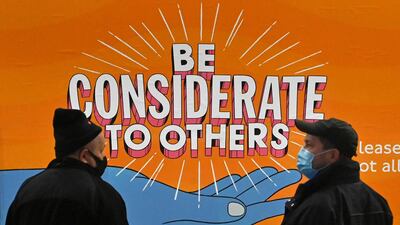
Travellers stand on a London Underground platform with a sign urging people to be considerate to others in London. AFP -
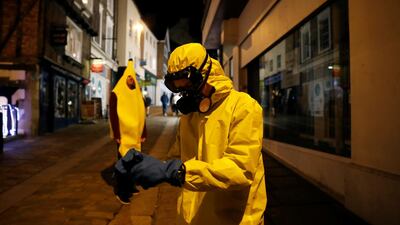
A person dressed in a costume for Halloween is seen, after Britain's Prime Minister Boris Johnson announced a second national lockdown, in Durham. Reuters -
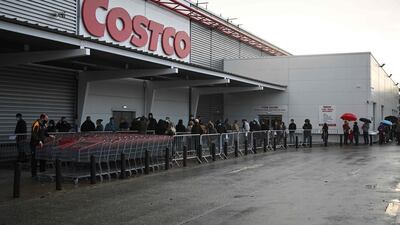
Shoppers queue outside a Costco wholesale store in Leeds. AFP -
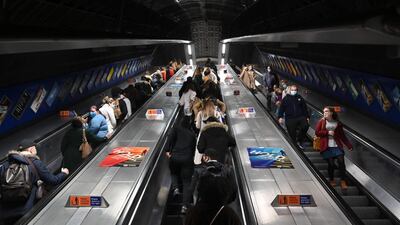
Travellers ride an escalator in a train station in London as England prepares to enter into a second lockdown in an effort to stem soaring infections. AFP -
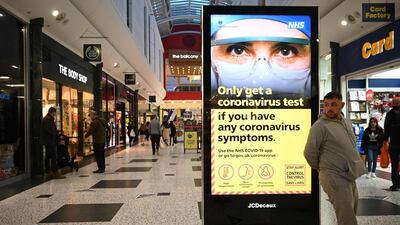
An electronic billboard displays government messages in a shopping centre in Leeds. AFP -

A woman walks past a store on Oxford street in London. Reuters -
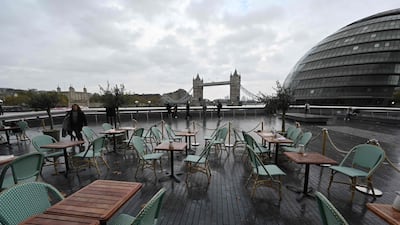
Empty tables are seen outside a restautrant with Tower Bridge in the background in London. A new four-week coronavirus lockdown in England will be extended if it fails to reduce infection rates, the government said Sunday. AFP -
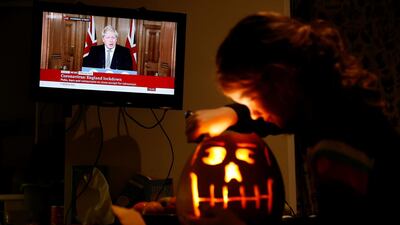
8 year old Alice Wilkinson carves a halloween pumpkin at her home in Manchester as Boris Johnson speaks at a news conference. Reuters


But any rebellion would only be symbolic as Labour has said it will vote for the lockdown.
Labour leader Sir Keir Starmer attacked the PM and Chancellor Rishi Sunak for not acting sooner.
The government’s scientists had called for a two-week “circuit-breaker” lockdown in September.
Mr Starmer said the government had "failed to learn this lesson and as a result, this lockdown will be longer than it needed to be".
Earlier, Mr Sunak warned unemployment in England would shoot up because of the second lockdown.
The chancellor also said he hoped the shutdown, in place across England, would last only four weeks.
Speaking on BBC Radio 4's Today programme, Mr Sunak said: "Close to three quarters of a million people have already tragically lost their jobs and sadly many more will. That is going to happen as a result of the restrictions we are putting in place."
Former prime minister Tony Blair urged the government to accelerate deployment of vaccines and therapeutic drugs, as well as speeding up the delivery of rapid testing.

