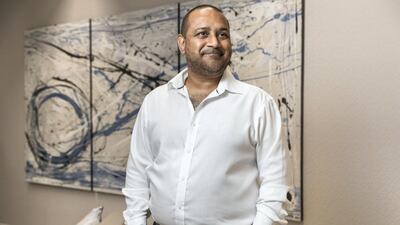

The millionaire Dubai resident Sanjay Shah, who is accused of a £1.5 billion (Dh6.8bn) Danish tax fraud, has returned to the UK’s High Court in an attempt to gain access to millions more in loan payments to cover his legal costs.
Mr Shah, who is British but lives in Dubai, has seen his funds cut off as he fights a court case against the Danish tax authority, SKAT, which claims he was the key mover behind a £1.5bn tax fraud.
Earlier this year the Danish authorities placed a worldwide freezing order on many of his assets, including a £15m home near London’s Hyde Park, as it seeks to recoup its losses from the scam.
Mr Shah has returned to London’s High Court in a bid to gain access to £13.6m in loan repayments, which his legal team claims is not part of the seizure order, to use to fund his legal battle.
He had sought to ask the people repaying the loan, who are also subjected to the same investigation by SKAT, to pay the money to him.
However, the court heard the other defendants feared that they could face “double jeopardy” if SKAT seized the funds and could leave them liable to paying the sums back twice.
“In broad terms the Sanjay Shah application is intended to ensure that the Sanjay Shah defendants obtain the loan proceeds and can use them to meet their legal expenses, and the Stakeholder application is intended to ensure that the Stakeholder defendants are not at risk in repaying the loans, and later finding themselves faced with a claim that they paid the wrong person or otherwise remain liable for the amount of the loan proceeds,” Mr Justice Foxton said.
The court has ruled the money should be paid directly to the court and has ordered SKAT and Mr Shah’s legal teams to try to come to an arrangement over the funds before a further hearing to be held in July to decide who gets the money.
Mr Justice Foxton said he hoped the July hearing would not be affected by funding issues if there was a problem over the payment of legal fees.
“I would ask the parties to explore whether agreement can be reached for some element of the loan proceeds to be released to the Sanjay Shah defendants within a short period, to avoid that undesirable position,” he added.
Mr Shah’s legal team had tried to argue that it was “too late” for SKAT to seek an injunction on the loan money as it has had “ample opportunity” to do so.
“I do not accept that this argument provides a simple answer to the issue before the court,” Mr Justice Foxton added.
“If SKAT's proprietary claim to the loan proceeds is eventually upheld, then the use of that money by the Sanjay Shah defendants to meet their legal expenses will have involved a civil wrong.”
The Danish tax authority has launched the legal action in the UK as many of the companies allegedly involved were based there.
SKAT claims that Mr Shah was a central player in a scheme in which foreign companies pretended to own shares in Danish companies and then claim tax refunds they were not eligible to receive.
Mr Shah claims that he was exploiting a perfectly legal loophole to make trades that are at the heart of the alleged wrongdoing.
He said his schemes were a “widely known and wholly legitimate trading strategy” but have been stopped by other European governments.
Earlier this year a centre for autistic children in the UAE funded by Mr Shah was closed because of the global asset freeze on his multi-million-pound fortune.
His company Solo Capital Partners, which closed in 2016, was the main funder of the Autism Rocks Support Centre, charity financial records show.
Mr Shah’s wife, Usha – described as founder and chief executive of the centre – is one of the 92 defendants accused of involvement in the tax fraud, according to documents filed in the High Court.
She is said to have been the sole director of a company that saw tens of millions of pounds pass through its accounts from the tax operation.
The UK-based Autism Rocks charity was set up in 2014 and sought to raise money by organising concerts that featured artists including Prince, Joss Stone and Elvis Costello.
The support centre was launched three years later in Dubai and was described as a “boutique centre offering evidence-based therapies that work”.
Mr Shah moved to Dubai in 2009.

