

However long the coronavirus pandemic disrupts daily life, one of the lasting legacies of the lockdown is bound to be the impact on children at a key stage of life.
Closed classrooms, schools used as clinics and isolation in the family unit all create immediate pressures. Longer term, the trajectory of educational opportunities for as many young people as possible has suffered immense disruption.
Former Australian prime minister Julia Gillard is leading an international effort to mitigate the worst effects of the coronavirus curfews and shutdowns. Launched on Wednesday, the Global Partnership for Education (GPE) is to provide $250 million (Dh918 million) for 67 countries to fund schemes to address the crisis in learning.
As chairman, Ms Gillard is keen to ensure that the GPE is there for its partner countries, especially some of the poorest in the developing world. "No child in the world is in any way at fault here," she told The National. "No child in the world, whether it is in Australia or the UAE, should in any way be deprived of education as a result of the measures needed to fight coronavirus.
“This dimension of the crisis should not be neglected — nine out of 10 students worldwide are affected. That is an extraordinary number. In low income countries, about 350 million children are affected.”
The GPE, which has worked in conjunction with the UAE since 2018, is offering targeted assistance to ensure education systems are able to respond to school closures and the challenges of restarting when lockdowns ease.
-
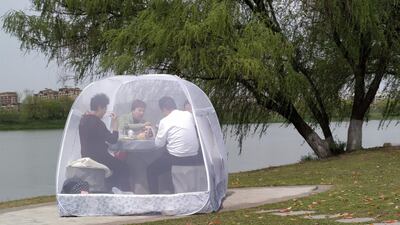
People enjoy a meal inside a tent, at a park in Nanjing, Jiangsu province, China. Reuters -

French tenor Stephane Senechal sings at his window for the inhabitants of his street in Paris, France. EPA -
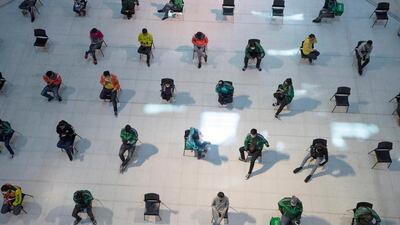
People practice social distancing as they sit on chairs spread apart in a waiting area for take-away food orders at a shopping mall in hopes of preventing the spread of the coronavirus in Bangkok, Thailand. AP Photo -
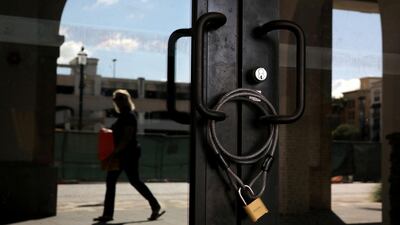
A restaurant is seen closed as a woman walks past at an empty commercial area after local authorities restricted the activities of restaurants, bars, gyms, movie theaters and other similar businesses in West Palm Beach, Florida, US. Reuters -
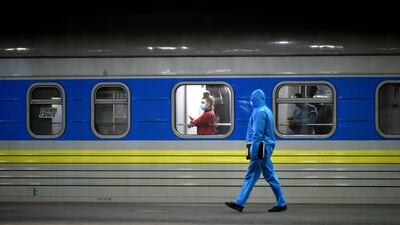
A passenger looks out the window as a medical worker walks past her carriage of a train with Ukrainians evacuated from Riga at a railway station in Kiev. AFP -

People wearing face masks as a precautionary measure against covid-19 'elbow bump' as they stand in Greenwich in south London. AFP -
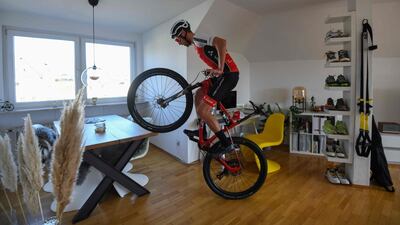
Ben Zwiehoff, the German national team's racing cyclist in the mountain bike cross-country discipline works on his balance on his bike in his flat, in Essen, western Germany. AFP -

Gonzaga Yiga, a 49-year-old community chairperson, appeals to residents through a speaker from the tallest building of the area, in Kampala, Uganda. AFP -

A nurse anesthetist gestures during the disinfection of ambulances, in Brest, western France. AFP -
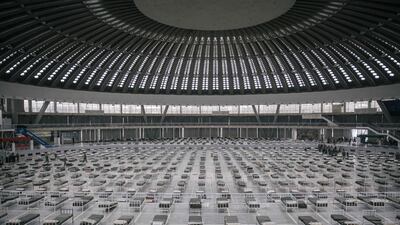
A general view shows Serbian military personal setting up beds inside a hall at the Belgrade Fair to accommodate people suffering from mild symptoms of the coronavirus disease. AFP -
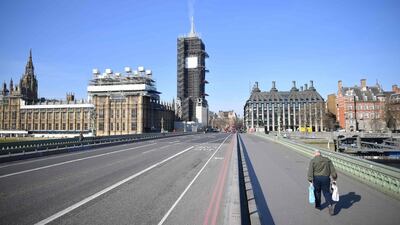
A picture shows the Houses of Parliament at the end of an empty Westminster Bridge in central London, the morning after Britain ordered a lockdown to slow the spread of the novel coronavirus. AFP -
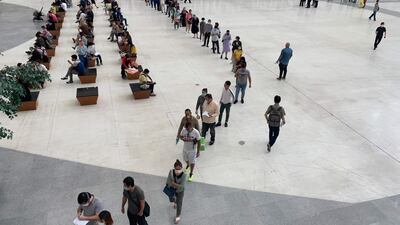
People queue at the Immigration Office in Bangkok, as Thailand moves to close its borders after a spike in the number of coronavirus cases in the past week. AFP -
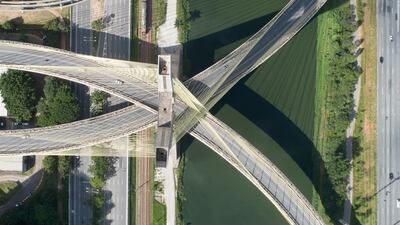
An aerial view of empty Octavio Frias de Oliveira bridge, a cable-stayed bridge, on the first day of lockdown imposed by state government in Sao Paulo, Brazil. Reuters -
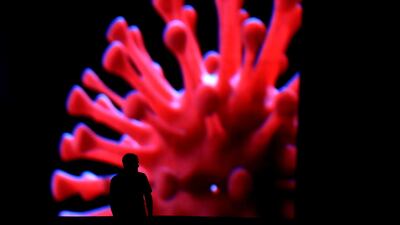
A man passes by an LED outdoor screen during the coronavirus outbreak in Brasilia, Brazil. Reuters -
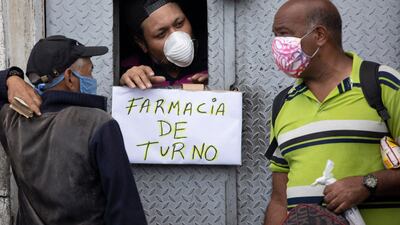
A man attends customers through an opening from which hangs a handwritten sign that reads in Spanish: "Pharmacy on duty," in Caracas, Venezuela. AP Photo -
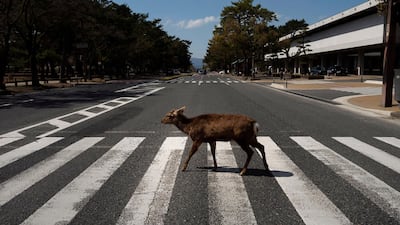
A deer walks across a pedestrian crossing in Nara, Japan. AP Photo


Educationalists estimate that 650 million children in Africa, Asia, Latin America and the Caribbean are no longer attending school. While some systems are able to provide digital access or other home-schooling supports, Ms Gillard pointed out that 350 million of the children are cut-off from education.
An array of supports can be put in place, developed by the countries themselves and then grant-funded by GPE, to reduce the numbers excluded from education. “There are a lot of protective factors to consider, including cash payments to combat issues like child marriage and helping with distance learning,” she said.
Last week, the GPE provided the UN’s education agency UNICEF with an $8 million grant for basic Covid-19 education awareness across a range of countries.
Ms Gillard said the need to ensure resilience in education provision could stretch much further, including backing for learning by radio, providing textbooks to homes and ensuring that governments had the systems in place to address the shock.
During her time as prime minister, Ms Gillard went viral around the world when she told the opposition leader in parliament that she would “not be lectured about sexism and misogyny by this man”. The clip is almost a decade old but remains such an inspirational influence for women defying the odds that people still mention it to her to this day.
The impact on girls is known to be particularly harsh during school shutdowns. The experience of the Ebola outbreak in Africa between 2014 and 2016 is that girls were forced into marriage or fell pregnant in greater numbers as a result of the shutdown then.
Economic hardship has spillover effects that are prolonged, including much lower re-enrolment later on. Retaining the education workforce is also a massive challenge.
“We need to try to keep education continuity,” she said. “We all know that when schools are shut, teachers aren’t teaching and not getting paid.”
Reaching the pandemic peak and restarting institutions is not just a matter of ordering the commencement of a new term. “We will get to the stage where education will reopen and we’ll need cleaning and refurbishment,” she said. “We know from other health emergencies that schools were used as clinics, were used for treatment of Ebola. There is a lot of work to get schools back properly.”
The GPE received a pledge from Reem Al Hashimy, the Minister of State for International Co-operation, which made the UAE the alliance’s first regional supporter in 2018. A place on the GPE board means that the UAE provides input from the Arab perspective on its activities. It has also worked closely with Dubai Cares.
Ms Gillard hopes for further and deeper support going forward from around the world to ensure that educational access and opportunity is there to rebuild and grow education. “We will need to mobilise governments for more support for learning in the world,” she said. "Funding is under a lot of stress and strain economically and politically, but I would remind everyone that the world gets a lot more peace and development as a result of education.”

