


The rivalry between SpaceX and Boeing has the hallmarks of David and Goliath.
One is a titan of industry, the poster-child of America’s ambitions to explore the cosmos and a key enabler of the Apollo programme that landed the first human being on the Moon.
The other is a young upstart venture run by an eccentric multibillionaire entrepreneur and made up of a rag-tag bunch of engineers, some of whom used to build water towers.
But out of a dream of landing a greenhouse on Mars using a converted Russian ballistic missile to kick-start human colonisation, SpaceX rose to the top of the world's burgeoning commercial space sector. It now challenges established aerospace legacy companies like Boeing for accolades and Nasa funding.
Nearly 50 years after Soviet cosmonaut Yuri Gagarin became the first person to journey into outer space, a duopoly on American human spaceflight is emerging between the two rivals, with both competing for the spotlight as Nasa seeks to return to the Moon and send astronauts to Mars for the first time.
The two companies have already competed in the high-stakes field of human spaceflight.
SpaceX beat Boeing on its own turf last year, defying expectations to become the first American mission to deliver astronauts to the International Space Station (ISS) since 2010.
A second crewed SpaceX mission to the orbital station is planned for later this month, and the company is also planning the first space flight crewed entirely by civilians.
The Inspiration4 mission will launch four people, including sponsor Jared Isaacman, into space on board a Crew Dragon capsule modified with an observation dome.
Boeing's Starliner spacecraft has yet to complete its second uncrewed test flight. Originally planned for last week, that mission has been put off, again, until May.
Plagued by software issues, the Starliner failed to rendezvous with the ISS during a 2019 flight in a major embarrassment for the company, which has had a hand in almost every crewed Nasa space mission.
The first Crew Dragon launch marked the end of an era in which only government-owned spacecraft were capable of making giant leaps for mankind in space.
The fortunes of Boeing and SpaceX rest on the success of two wildly different rockets, with each company hoping its design will help to usher in a new era in human space exploration.
Returning to the Moon
Nasa plans to land the first woman and the next man on the lunar surface by 2024, under its Artemis programme, and those astronauts will probably fly to the Moon on a Boeing rocket.
It is the prime contractor for the programme’s Space Launch System (SLS), a colossal rocket more powerful than anything Nasa has yet built.
In its final configuration, the 108-metre-tall craft is designed to carry a payload of 46 tonnes to the Moon with the aim of supporting exploration efforts.
The SLS project passed a significant development milestone this year when engineers successfully tested four of the spacecraft's giant engines, capping off a nearly year-long test campaign to validate the rocket's design.
But despite the recent successful test, SLS is now three years behind schedule and nearly $3 billion over budget.
Critics of the project say Nasa should move on from the expendable rocket's proven but expensive technologies, like its two solid fuel boosters.
The space agency this month began to review the affordability of the SLS. It has already spent more than $20bn on the project, with each future launch of the rocket priced at an additional $2bn.
The high costs associated with the traditional expendable design, similar to that of the shuttle programme of the 1980s, make the innovative offerings of commercial competitors such as SpaceX a tempting proposition. Its smaller but reusable Falcon Heavy rocket costs as little as $90 million to fly.
In another blow to Boeing’s lunar ambitions, lander designs from rivals SpaceX, Blue Origin and Dynetics were all chosen ahead of its own proposal for continued development under the Artemis programme.
The three winning designs were together awarded nearly a billion dollars in funding, well short of the $3.3bn Nasa had asked for to fund the landing section, which will actually carry astronauts down to the surface from the rocket – another set-back for the project.
SpaceX proposed a version of its Starship spacecraft to ferry passengers and cargo between lunar orbit and the surface.
It is the most radical of the three designs, and the lunar-optimised Starship could negate the need for the SLS, instead hitching a ride to our nearest celestial neighbour on the super heavy booster the company is developing.
This raises serious questions over the value of the Boeing-managed project, with many wondering why Nasa is still funding the SLS at all.
Former Nasa administrator Jim Bridenstine, who stepped down from his post as head of the space agency shortly after the SLS engine test in January, said last year that the Boeing spacecraft was “the only rocket that’s going to be human rated by 2024 that will take humans to the Moon”.
But since then, opposition to the project grew as costs ballooned.
The Bloomberg news agency’s editorial board in February published a scathing takedown of the SLS project, calling on President Joe Biden to scrap the heavy-lift rocket, citing spiralling costs and increasing delays.
With the programme still well behind schedule, Nasa may have to push back the ambitious 2024 Moon landing target put in place by the Trump administration.
Top Nasa officials regularly voiced doubts about the 2024 deadline, which was brought forward from 2028 by president Donald Trump shortly before the 50th anniversary of the first Moon landings.

President Biden gave his support to the agency’s goal of returning humans to the lunar surface after speculation about the new administration’s stance on the Artemis project.
Nasa’s Artemis missions are due to begin before the end of this year with an uncrewed flight around the Moon.
That flight is intended as a dry run for the 2024 mission carrying astronauts, which will then be followed by a later mission in which humans will spend about a week on the Moon.
Meanwhile, the development of SpaceX's Starship continues at breakneck speed, with the company conducting a flurry of flight tests at its facility in Southern Texas in recent months.
Although its tests frequently ended in spectacular fashion, with prototype Starships regularly bursting into unplanned fireballs during flight or while landing, SpaceX has ambitious targets for lunar exploration.
The company hopes to carry out the first commercial mission to the Moon and plans to fly Japanese entrepreneur Yusaku Maezawa and eight other civilians around the Moon in a Starship.
As with the Artemis programme, the mission will be preceded by an unmanned Starship flight.
To Mars
-
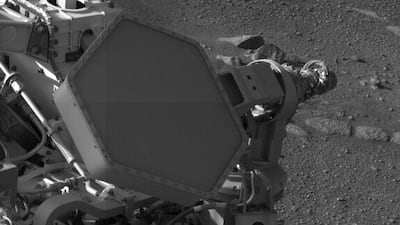
NASA's Mars Perseverance rover as it acquired this image using its onboard Left Navigation Camera (Navcam). AFP -
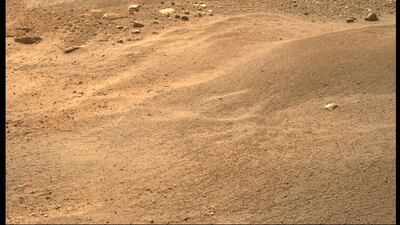
NASA's Mars Perseverance rover using its Left Mastcam-Z camera (a pair of cameras located high on the rover's mast). AFP -
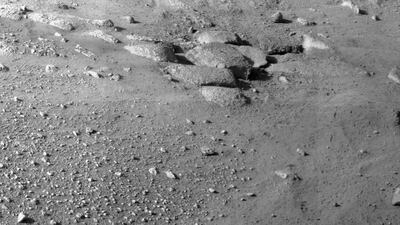
NASA's Mars Perseverance rover as it acquired this image using its onboard Right Navigation Camera (Navcam) on Mars. AFP -

The surface of Mars directly below NASA's Mars Perseverance rover, seen using the rover's down-look camera. Nasa / JPL-Caltech / Reuters -

The surface of Mars directly below Nasa's Mars Perseverance rover, seen using the rover's down-look camera. Nasa / JPL-Caltech / Reuters -

The surface of Mars directly below Nasa's Mars Perseverance rover, seen using the rover's down-look camera. Nasa / JPL-Caltech / Reuters -

The surface of Mars directly below Nasa's Mars Perseverance rover, seen using the rover's down-look camera. Nasa / JPL-Caltech / Reuters -

The surface of Mars directly below Nasa's Mars Perseverance rover, seen using the rover's down-look camera. Nasa / JPL-Caltech / Reuters -

The surface of Mars directly below Nasa's Mars Perseverance rover, seen using the rover's down-look camera. Nasa / JPL-Caltech / Reuters -

The surface of Mars directly below Nasa's Mars Perseverance rover, seen using the rover's down-look camera. Nasa / JPL-Caltech / Reuters -

The surface of Mars directly below Nasa's Mars Perseverance rover, seen using the rover's down-look camera. Nasa / JPL-Caltech / Reuters -

The surface of Mars directly below Nasa's Mars Perseverance rover, seen using rover's down-look camera. Nasa / JPL-Caltech / Reuters -

A Nasa illustration shows a diagram added over the 21-metre parachute deployed during the descent of the Perseverance rover to Mars. Systems engineer Ian Clark used binary code to spell out 'Dare Mighty Things' in the orange and white strips. Nasa / JPL-Caltech / AP -

The Perseverance rover descends to the surface of Mars. A key objective of Perseverance's mission on Mars is to search for signs of ancient microbial life. Nasa / JPL-Caltech / EPA -

The heatshield drifts away following separation from Nasa's Perseverence rover, during its descent to Mars. Nasa / JPL-Caltech / EPA -

A close-up of Nasa's Perseverance rover during its descent to Mars. The rover will gather data on the planet's geology and past climate, paving the way for human exploration of the Red Planet. Nasa / JPL-Caltech / EPA -

Martian dust swirls up as Nasa's Perseverance rover descends to the surface of the Red Planet. The mission aims to be the first to collect and cache Martian rock and regolith. Nasa / JPL-Caltech / EPA -

The 21-metre parachute attached to Nasa's Perseverance rover begins to open to slow down the descent to Mars. Nasa / JPL-Caltech / EPA -
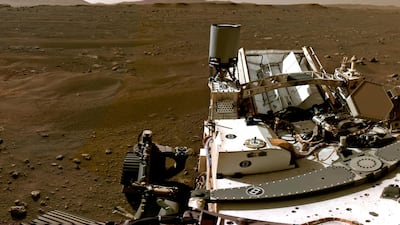
A portion of a panorama made up of individual images taken by the navigation cameras aboard Nasa's Perseverance rover reveal the Martian landscape. Nasa / JPL-Caltech / Reuters


The ultimate goal of Nasa’s Artemis programme, however, is to prepare for the much more challenging task of landing humans on Mars.
Boeing and SpaceX have set their sights on this goal.
In 2016, Boeing's chief executive at the time, Dennis Muilenburg, threw down the gauntlet to Elon Musk.
"I'm convinced the first person to step foot on Mars will arrive there riding a Boeing rocket," he said at a public event hosted by The Atlantic magazine held in Chicago.
The SpaceX founder responded simply with a tweet: “Do it.”
The exchange kicked off a new kind of space race between the two companies, and Nasa is expected to exploit the rivalry, as it did with the crewed missions to the ISS, to stimulate healthy competition on innovation and cost.
Boeing hopes its SLS will be used for a manned Nasa mission to the Red Planet, and the US space agency is planning to make that happen in the late 2030s or early 2040s.
Mr Musk, who has said he does not care if his company is beaten to the milestone of landing the first humans on Mars, has frequently changed the target date for his company’s first manned mission there.
In March this year he told his 50 million Twitter followers that SpaceX would be landing rockets on the Martian surface “well before 2030”.
SpaceX is assembling the next prototype Starship, and Mr Musk recently unveiled the first test craft of its Super Heavy booster.
The company's founder says the next prototype Starship, SN15, will feature a range of upgrades over previous versions.
Boeing’s rivals in Boca Chica are planning to attempt a first orbital flight with their space craft later this year.

