US President Joe Biden plans to send an additional 20 million doses of coronavirus vaccines abroad by the end of June – including, for the first time, shots authorised for domestic use.
Mr Biden announced in White House remarks on Monday the export of 20 million doses of Pfizer-BioNTech, Moderna or Johnson & Johnson vaccines.
This is on top of 60 million AstraZeneca doses he had already planned to donate to other countries, according to a senior administration official familiar with the plan.
The official said the measures are only a first step in the US shift towards quelling the pandemic abroad.
“We know America will never be fully safe until the pandemic that’s raging globally is under control,” Mr Biden said.
Mr Biden previously pledged that the US would become an “arsenal” of global vaccine supply, but said he would only share US-purchased doses once there was enough supply to meet local demand – which is now the case.
"We will not use our vaccines to secure favours from other countries," Mr Biden added, in subtle reference to how China and Russia have deployed their domestically produced vaccines.
White House Press Secretary Jen Psaki confirmed the plan during the White House press briefing before Mr Biden's remarks.
"This is the most doses donated by any country in the world by five times," she said.
Jeff Zients, who has served as the White House coronavirus response co-ordinator, will be put in charge of the effort to beat the pandemic globally, the official said. Mr Zients will work with the National Security Council and other agencies to send doses abroad.
The announcement is a watershed moment in the pandemic and for Mr Biden’s administration.
The US government claimed almost all of the first few hundred million doses of vaccines produced on American soil.
This approach allowed Mr Biden to advance what has become one of the most successful domestic vaccination efforts in the world, but it has fuelled an imbalance between nations that produce their own shots and those that can’t.
The Pfizer-BioNTech, Moderna and Johnson & Johnson vaccines are authorised for use in the US, but the AstraZeneca shot is not.
Mexico and Canada have received doses of the US AstraZeneca stockpile and Pfizer has begun shipping doses of its US-produced vaccine to Mexico, Canada and Uruguay, among other countries.
The US domestic vaccination campaign is beginning to run out of willing arms. Almost 60 per cent of adults have received at least one shot.
Meanwhile, scores of low-income nations and even some developed countries are struggling to secure vaccines.
Covax, a global programme aimed at easing vaccine procurement and access for lower-income countries, is short of supplies and expects the shortfall to reach about 190 million doses next month, the UN children's fund said on Monday.
Mr Biden previously pledged up to $4 billion for Covax.
-

A worker disinfects an area before it is set up as a vaccination centre to administer the Pfizer-BioNTech vaccine, in the Santa Maria de Ojial community, in Iquitos, Peru. Reuters -
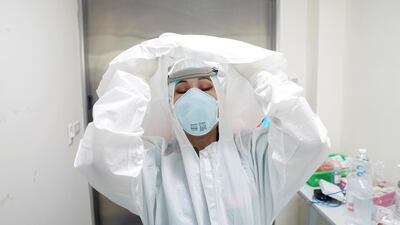
A doctor takes off her personal protection equipment (PPE) after treating a patient suffering from Covid-19 in the Intensive Care Unit at the King Chulalongkorn Memorial Hospital in Bangkok, Thailand. Reuters -

A health worker inoculates a man with a dose of the Sinopharm vaccine at a vaccination centre in Rawalpindi, Pakistan. AFP -

People take part in a gym class which began at one minute past midnight amid an easing of coronavirus restrictions, at the Park Road Fusion Lifestyle Gym in London. Legal restrictions on meeting others outdoors across the UK were lifted on 17 May. Indoor locations such as pubs, adult group sports and exercise classes and cinemas were allowed to reopen. EPA -

People wearing face masks walk by a worker using her smartphone outside a restaurant in Beijing. AP Photo -
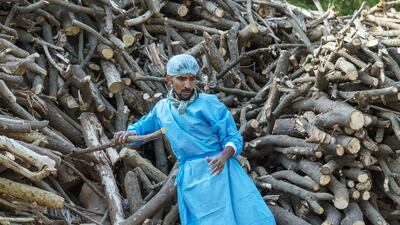
A worker wearing personal protective equipment sorts funeral pyre wood at a crematorium in New Delhi, India. Bloomberg -

A Bahraini man holding Saudi and Bahraini national flags welcomes Saudis as they enter Bahrain via the King Fahad Causeway, after Saudi authorities lifted the travel ban on its citizens after 14 months due to coronavirus restrictions. Reuters -

A photo taken with a drone shows empty streets in the last weekend of mass confinement in Quito, Ecuador. A state of emergency was enforced on 23 April on 16 of the 24 provinces of Ecuador, amid the ongoing pandemic. EPA


Manufacturing errors at a plant in Baltimore resulted in a batch of Johnson & Johnson’s shot becoming contaminated, greatly slowing production of the vaccine. It was once envisioned as a pillar of US supply, but the US has instead relied almost entirely on Pfizer-BioNTech and Moderna shots.
Mr Biden has faced pressure to do more to help the world during the pandemic, as the US winds down nearly all mitigation measures such as masking.
Other countries are trying to quell outbreaks and new variants with few or no vaccine doses.
The “new phase” of his pandemic effort is focused on efforts to persuade vaccine-hesitant adults to be immunised.
US caseloads continue to fall, with 16,857 new cases recorded on Sunday. This is the lowest daily total since March 2020, although this is typical for a Sunday.
The pace of vaccination has fallen by over a third from a month ago and is hovering now at about two million doses a day.
Vaccine exports have been a thorny issue for Mr Biden, who has tried to reclaim the mantle of US leadership abroad while adopting some of the “America First” approaches of his predecessor, Donald Trump, in his pandemic response.
While the EU and India balanced vaccine exports with domestic allocation, the US has for months cornered the market on its supply, effectively preventing early exports.
Both Mr Trump and Mr Biden used wartime powers to reserve plant resources and vaccine ingredients for domestic production, effectively placing the government at the front of the queue. American orders also include contractual clauses limiting the government’s ability to share doses abroad.
The administration sought to skirt those restrictions by framing the 4.2 million AstraZeneca doses already shipped to Mexico and Canada as a “loan”.

