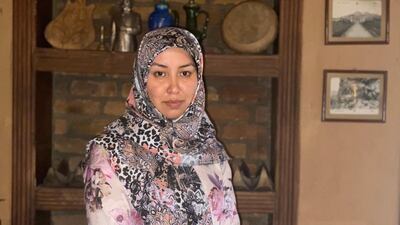
Salima Mazari, the governor of Charkint district in Afghanistan's Balkh province, poses for a photo during an interview with The National at a cafe in Kabul on October 10, 2020. Hikmat Noori for The National
Salima Mazari, the governor of Charkint district in Afghanistan's Balkh province, poses for a photo during an interview with The National at a cafe in Kabul on October 10, 2020. Hikmat Noori for The N

The woman convincing the Afghan Taliban to give up arms


  • English
  • Arabic

Three years ago, Salima Mazari knew very little about the violence that has plagued her country for decades. Born and raised as a refugee in Iran, she was sheltered from the worst of the conflict, despite enduring other hardships familiar to millions of Afghans forced to leave their country.

But she returned, Ms Mazari, 39, told The National, because she did not want to be a refugee any longer and wanted to help rebuild her country.

"After I finished university, I started work in Iran. But nine years ago, I returned to Afghanistan with my husband and children to serve my country," she said.

"Over the years, I worked in various management roles, most recently as an administrator at a private university. I applied through the civil services commission when the vacancy for the district governor opened up for my home district of Charkint. I knew I had a chance because of my qualifications and years of management experience."

Ms Mazari got the job, becoming the first female governor of the district in the northern province of Balkh, where a resurgent Taliban insurgency threatens the local population. The post brought her face to face with the violence in her homeland.

There are many days now when I pick up a gun and join the men in battle

“I had never even been close to a gun before this,” she said.

As a district governor, she was given two soldiers as bodyguards, but they were “only provided with really old AK47s”.

Wanting to make sure the weapons still worked, she went with the bodyguards to the outskirts of the town to test the rifles. “When one of them fired the gun towards the mountains, it was the first time I had heard a gunshot up close. It was such a horrible sound, I passed out from shock. When I came to, I was on the ground,” she said, laughing at the memory.

Ms Mazari has become much more familiar with weapons since those early days in office in 2018. “There are many days now when I pick up a gun and join the men in battle, but mostly I help co-ordinate between the people and government forces,” she said.

But she had to fight a battle before even getting the job, despite scoring the highest marks in her application.

"In Afghanistan, corruption is so deep that if you’re trying to enter with only talent on your side, it is very hard,” she said, recalling the effort it took to ensure her application was not dismissed for lacking the financial and political backing of other candidates.

The job has been nothing like what she expected. “The role involves a lot of military undertaking. I was hoping to bring about development projects, but much of our resources are directed towards maintaining security,” she said.

Charkint is surrounded by Taliban fighters who often launch raids on the district, capturing police checkposts on the way. When they take control of villages, they force people to pay taxes and plunder army and police posts for weapons and other items.

Under Ms Mazari's leadership the villagers have armed themselves and repelled many Taliban attacks. But they have to be on constant guard and put their own resources into ensuring the insurgents are kept at bay. Many residents sold their livestock to raise money for weapons to join her in battle.

Several times while speaking to The National, Ms Mazari had to pause to take calls from the Charkint police chief and members of a force raised from locals who support her push against the Taliban.

“It is the corruption among government officials I struggle with the most. Police commanders refuse to do their duty to protect the people, who are left to defend themselves," she said.

“In such a situation, I usually just pick up the gun and move forward myself; then they are forced to follow me.”

The soldiers are not put off by having a female commander on the front line, she said. “I know my presence in the battles makes a difference; for the soldiers and the people to see that I am with them in the fight for the republic and not sacrificing them, it provides a kind of moral support.”

However, Ms Mazari does not want the residents or herself to continue fighting. Neither is she waiting for the Taliban to make peace with the Afghan government.

Instead, she has reached out directly to the Taliban fighters in her district to begin peace negotiations.

“A little over a month ago the Taliban attacked one of the villages that stopped paying them taxes, killing even the women and children. The aftermath was horrifying and the survivors wanted revenge,” she said.

But knowing that the insurgents had better resources and further fighting would cause more bloodshed, she sent a message to some of the fighters through village elders and religious leaders, appealing to their shared faith.

“I told them we are from the same Islam; if you are talking about hijab, we wear hijab too; if you are talking praying, we pray five times too. If you’re talking about corruption, I am fighting it too,” she said.

“But the Taliban are only killing, where in Islam does it allow someone to kill a mother and child?”

As a result of her efforts, 125 Taliban fighters surrendered to her last month, in exchange for clemency.

“You have to realise that these are mostly youth who have been brainwashed and then sent to Pakistan for training. They return armed and attack their own people,” Ms Mazari said.

She is confident that she can convert more fighters to join the republic.

“What I learnt is that a group will be defeated if you get one – a link in the chain – to surrender, someone who can influence others; the rest will follow.”

But it is up to the government to ensure that these fighters remained loyal to the Afghan flag, she said.

“These young men risked their lives by surrendering. They are now enemies of the Taliban who will seek revenge on them.”

In recent months she has been travelling to Kabul in hopes of securing backing from security officials to give the former insurgents some support and create employment opportunities for them.

Ms Mazari is convinced that dialogue is better than violence when it comes to taking on the Taliban, along with gaining the support of the public.

“And the only way to win the people’s trust is to show honesty in your work and intention,” said the self-taught people’s commander.

“I find that when I am honest with people they always respond in kind.”

Key products and UAE prices

iPhone XS
With a 5.8-inch screen, it will be an advance version of the iPhone X. It will be dual sim and comes with better battery life, a faster processor and better camera. A new gold colour will be available.
Price: Dh4,229

iPhone XS Max
It is expected to be a grander version of the iPhone X with a 6.5-inch screen; an inch bigger than the screen of the iPhone 8 Plus.
Price: Dh4,649

iPhone XR
A low-cost version of the iPhone X with a 6.1-inch screen, it is expected to attract mass attention. According to industry experts, it is likely to have aluminium edges instead of stainless steel.
Price: Dh3,179

Apple Watch Series 4
More comprehensive health device with edge-to-edge displays that are more than 30 per cent bigger than displays on current models.

Mercer, the investment consulting arm of US services company Marsh & McLennan, expects its wealth division to at least double its assets under management (AUM) in the Middle East as wealth in the region continues to grow despite economic headwinds, a company official said.

Mercer Wealth, which globally has $160 billion in AUM, plans to boost its AUM in the region to $2-$3bn in the next 2-3 years from the present $1bn, said Yasir AbuShaban, a Dubai-based principal with Mercer Wealth.

Within the next two to three years, we are looking at reaching $2 to $3 billion as a conservative estimate and we do see an opportunity to do so,” said Mr AbuShaban.

Mercer does not directly make investments, but allocates clients’ money they have discretion to, to professional asset managers. They also provide advice to clients.

“We have buying power. We can negotiate on their (client’s) behalf with asset managers to provide them lower fees than they otherwise would have to get on their own,” he added.

Mercer Wealth’s clients include sovereign wealth funds, family offices, and insurance companies among others.

From its office in Dubai, Mercer also looks after Africa, India and Turkey, where they also see opportunity for growth.

Wealth creation in Middle East and Africa (MEA) grew 8.5 per cent to $8.1 trillion last year from $7.5tn in 2015, higher than last year’s global average of 6 per cent and the second-highest growth in a region after Asia-Pacific which grew 9.9 per cent, according to consultancy Boston Consulting Group (BCG). In the region, where wealth grew just 1.9 per cent in 2015 compared with 2014, a pickup in oil prices has helped in wealth generation.

BCG is forecasting MEA wealth will rise to $12tn by 2021, growing at an annual average of 8 per cent.

Drivers of wealth generation in the region will be split evenly between new wealth creation and growth of performance of existing assets, according to BCG.

Another general trend in the region is clients’ looking for a comprehensive approach to investing, according to Mr AbuShaban.

“Institutional investors or some of the families are seeing a slowdown in the available capital they have to invest and in that sense they are looking at optimizing the way they manage their portfolios and making sure they are not investing haphazardly and different parts of their investment are working together,” said Mr AbuShaban.

Some clients also have a higher appetite for risk, given the low interest-rate environment that does not provide enough yield for some institutional investors. These clients are keen to invest in illiquid assets, such as private equity and infrastructure.

“What we have seen is a desire for higher returns in what has been a low-return environment specifically in various fixed income or bonds,” he said.

“In this environment, we have seen a de facto increase in the risk that clients are taking in things like illiquid investments, private equity investments, infrastructure and private debt, those kind of investments were higher illiquidity results in incrementally higher returns.”

The Abu Dhabi Investment Authority, one of the largest sovereign wealth funds, said in its 2016 report that has gradually increased its exposure in direct private equity and private credit transactions, mainly in Asian markets and especially in China and India. The authority’s private equity department focused on structured equities owing to “their defensive characteristics.”

MATCH INFO

Barcelona 4 (Suarez 27', Vidal 32', Dembele 35', Messi 78')

Sevilla 0

Red cards: Ronald Araujo, Ousmane Dembele (Barcelona)

Ammar 808:
Maghreb United

Sofyann Ben Youssef
Glitterbeat 

Profile of Hala Insurance

Date Started: September 2018

Founders: Walid and Karim Dib

Based: Abu Dhabi

Employees: Nine

Amount raised: $1.2 million

Funders: Oman Technology Fund, AB Accelerator, 500 Startups, private backers


Key findings of Jenkins report
  • Founder of the Muslim Brotherhood, Hassan al Banna, "accepted the political utility of violence"
  • Views of key Muslim Brotherhood ideologue, Sayyid Qutb, have “consistently been understood” as permitting “the use of extreme violence in the pursuit of the perfect Islamic society” and “never been institutionally disowned” by the movement.
  • Muslim Brotherhood at all levels has repeatedly defended Hamas attacks against Israel, including the use of suicide bombers and the killing of civilians.
  • Laying out the report in the House of Commons, David Cameron told MPs: "The main findings of the review support the conclusion that membership of, association with, or influence by the Muslim Brotherhood should be considered as a possible indicator of extremism."
The five pillars of Islam

1. Fasting 

2. Prayer 

3. Hajj 

4. Shahada 

5. Zakat
